Four nations sign Badr defence pact in Doha on Wednesday
Turkey, Qatar, Pakistan and Indonesia signed the Badr Memorandum of Understanding in Doha on Wednesday, covering joint weapons production, military training and research, Turkey's defence ministry said.
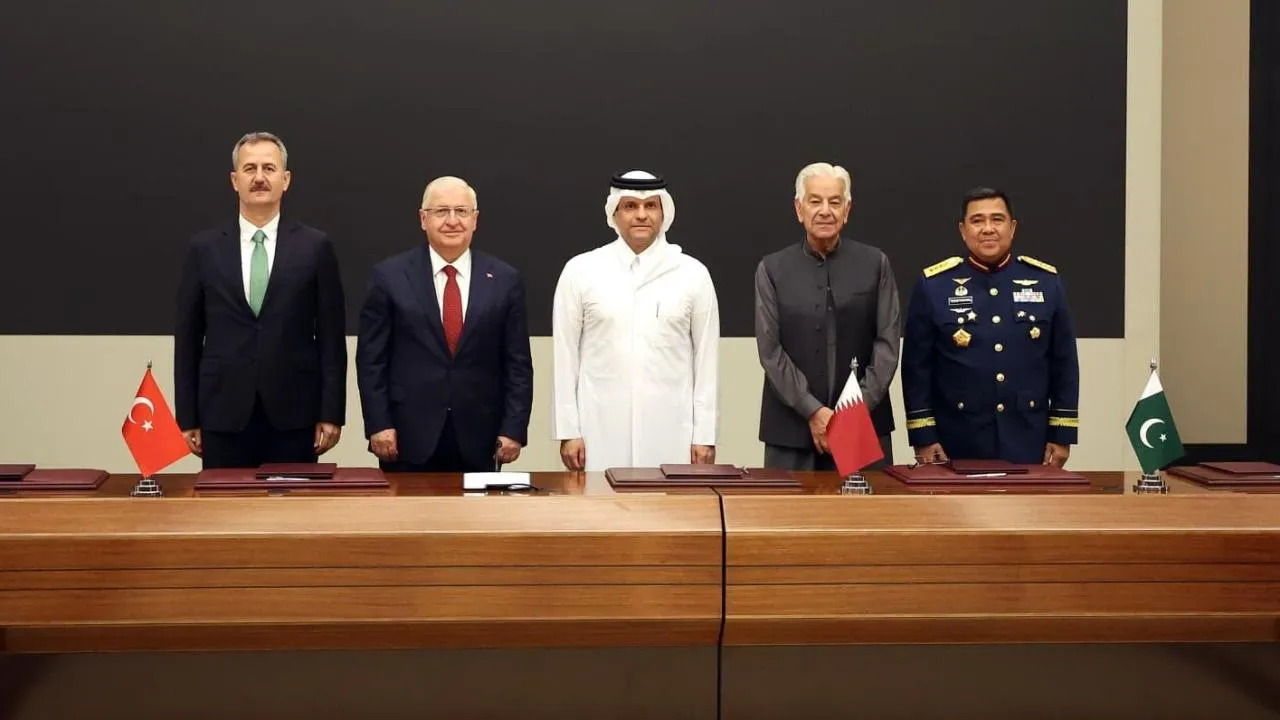 Photo: Arab News
Key points
Turkey, Qatar, Pakistan and Indonesia signed the Badr Memorandum of Understanding in Doha on Wednesday to boost defence cooperation and joint weapons production.
Turkey, Qatar, Pakistan and Indonesia signed the Badr Memorandum of Understanding in Doha on Wednesday, their defence ministries said, an accord covering joint weapons production, military training and research. The Turkish National Defence Ministry said the agreement was signed by the defence ministers of the four countries in the Qatari capital, and that it aims to strengthen defensive capabilities and deepen partnerships among the signatories.
The Badr accord matters because it binds four countries with existing bilateral defence ties into one framework for combining manufacturing capacity, rather than adding a mutual defence pledge. Unlike the Mecca Joint Defence Agreement Turkey signed with Pakistan and Saudi Arabia in August 2026, the Badr memorandum does not oblige any party to treat an armed attack on one as an attack on all, according to the Turkish ministry's framing of the deal.
What the accord covers
The memorandum covers cooperation in military production, technical military training, research and development, and the development of solutions and industrial sectors alongside advances in modern defence systems, the Turkish defence ministry said. The ministry described the accord as carrying substantial economic importance for the participating countries, by combining their military production capabilities, improving integration and strengthening their defence industries to meet the requirements of allied and friendly nations.
Haluk Gorgun, head of Turkey's Presidency of Defence Industries, attended the signing ceremony alongside the four defence ministers, the Turkish defence ministry said. The ministry said the initiative would facilitate cooperation and integration by leveraging each country's unique military production capabilities, enhance defence industrial capacities, and enable the fulfilment of the needs of allied and friendly nations.
The four ministers who signed are Turkish National Defence Minister Yasar Guler, Qatar's Deputy Prime Minister and Minister of State for Defence Affairs Sheikh Saud bin Abdulrahman bin Hasan Al Thani, Indonesian Deputy Defence Minister Yusuf Jauhari and Pakistani Defence Minister Khawaja Muhammad Asif, the Turkish defence ministry said. The name Badr means full moon, the ministry noted, and the accord is intended to deepen defence industry ties and multilateral collaboration.
Who signed in Doha
The Badr memorandum builds on existing bilateral projects among the four countries, the state-run Anadolu news agency reported. Turkey already supplies Qatar with armed drones and armored vehicles, builds warships in cooperation with Pakistan and has developed a tank with Indonesia. Joint production and technology sharing are central to the initiative.
The Badr accord is distinct from the Mecca Joint Defence Agreement, which Turkey, Pakistan and Saudi Arabia signed in August 2026 under which an armed attack on one member is considered an attack on all. The Badr memorandum does not establish a NATO-style collective-defence commitment, the Times of India reported. On Tuesday, Turkey submitted the Mecca pact with Pakistan and Saudi Arabia to parliament for ratification, three parliamentary sources said.
How it differs from Mecca pact
Turkey, which has NATO's second-largest army and a robust defence industry, has been helping Gulf nations, including Qatar, where it has a military base, bolster their defences, the Jerusalem Post reported. Qatar's minister of state for defence affairs, Sheikh Saoud bin Abdulrahman Al Thani, told a security forum in Doha on Monday that Qatar plans to establish a centre for producing military equipment as it seeks to develop its own defence industry.
The US-Israeli war on Iran has disrupted Qatar's energy production and shipping through the Strait of Hormuz, the waterway connecting the Persian Gulf to the open sea. At an emergency meeting of the Turkey-Pakistan-Saudi alliance in Riyadh earlier this month, the three countries agreed to ensure the rapid deployment of military forces and capabilities in Saudi Arabia, the Jerusalem Post reported.
Existing ties among the four
The Badr accord is expected to deepen defence industry ties, expand military cooperation and strengthen multilateral collaboration in support of security, stability and shared objectives, the Turkish defence ministry said. The Times of India assessed that the agreement could strengthen Pakistan's access to military technology, including drones, naval platforms and other defence systems, while noting the Badr accord itself does not establish a NATO-style collective-defence commitment.
Frequently asked questions
What is the Badr defence pact?
The Badr Memorandum of Understanding is an agreement signed by Turkey, Qatar, Pakistan and Indonesia in Doha covering military production, technical military training, research and development, and defence industrial capacity, the Turkish defence ministry said.
Who signed the Badr memorandum in Doha?
The defence ministers of the four countries signed: Turkey's Yasar Guler, Qatar's Sheikh Saud bin Abdulrahman bin Hasan Al Thani, Indonesia's Yusuf Jauhari and Pakistan's Khawaja Muhammad Asif, the Turkish defence ministry said.
Does the Badr pact create a mutual defence commitment?
No. Unlike the Mecca Joint Defence Agreement Turkey signed with Pakistan and Saudi Arabia in August 2026, the Badr memorandum does not establish a NATO-style collective-defence commitment, the Times of India reported.