COP31 opens in Antalya as world faces 1.5C overshoot
Nearly 200 countries gather in Antalya, Turkey, for COP31 on 9 November, the first summit after confirmation that global warming will overshoot the 1.5C target.
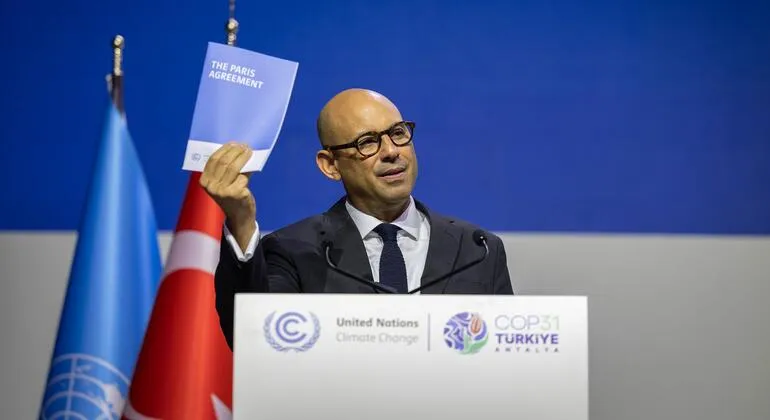 Photo: UN News
Key points
COP31 opened in Antalya on 9 November, the first climate summit after confirmation that global warming will overshoot the 1.5C target.
Nearly 200 countries arrived on Türkiye's Mediterranean coast on 9 November for a climate summit with a different ambition: fewer grand declarations and more concrete decisions. With a powerful El Niño threatening to worsen extreme weather, negotiators face difficult questions over climate finance, clean energy and how to protect communities already living with the consequences of climate change.
The United Nations annual climate meeting is the first to take place after confirmation that global warming will overshoot the headline limit of 1.5 °C. The aim of keeping warming within 1.5 °C above pre-industrial temperatures was set out in the 2015 Paris agreement. As tens of thousands of delegates and observers arrive in Antalya, Turkey, some scientists and climate advocates say the 12-day event must discuss how to deal with the overshoot.
Overshoot acknowledged
The UN Environment Programme last month acknowledged that, under all plausible emissions trajectories, the world will surpass the 1.5 °C target agreed at COP21 in Paris. Its Limiting Overshoot report is the first UN report to state explicitly that overshoot is now inevitable. It also laid out how to bring temperatures back below the 1.5 °C target this century.
In addition to slashing emissions to near-zero levels, the report confirmed the need to remove hundreds of billions of tonnes of CO2 from the atmosphere this century, either using CO2 removal technologies or nature-based approaches such as reforestation. "[K]eeping 1.5 °C within reach requires climate policy to evolve to include the removal of already emitted [greenhouse gases]," the report states.
This idea to limit the "magnitude and the duration" of overshooting 1.5 °C is expected to shape discussion among parties at the COP meeting, says Clea Schumer, a research associate at the World Resources Institute, an environmental research and advocacy organization in Washington DC. Some language on limiting overshoot was included in the final decision of the COP30 summit last year in Belém, Brazil, but CO2 removal has mostly gone unmentioned.
Carbon removal debated
Most governments "are happy that they finally don't have to pretend any more that we will make it" to 1.5 °C, says Oliver Geden, a researcher at the German Institute for International and Security Affairs in Berlin. They now want to limit overshoot, "but how we actually do that, nobody is talking about", he adds. Steve Smith, a climate researcher at the University of Oxford, UK, agrees that CO2 removal could move up the agenda amid discussions about the necessary return from overshoot.
Environmental advocacy groups, such as New York-based Natural Resources Defense Council (NRDC), that had been skeptical of CO2 removal, have now changed their position. A report from the organisation in September called on environmentalists to support CO2 removal in the same way they supported renewable energy and electrification. "It is now time to set the stage for another—an industry that removes carbon dioxide from the atmosphere—to contribute to the fight for climate stability," the report says.
Reform calls grow
Some scientists say the failure to cut emissions fast enough to avoid overshoot is a sign that there need to be reforms to COP meetings. "We need to first recognize that global policy has failed. This is a moment of self-critique," says Johan Rockström, a climate scientist at the Potsdam Institute for Climate Impact Research in Germany. Rockström leads a group of scientists advising a coalition of around 60 countries working in parallel to the COP.
Rockström has argued for some years that the COP process needs reform. Ahead of COP31, he told Nature that a top priority should be to allow for decisions to be made by majority votes among parties. Currently, agreements must involve all countries coming to a consensus. "Overshoot gives even more impetus for the need for reform. It shows that we've not been able to make the progress that we need," says Rockström.
COP31 has opened in Turkiye amid war-driven energy disruptions and a renewed reliance on fossil fuels. While delegates discuss electrification and climate action, activists outside the summit are demanding an end to greenwashing and a shift away from industrial agriculture. The summit runs for 12 days, with decisions expected on climate finance and clean energy.
Frequently asked questions
What is the 1.5C overshoot and why does it matter?
The 1.5C target was set in the 2015 Paris agreement to limit global warming. The UN Environment Programme's Limiting Overshoot report is the first UN report to state explicitly that overshoot is now inevitable, meaning temperatures will surpass 1.5C before being brought back down.
Why is carbon dioxide removal a key topic at COP31?
The Limiting Overshoot report confirmed the need to remove hundreds of billions of tonnes of CO2 from the atmosphere this century to bring temperatures back below 1.5C. No country has yet included quantified CO2 removal targets in climate commitments, says Steve Smith of the University of Oxford.
What reforms are being proposed for COP meetings?
Johan Rockström and other scientists argue for majority votes among parties instead of consensus, which allows a small number of states to block decisions. They say the overshoot shows global policy has failed and reform is needed.