Eight eMudhra certificate keys compromised, browsers block them
Eight eMudhra intermediate certificate private keys were reported compromised, prompting Mozilla, Chrome, Apple and Microsoft to block the certificates between 17 and 20 October 2026.
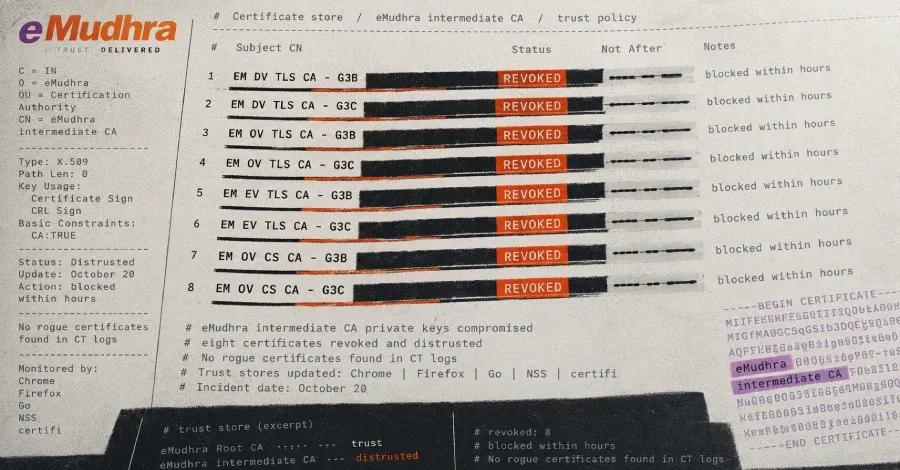 Photo: The Hacker News
Key points
Private keys for eight eMudhra intermediate certificates were compromised, and browsers and vendors blocked the certificates between 17 and 20 October 2026.
Eight eMudhra intermediate certificate private keys were reported compromised, and Mozilla, Chrome, Apple and Microsoft blocked the affected certificates between 17 and 20 October 2026. Cloudflare became aware of the compromise on 19 October 2026 at approximately 17:00 UTC and began assessment. The certificates were widely trusted by browsers, operating systems, and also within Cloudflare, which deployed mitigations across its products.
The compromise matters because the keys themselves are weak, so an attacker can create a forged certificate for any domain and use it to impersonate servers to intercept or modify traffic. Mozilla reported that these keys could allow attackers to issue fraudulent HTTPS certificates for websites they do not control, and an attacker who could intercept a user's connection could use those certificates to impersonate websites and potentially read or modify traffic.
Why the weak keys matter
The mechanism is a certificate authority key failure, not a break in the encryption itself. Cloudflare stated its work addresses certificate-based authentication, not a weakness in TLS's encryption algorithms. An intermediate certificate sits between a root certificate and a website certificate; whoever holds its private key can issue new certificates that browsers trust. Because eight eMudhra intermediates used weak keys, forged certificates for any domain could be produced and trusted.
A discussion on LWN.net on 20 October 2026 raised how the weak keys were generated, with one commenter asking about a flaw in the KGC script that caused eMudhra to generate a 1-byte-long private key using an HSM, and another noting a key described as mostly zeros. These are reader questions on the page, not confirmed findings. Mozilla's report, as summarised by Cloudflare, states the keys were weak.
Mozilla announced it received a report that private keys associated with eight eMudhra intermediate certificates had been compromised, and blocked the affected certificates using its OneCRL centralised list of revoked certificates. It also updated the trusted certificate list in Network Security Services (NSS) 3.131.1. A single-page site about the compromise tracks which clients still trust the certificates, and Mozilla's Dennis Jackson crowdsourced a list of commonly used packages that have been patched.
How browsers blocked the certificates
Blocking dates vary by platform, according to the single-page site cited on LWN.net: Chrome blocked the certificates since 17 October, Apple devices since the 19th, and Microsoft blocked them on the 20th. Cloudflare's own timeline records its awareness on 19 October at approximately 17:00 UTC, Cloudflare One Client and WARP security updates published 20 October at 02:00 UTC, and Cloudflare Tunnel (cloudflared) update 2026.10.2 published 20 October at 09:15 UTC.
Cloudflare's security review did not identify active exploitation of this issue on Cloudflare services. It released updates for Cloudflare One Clients (WARP or the 1.1.1.1 app) and Cloudflare Tunnel, and deployed mitigations across its CDN, Developer, and Zero Trust products. Customers using Cloudflare Zero Trust with Gateway and an up-to-date client are automatically protected. Teams across Cloudflare are working on further remediation, with some customers needing to act on software or trust configurations they operate.
Linux users should update their distribution's ca-certificates package as soon as an update is available, according to guidance posted on LWN.net on 20 October 2026; in the meantime, users can manually distrust the relevant files. Ubuntu and Arch had released updates blacklisting the certificates, while Debian had not at the time of a comment posted that day. The NetBSD Foundation issued instructions to block the certificates on NetBSD installations.
What users and developers should do
Developers must look beneath the SDK: an API client may delegate certificate verification to an HTTP library, a language runtime, the operating system, or a custom trust configuration, so updating the SDK alone may not change the underlying policy. Cloudflare advises that once you patch, certificate errors may appear in dashboards, and warns against resolving them by disabling verification, which would remove the authentication protection the updates are intended to restore.
Cloudflare published specific upgrade versions: Cloudflare One Client v2.5.6 on Android, v1.12.16 on iOS, and Windows Desktop, macOS and Linux builds 2026.8.2115.0; the 1.1.1.1 app v6.38.10 on Android, v6.31.7 on iOS, and the same desktop builds; and Cloudflare Tunnel 2026.10.2, with container deployments updated and redeployed. Customers using mutual TLS client authentication should review and update their trust stores and uploaded certificate authorities.
Dennis Jackson's test site provides browser checks, non-browser testing instructions, and package update information, but results apply to the verification path being tested, not every application on the device: a successful browser test does not prove a background service is protected, nor does a curl test if the application uses a different verifier. Cloudflare's CDN and server-side Zero Trust mitigations were fully deployed on 20 October at 19:20 UTC, with further remediation continuing.
Frequently asked questions
What happened with eMudhra certificates?
Private keys associated with eight eMudhra intermediate certificates were reported compromised. Because the keys are weak, an attacker could create a forged certificate for any domain and impersonate servers to intercept or modify traffic.
Which browsers blocked the compromised certificates?
Mozilla blocked them via its OneCRL list and updated NSS to 3.131.1. According to the compromise site cited on LWN.net, Chrome blocked them since 17 October, Apple devices since the 19th, and Microsoft on the 20th.
What should Linux users and developers do?
Update your distribution's ca-certificates package when available; Ubuntu and Arch had released blacklisting updates, Debian had not yet. Developers should update underlying trust stores and HTTP libraries, not just SDKs, and must not disable certificate verification to clear errors.