Young workers in 25 European countries protest over living costs
Students and young workers rallied in more than 25 countries on 20 November over housing costs, education funding and military spending, with tens of thousands marching in Italy.
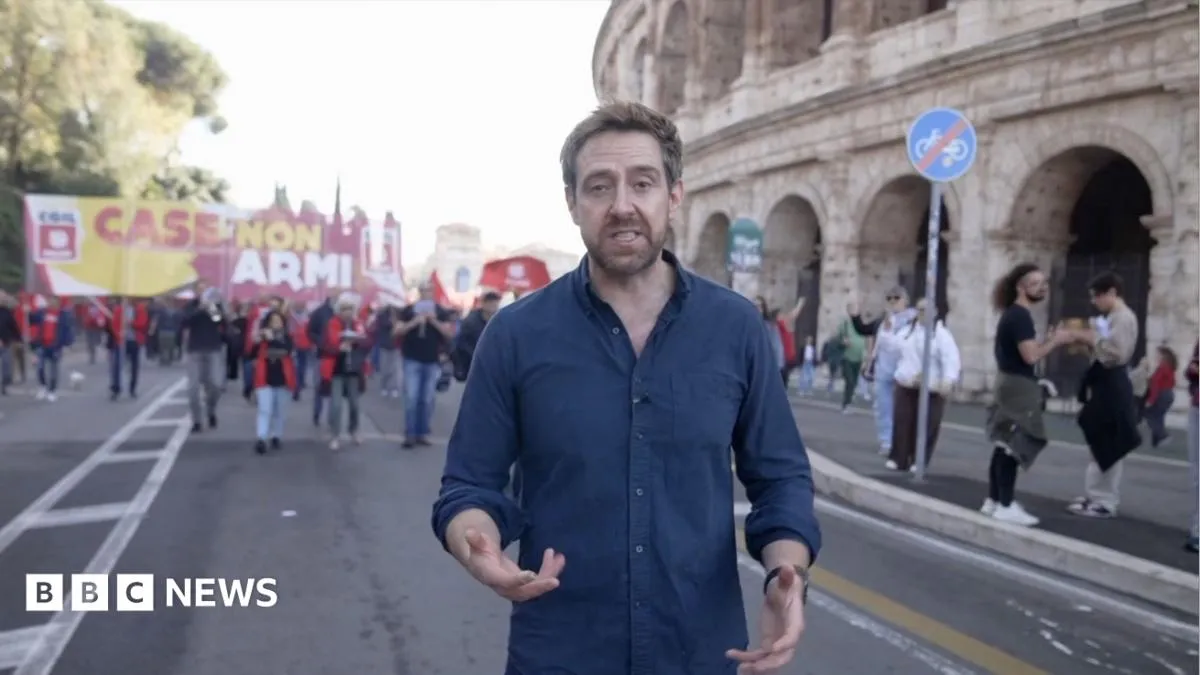 Photo: BBC News
Key points
Young people in more than 25 European countries held coordinated protests on 20 November over the cost of living, housing, education funding and military spending.
Students and young workers marched in more than 25 European countries on 20 November in coordinated protests against the cost of living, housing costs and military spending. Organisers described it as an "international youth strike", with demonstrations in Britain, Germany, Spain, Italy and Croatia among others. In Italy, tens of thousands marched as the country's largest trade union, CGIL, staged a general strike against the economic policies of Prime Minister Giorgia Meloni.
Seventy-three German cities
The scale varied sharply between countries. In Germany, the campaign group "Gen Z regelt" — "Gen Z takes charge" in German — said it was organising protests in 73 cities and towns. In Berlin, roughly 4,000 people attended a protest in the city's Alexanderplatz square, while about 1,000 students demonstrated in the capital over fears of a return to compulsory military service. The Cologne protest drew fewer than the 5,000 people expected, though still in the thousands, police said.
The Youth Strike coalition, which said it grouped activists from more than 50 organisations, called the day Europe's biggest coordinated youth protest of recent years and said demonstrations were planned in about 400 cities. Its slogan was "fight for our future, not their wars". The coalition made five broad demands: an end to militarisation and conscription; structural investment in education and welfare; solidarity with Palestine; climate and social justice; and a "radical transformation of the system we live in".
Organisers linked the national campaigns to one another. An Italian organiser, Alessandro di Miceli, said the Europe-wide protests were "to claim our right to a better and dignified future", and that specific demands differed from country to country but were all "deeply connected between each other". A Portuguese organiser, Leonor Chico, said governments "show us every day that the needs of our generation are not their priority".
Italy's general strike
In Italy the day overlapped with a general strike that the CGIL said would affect transport, schools and hospitals. Maurizio Landini, the leader of CGIL, said: "Today is also a very important day because young people are taking to the streets not just in Italy but across Europe." He added that "across Europe and among ordinary people, the demand for change is growing." Laura Peritore, 24, a university student, said the government was "cutting healthcare and education, taking away our present and trying to rob us of our future".
In Germany, the protest drew on fears that compulsory military service could return. Hannes Kramer, a German student protester, said: "While seemingly unlimited amounts of money are being poured into the military and the infrastructure supporting the military, the welfare state is being dismantled." At the Cologne protest, university student Jasmin Hamadi said she was "certainly not happy that there are cutbacks everywhere, not at my university, nor in the broader education system or in schools".
In Britain, protesters gathered in their hundreds at Parliament Square in London, and demonstrators also assembled in Whitehall in central London. One cardboard sign read: "I wasn't skipping lectures, I was working to survive." Marchers waved banners reading: "No to war, racism, climate crisis, capitalism." Zennor Tyndale-Biscoe, a 17-year-old student who planned to demonstrate in Truro in southwest England, said the event was "a really important event in giving a platform to the youth voice throughout the country".
The demonstrations followed weeks of school protests in France, where students began blocking high schools in mid-September to demand better learning conditions. That movement grew into a nationwide campaign against soaring prices, inadequate public services and police brutality. Organisers of the 20 November rallies in France included the gilets jaunes, or yellow vests, whose protests rocked the country in 2018 and 2019. The calls to protest coincided with the eighth anniversary of that movement, which began as a campaign against rising fuel taxes.
Five demands and a longer campaign
The coalition framed the day around shared economic pressure rather than a single demand. It said the movements were linked by soaring housing costs, deteriorating learning conditions, stagnant pay and increased military spending, and argued that funds allocated to rearmament should go to education, youth policies and housing instead. Unions and housing rights activists put forward their own demands, ranging from a guaranteed right to housing for everyone to taxing the rich and ending rearmament policies.
The marches were largely peaceful and mainly drew moderate crowds of hundreds or thousands. In France, much larger protests have at times been marred by violent confrontations with the police and looting. The day also carried political weight elsewhere: in Spain, the protests fell on the anniversary of the death of the dictator Francisco Franco, with youth demonstrations expected at midday and anti-fascist rallies planned for the evening.
Organisers presented the day as part of a longer campaign rather than a single event. Shabbir Lakha from the UK-based Stop The War coalition said the mobilisation was "a crucial step towards building a lasting international movement capable of bringing together young people, students and workers around common demands". The French historian Sylvain Boulouque said: "We are seeing youth movements emerge across the world at the same time," adding that what unites almost all of them is "distrust of law enforcement and political authorities". Organisers said hundreds of protests and strikes were expected in countries including Portugal, Croatia and Switzerland, with rallies planned on 20 November and over the weekend that follows.
The protests came as Russia's invasion of Ukraine approaches its fifth year and ahead of a series of key elections in Spain, France, Italy and Greece. Organisers said hundreds of protests and strikes were expected in countries including Portugal, Croatia and Switzerland, with rallies planned on 20 November and over the weekend that follows. In Serbia, student-led protests culminated in the toppling in an election last month of long-time leader Aleksandar Vucic, and there has also been unrest in Albania.
Frequently asked questions
How many countries took part in the youth cost-of-living protests?
Organisers said they were holding an "international youth strike" in at least 25 countries, including Britain, Germany, Spain, Italy and Croatia. The Youth Strike coalition said demonstrations were planned in about 400 cities.
What did the protesters demand?
The Youth Strike coalition made five broad demands: an end to militarisation and conscription; structural investment in education and welfare; solidarity with Palestine; climate and social justice; and a "radical transformation of the system we live in". Unions and housing activists also called for a guaranteed right to housing and for taxing the rich.
Why did Italy's CGIL join the protests?
Italy's largest trade union, CGIL, staged a general strike against the economic policies of Prime Minister Giorgia Meloni. Its leader, Maurizio Landini, said young people were taking to the streets not just in Italy but across Europe.