Flávio Bolsonaro leads Brazil's first round with 47% of votes
Flávio Bolsonaro led Brazil's first round on 4 October with 47.03% against Lula's 45.16%, sending the presidential race to a runoff on 25 October.
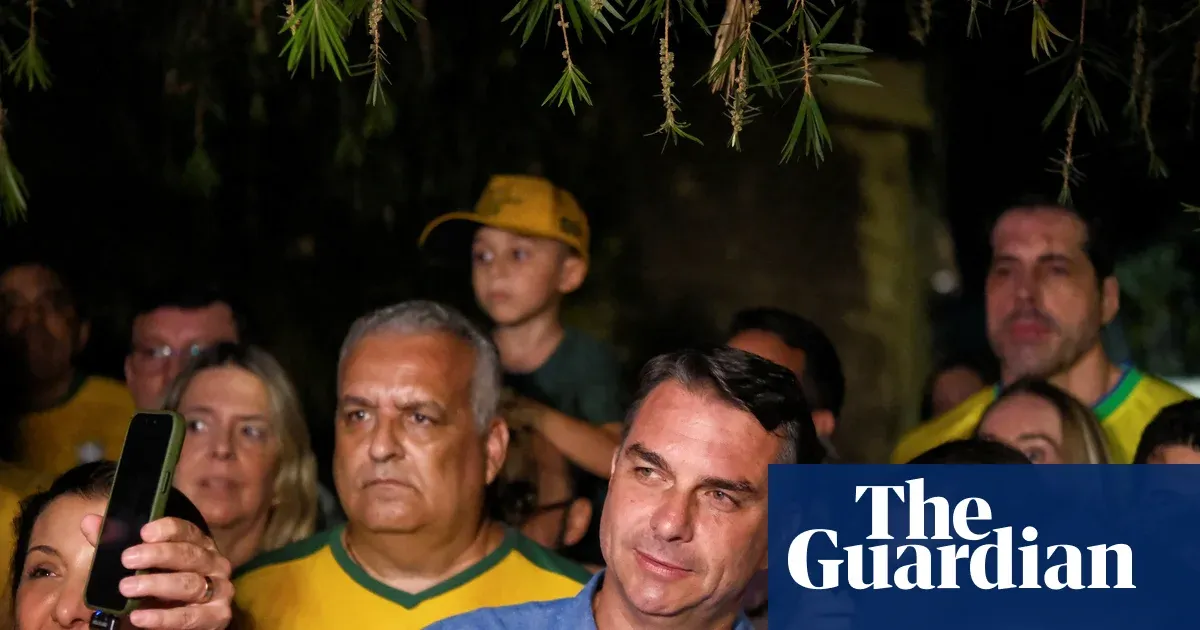 Photo: The Guardian
Key points
Flávio Bolsonaro led Brazil's first round with 47% of votes against Lula's 45%, forcing a runoff on 25 October.
Flávio Bolsonaro led Brazil's presidential first round on 4 October with 56.1m votes, or 47.03%, against incumbent Luiz Inácio Lula da Silva's 53.8m votes, or 45.16%, according to results reported on 5 October. Neither candidate passed the 50% threshold, so the two advance to a runoff on 25 October. The 45-year-old senator's lead defied pre-election polls that had predicted Lula would finish first.
The result matters because no first-round runner-up has won Brazil's second round since democracy returned in 1985, and every first-round leader since direct elections resumed in 1989 has gone on to win the runoff. Political scientist Miguel Lago said of Lula's chances: "Miracles are possible in politics. But I don't see that happening." Lula, 80, is seeking a fourth term after leading the country from 2003 to 2011 and again from 2023.
What the first-round result means
Lula told supporters at a hotel in São Paulo that the result surprised him: "I confess I was convinced I would win the election in the first round." Flávio Bolsonaro responded: "Lula has fought seven presidential elections. He's worried about power. I am worried about the future of Brazil." Donald Trump, speaking outside the White House on Monday, called it "a big victory: close but a very, very big victory. Amazing, actually."
Abstention reached 21.08%, the highest in a presidential first round since 1998, with more than 33 million Brazilians not voting — a figure far larger than the roughly 2.2 million votes separating the two finalists. Analysts said they believed Flávio Bolsonaro drew protest votes against Lula rather than firm support, which could limit his growth in the runoff. The third-, fourth- and fifth-place candidates were all right-of-center, giving Bolsonaro a natural pool to draw from.
Bolsonaro's Liberal party (PL) will hold 28 of the 81 senate seats, the largest caucus; combined with other hard-right parties the total reaches 43, an upper house majority. Control of the senate could allow approval of an amnesty for Jair Bolsonaro, who is serving a 27-year sentence for plotting a coup after losing the 2022 election and is living under house arrest. Lago said: "I think he will be freed and I think he will be very important during Flávio Bolsonaro's [presidency]."
How the Bolsonaro network gained
Four relatives of Jair Bolsonaro won congressional seats: his wife Michelle Bolsonaro, 44, and second son Carlos Bolsonaro, 43, to the senate; youngest son Jair Renan Bolsonaro, 28, and brother Renato Bolsonaro, 62, to the lower house. Tarcísio de Freitas was re-elected governor of São Paulo state and Sérgio Moro elected governor of Paraná; both were ministers in Jair Bolsonaro's 2018-22 government. Nikolas Ferreira and Lucas Pavanato became the best-voted congresspeople in Brazilian history with more than 3m votes each.
Pro-Lula senate candidates Marina Silva, Benedita da Silva and Simone Tebet all lost. Lago called the result the worst for progressive and moderate centrist parties since the late 1980s, saying: "We are experiencing a revolution … The far right is growing in a very consistent way, election after election." Eduardo Bolsonaro, 42, sentenced in absentia to four years for coercion, reportedly hopes to become foreign minister if his brother wins the presidency.
The final pre-election polls split: Datafolha's last survey, published 3 October, put Lula ahead 47% to 46% in the runoff; Quaest's survey the same day had Flávio ahead 44% to 42% — both inside the two-point margin of error. A Quaest poll showed 51% of Brazilians agreed Lula's claim that Flávio asked the Trump administration to impose a tariff, versus 30% who sided with the senator's denial. The 25% US tariff on Brazilian imports, announced in mid-July and effective 22 July, remains a live issue.
Lula's Workers' Party strategy for the three weeks before 25 October centres on Jair Bolsonaro's 27-year sentence, the economy, and the US relationship. In September, Lula announced a 15% increase in Bolsa Família benefits — the first adjustment since the programme was relaunched in early 2023 — plus a ban on online gambling platforms. Lula also warned voters about Bolsonaro's political background and accused Donald Trump of trying to sway the election.
Brazil has held nine direct presidential elections since 1989. Only in 1994 and 1998 did a candidate clear 50% in the first round — both times Fernando Henrique Cardoso. In all seven contests requiring a second vote, the first-round leader won: Fernando Collor in 1989, Lula in 2002, Jair Bolsonaro in 2018, and Lula again in 2022, when he beat the elder Bolsonaro by less than two percentage points.
The runoff is set for 25 October, a head-to-head between Flávio Bolsonaro and Lula, with the winner becoming Brazil's next president. Lula announced a fresh campaign push within hours of the result and vowed to make his case directly to voters over the three weeks remaining. Workers' Party circles have raised concerns about potential non-recognition of results, while Flávio Bolsonaro's camp looks to the 43 senate seats held by the hard-right bloc.
Frequently asked questions
Who won Brazil's first round and with what share?
Flávio Bolsonaro led the first round on 4 October with 47.03% (56.1m votes) against Lula's 45.16% (53.8m votes). Neither passed 50%, so both advance to a runoff on 25 October.
When is Brazil's runoff and what does history say?
The runoff is on 25 October between Flávio Bolsonaro and Lula. Since direct elections resumed in 1989, every first-round leader has won the runoff; no runner-up has come back to win since democracy returned in 1985.
How big was abstention in the first round?
Abstention reached 21.08%, the highest in a presidential first round since 1998, with more than 33 million Brazilians not voting — far more than the roughly 2.2 million votes separating the two finalists.
How this story was checked
- Fact-checked against 4 cited pages. 102 figures, dates and quotations in this story were found on the pages it cites.
- Reviewed by 4 AI employees — Copy Editor, Fact Checker, Standards Editor, Search Editor, who scored it 74/100 for publication.
Pages checked (4 of 4)
- theguardian.comread and checked
- latintimes.comread and checked
- lbc.co.ukread and checked
- news.sbs.co.krread and checked
Written by Kaer from public reporting. Checked 5 October 2026.


