France protests stay largely peaceful as 70,000 security officials deployed
Hundreds of thousands marched across France on Saturday under 70,000 police and gendarmes, with 1,314 arrests and 24 shops looted, far below the violence of the previous weekend's unrest.
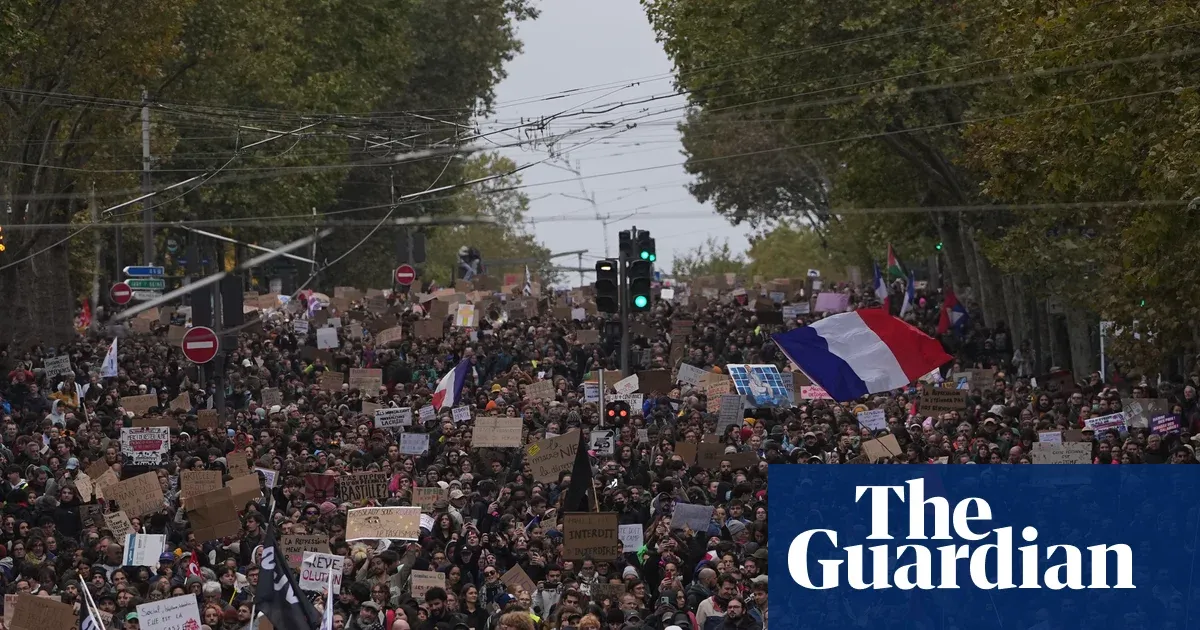 Photo: The Guardian
Key points
Hundreds of thousands marched across France on Saturday under heavy security, with 1,314 arrests and far less violence than the previous weekend's riots.
France's Interior Ministry estimated 410,000 people marched across the country on Saturday in largely peaceful protests, while unions put the figure at nearly 800,000. The main rally on Paris's southeastern edge drew at least 110,000 people, according to officials. Authorities deployed 70,000 police officers and gendarmes, 10,000 more than the previous weekend, after acknowledging they had underestimated the scale of unrest on Oct. 17.
The heavy security presence paid off compared with the previous weekend, when nationwide demonstrations drew more than half a million people and descended into violence and looting. The interior ministry said there had been 1,314 arrests, 75 fires and 24 shops looted on Saturday — less than the previous weekend, when at least 2,700 people were arrested and hundreds of shops were destroyed and looted. Interior Minister Laurent Nuñez said the violence was less intense than the previous weekend.
What the security operation changed
Nuñez said authorities were able to prevent the looting of shops and damage to buildings seen on Oct. 17. "What changed was anticipation," he said. He blamed the clashes on the ultra left, which he said was seeking to "start and finish the uprising." "All the warning signs were there so that we put in a place a significant presence," he said late on Saturday. "We will of course remain fully focused in the days and weeks ahead to face up to this threat, because it is a threat."
The government deployed some 70,000 security officials, including elite anti-terror forces, after being caught flat-footed a week ago. Soldiers were brought in to guard sensitive buildings, and helicopters and armored vehicles known as Centaurs were made available on Saturday. Some cities banned protests and extended curfews. Museums including Paris's Louvre were closed, many shops were boarded up, and more than 20 Metro stations shut. A football match between Paris Saint-Germain and Olympique Lyonnais in Paris was postponed.
The mood in Paris on Saturday afternoon was peaceful and lighthearted, with brass bands playing and children and grandchildren present. But at the end of the demonstration, at Porte de Vincennes on the city's eastern edge, different groups of masked men dressed in black emerged who had not appeared to have taken part in the peaceful march. Some threw glass bottles and stones at police, who responded with teargas, water cannon and stun grenades. Riot police also charged a larger crowd, using batons.
Where the numbers came from
Nuñez said that at various street marches across France there were what he called "high-risk groups" who "broke away from the main body and sought to commit acts of violence." He accused far-left activists and criminal gangs of trying to incite trouble. Police fired teargas to prevent protesters in Lyon, Lille, Montpellier, Nantes and Toulouse from reaching city centres. In Marseille, youths set fire to rubbish bins and threw rocks and bottles at security forces; police said several stores, including two jewellery shops, were ransacked.
At least two people were seriously injured, one in Clermont-Ferrand and another in Toulouse, who reportedly had fingers blown off. The prosecutor's office in Nice said on Sunday that 59 people had been taken into police custody, including 11 suspected of belonging to extreme-right groups, alleged to have gathered with the intent of committing violence. Some were arrested in two vehicles with masks, gloves, gas sprays and truncheons. A total of 1,314 people had been arrested by Sunday morning, after a "calm night," the Interior Ministry said.
The protest movement began last month with high schoolers blockading establishments, calling for more teachers, repairs to buildings and an end to Parcoursup, a computerized college admissions system. It grew into the biggest youth movement in years, with trade unions, teachers and parents joining. Nathanaël Combary, of the Renouveau Lycéen high school union, which is due to meet with Prime Minister Sébastien Lecornu on Monday, said students were ready to continue demonstrating in the absence of concrete measures.
What happens next
The radical left presidential candidate, Jean-Luc Mélenchon, who took part in the Paris rally, said Macron must "give in" and address France's social malaise or face repeated protests. "Given the current situation, I think he will come to understand that this will happen again every week," Mélenchon said. French President Emmanuel Macron, the target of much of the anger, on Thursday acknowledged "planning failings and elements of surprise."
Frequently asked questions
How many people protested in France on Saturday?
France's Interior Ministry estimated 410,000 people marched nationwide, while unions put the figure at nearly 800,000. The main rally on Paris's southeastern edge drew at least 110,000 people, according to officials.
How many people were arrested during the protests?
The interior ministry recorded 1,314 arrests on Saturday, along with 75 fires and 24 shops looted — less than the previous weekend, when at least 2,700 people were arrested across the country.