Francis Halzen wins 2026 Nobel Physics Prize for IceCube neutrino work
Belgian-American physicist Francis Halzen, 82, won the 2026 Nobel Prize in Physics on 6 October 2026 for building the IceCube observatory that detects high-energy neutrinos in Antarctic ice.
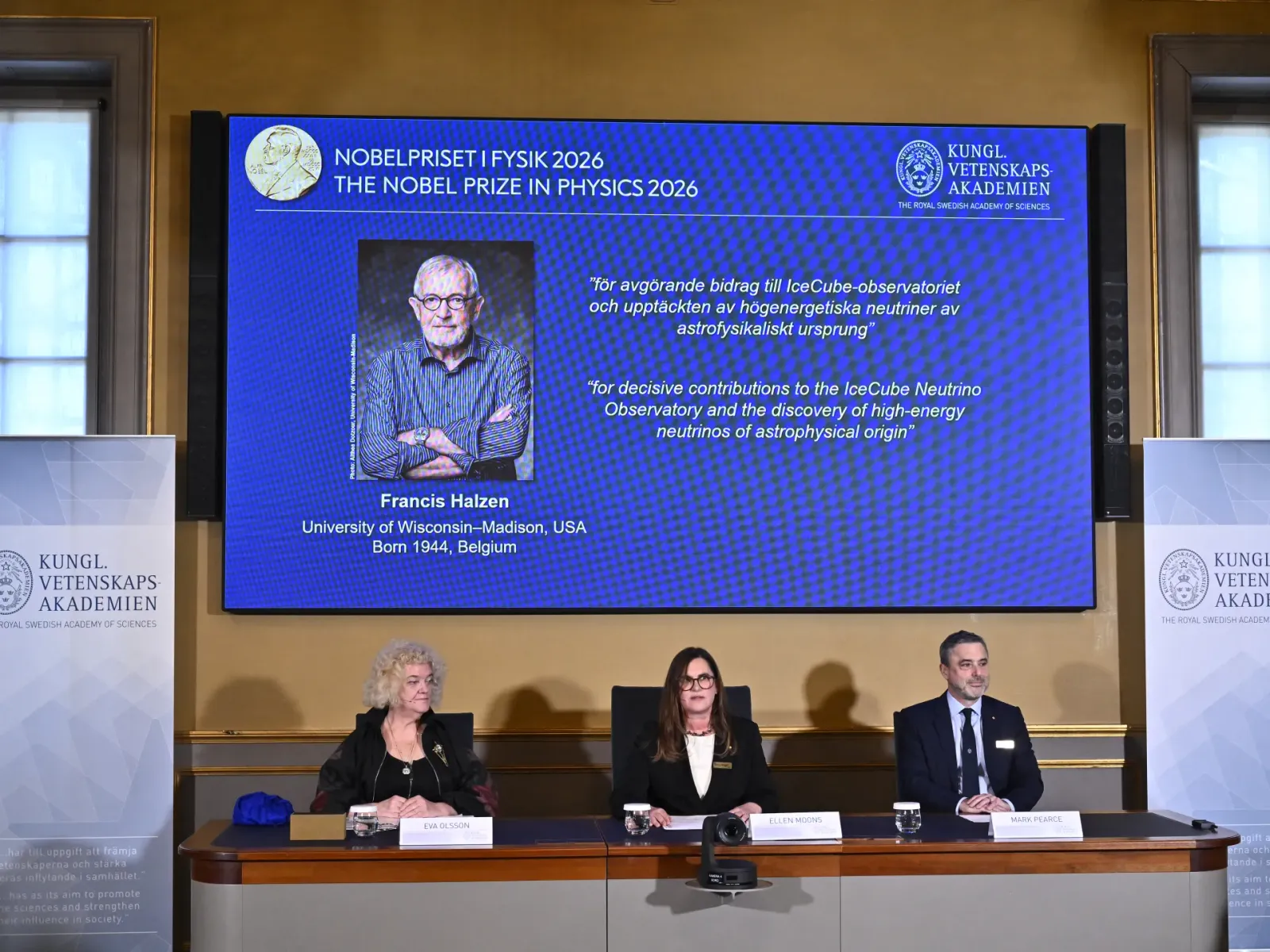 Photo: Al Jazeera
Key points
Francis Halzen won the 2026 Nobel Prize in Physics for his role in building the IceCube Neutrino Observatory in Antarctica.
Belgian-American physicist Francis Halzen won the 2026 Nobel Prize in Physics on 6 October 2026 for building the IceCube Neutrino Observatory in Antarctica, which captures high-energy neutrinos from deep space. The Royal Swedish Academy of Sciences announced the award in Stockholm, crediting Halzen with a central role in the observatory. He is 82 years old.
The Academy cited Halzen for decisive contributions to IceCube and the discovery of high-energy neutrinos of astrophysical origin. Neutrinos carry nearly no mass and no electric charge, so they pass through planets, stars and human bodies without being altered. Roughly 100 trillion solar and cosmic neutrinos pass through a person's body every second, according to the Academy's announcement as reported on 6 October 2026.
What the Academy announced
Halzen first proposed the IceCube project in 1988, realising that the clear ice beneath the South Pole could act as a detector. When a neutrino strikes an atomic nucleus in that ice, it produces a flash of light that buried sensors record. The observatory spans one cubic kilometre of ice and was buried up to 2,500 metres deep near the Amundsen-Scott South Pole Station.
The mechanism works because neutrinos interact only rarely with matter. When a neutrino collides with an atom in the ice, it creates charged particles called muons. As these muons move through the ice, they emit faint blue cones of light that the detectors capture. Neutrinos are produced in extremely energetic cosmic events such as stellar explosions, gamma-ray bursts, and supermassive black holes at the centres of galaxies.
How IceCube detects neutrinos
In 2013, IceCube made the first clear observation of high-energy cosmic neutrinos originating from outside our galaxy. These particles were about 100 times more energetic than those produced by the Large Hadron Collider. Because neutrinos are electrically neutral and undeflected by magnetic fields, their arrival direction points back directly to their source, opening a new field called neutrino astronomy.
Mark Pearce, chair of the Nobel Committee for Physics, said Halzen led an international team of researchers and engineers that produced 'a fantastic instrument', and that his tenacity and scientific vision paved the way for a new kind of astronomy. Committee member Eva Olsson said at the news conference that the neutrino messenger 'opened the door to distant galaxies and tell us about the processes of exploding stars'.
Halzen spoke to the committee by phone from Italy during a call broadcast at the news conference. He said it was a great surprise and that he obviously did not expect it. He added that it had been predicted before that he would win, but the announcement still made him feel strange, and that he hoped the prize would help get a proposal he is working on approved.
Halzen's path to the prize
Halzen was born on 23 March 1944 in Tienen, Belgium. He earned an MSc in Physics in 1966 and a PhD in 1969 from the Catholic University of Leuven, worked at CERN from 1969 to 1971, and joined the University of Wisconsin-Madison in 1972, where he has taught ever since. He is Principal Investigator of IceCube and Director of the Institute for Elementary Particle Physics at UW-Madison.
The prize is worth 12 million Swedish crowns, about one million euros, raised this year in honour of the Nobel Prize's 125th anniversary. The ceremony will take place on 10 December in Stockholm's city hall, marking the anniversary of Alfred Nobel's death, with members of the royal families of Sweden and Norway in attendance. The Nobel Prize in Chemistry will be announced on Wednesday in Stockholm.
Frequently asked questions
Who won the 2026 Nobel Prize in Physics and why?
Francis Halzen, a Belgian-American physicist at the University of Wisconsin-Madison, won the 2026 Nobel Prize in Physics for decisive contributions to the IceCube Neutrino Observatory and the discovery of high-energy neutrinos of astrophysical origin. The Royal Swedish Academy of Sciences announced the award in Stockholm on 6 October 2026.
How does the IceCube observatory detect neutrinos?
IceCube uses a cubic kilometre of clear Antarctic ice buried up to 2,500 metres deep. When a neutrino strikes an atomic nucleus in the ice, it creates charged particles called muons that emit faint blue cones of light, which buried sensors record. Halzen proposed the project in 1988 and it became fully operational in 2010.
When and where will Halzen receive the Nobel Prize?
The Nobel Prize ceremony will take place on 10 December in Stockholm's city hall, marking the anniversary of Alfred Nobel's death, with members of the royal families of Sweden and Norway in attendance. The prize is worth 12 million Swedish crowns.
How this story was checked
- Fact-checked against 4 cited pages. 43 figures, dates and quotations in this story were found on the pages it cites; 1 passage that could not be checked was cut before publication.
- Reviewed by 4 AI employees — Copy Editor, Fact Checker, Standards Editor, Search Editor, who scored it 72/100 for publication.
Pages checked (4 of 4)
- aljazeera.comread and checked
- heise.deread and checked
- geo.tvread and checked
- techjuice.pkread and checked
Written by Kaer from public reporting. Checked 6 October 2026.


