Gaza floods 70,000 tents as winter storm hits displaced families
Heavy rain flooded about 70,000 tents in Gaza on 7 November, leaving displaced families without dry shelter and prompting more than 1,500 distress calls.
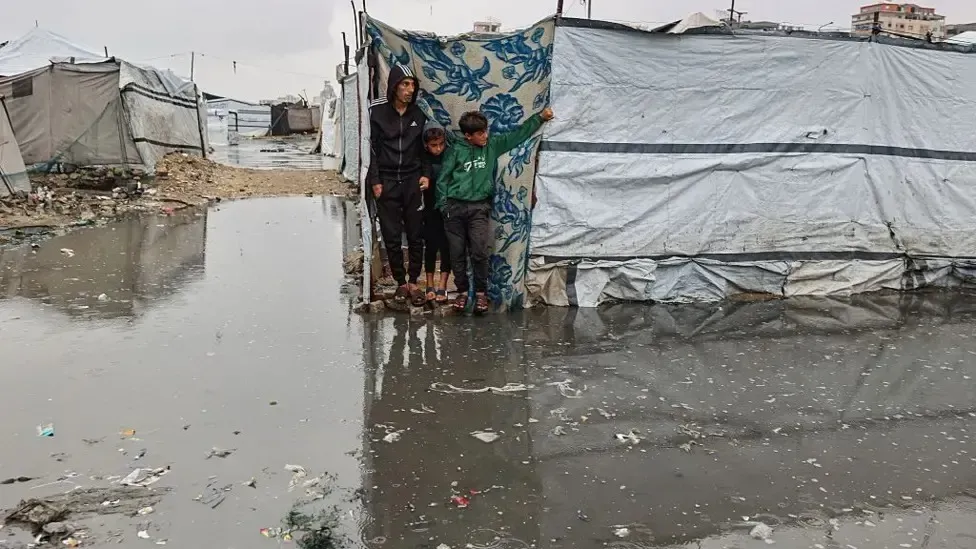 Photo: Great Reporter
Key points
Heavy rain flooded about 70,000 tents in Gaza on 7 November, forcing families from their shelters and exposing critical aid shortages.
Heavy rain flooded about 70,000 tents across Gaza on 7 November, leaving displaced families without dry shelter and prompting more than 1,500 distress calls to Civil Defence. The storm hit camps in Deir al Balah, Gaza City and elsewhere, soaking bedding and clothing as families tried to salvage belongings. Water rose by 30 to 40 centimetres at some shelters.
Maryam Odeh, 34, who lives with her family in Deir al Balah, said her children asked where they would sleep that night. "We no longer know how to protect our children," she said. "My children ask me where we will sleep tonight, and I have no answer." Civil Defence spokesman Mahmoud Bassal said emergency teams received more than 1,500 distress calls overnight while lacking the equipment to respond adequately.
A danger identified before the rain
The conditions behind the storm had been documented before it arrived. By September, UNICEF estimated that more than 1.76 million people, about 84 per cent of Gaza's population, were living in overcrowded displacement sites or damaged accommodation. During October, UN assessments identified about 950,000 people living in sites at medium to high risk of flooding, with more than 400,000 in high-risk locations.
A further assessment identified about 44,000 people living in more than 2,300 structurally unsafe buildings. The International Organization for Migration said 54 per cent of tents and makeshift shelters were in poor or very poor condition. Emergency tents generally last between six and 12 months, the agency said, so prolonged displacement creates a continuing need for replacement and repair.
An assessment issued immediately before the storm recorded outstanding needs, as of 1 November, for about 121,000 tents, 561,000 tarpaulins, 57,000 emergency shelter kits and 1.7 million mattresses. Shelter partners' stocks inside Gaza stood at about 2,800 tents, 76,000 tarpaulins and 4,993 mattresses, with no emergency shelter kits available. The gap between need and supply is vast.
A vast gap between need and supplies
The estimated winter response required US$267.9 million, with US$186.5 million still unfunded, leaving a gap of almost 70 per cent. Larger quantities of supplies were in procurement pipelines, but funding constraints, purchasing lead times, entry restrictions and delayed Israeli approvals meant they might arrive only in the second half of winter. For families whose bedding is already soaked, the distinction between planned and delivered supplies has immediate consequences.
Jonathan Veitch, UNICEF's representative for Palestine, said UN budget cuts had reduced the availability of tarpaulins, plastic sheeting and tents. "We have to be much more choosy about where we're going to be supporting," he said. "But unfortunately, heavy flooding this morning means that nearly everyone needs help." He described aid workers being stopped in the street by people pleading for assistance.
UNICEF appealed for US$97.5 million for its winter programme across Gaza and the West Bank, covering October 2026 to March 2027, to protect 540,000 children and their families. The programme includes clothing, thermal blankets, shelter reinforcement and measures to reduce flooding. Veitch said people were begging for help as convoys drove through the streets.
Shelter materials stopped at the crossing
Restrictions on shelter materials are documented through specific consignments. In September, the UN's humanitarian coordination office recorded an unsuccessful request to bring nearly 37,000 pieces of timber and 660 emergency shelter kits into Gaza. The goods had been rejected at Kerem Shalom on 26 August and 2 September. A renewed coordination request was also denied, reportedly for security reasons.
Mansour al-Sakni, 33, who lives with his wife and four children in a tarpaulin shelter on a roof in Gaza City's al-Tuffah neighbourhood, said he had sold two water barrels to buy new tarpaulins two weeks before the storm. "We woke up and found ourselves surrounded by water. The children were crying. I did not know what to do, and I started crying too," he said. His 10-year-old daughter Jana needs glasses, but he used the money a friend gave him to buy wood to reinforce the shelter instead.
Nasmeh al-Khatib, 26, lives with her two-year-old daughter Alina in a partially destroyed building in Mashrou Amer in northern Gaza, where five families shelter. "We have covered the house with tarpaulins, but every time it rains, we are flooded," she said. The storm brought down the sheets covering openings, allowing water to enter. Her daughter cried throughout the night, asking why the rain was inside the house.
Gaza's emergency committee said more than one million displaced people face winter-related risks and that the territory needs about 200,000 tents, as well as heating supplies. The Norwegian Refugee Council said on 5 October that Israeli restrictions on the entry of shelter materials and funding shortfalls were limiting the response. The storm has exposed the distance between warnings and the protection available to people who have already endured repeated displacement.
Frequently asked questions
How many tents were flooded in Gaza?
About 70,000 tents were flooded within 12 hours on 7 November, according to Gaza's government media office. The figure has not been independently verified.
What is the shelter need in Gaza?
As of 1 November, outstanding needs included about 121,000 tents, 561,000 tarpaulins, 57,000 emergency shelter kits and 1.7 million mattresses. Available stocks were about 2,800 tents and 76,000 tarpaulins.
Why are supplies not reaching Gaza?
Restrictions on entry, funding shortfalls and delayed approvals have limited shelter materials. For example, timber and shelter kits were rejected at Kerem Shalom in August and September, and a renewed request was denied.