Hall and Woodford win 2026 Nobel economics prize in Stockholm
US economists Robert Hall and Michael Woodford won the 2026 Nobel economics prize on 12 October 2026 for microeconomic foundations of macroeconomic stabilisation, worth $1.2m.
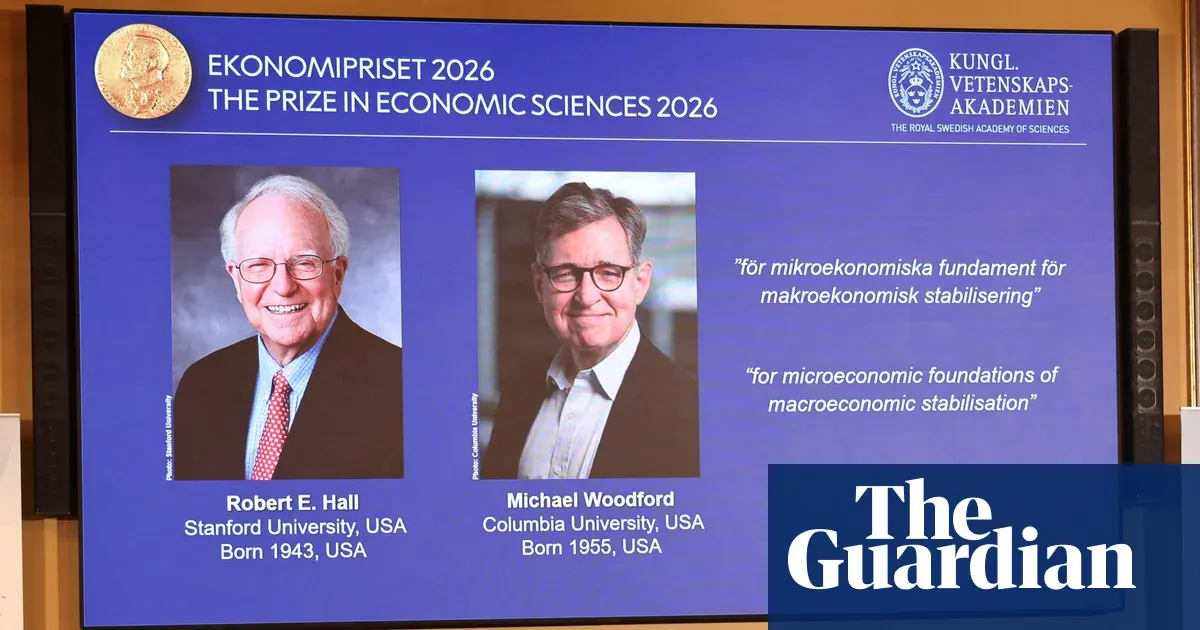 Photo: The Guardian
Key points
US economists Robert Hall and Michael Woodford won the 2026 Nobel economics prize for models that help central banks stabilise economies.
Two US economists, Robert Hall of Stanford University in California and Michael Woodford of Columbia University in New York, won the 2026 Nobel economics prize on 12 October 2026 for developing models that help central bankers and finance ministers stabilise their economies. The Royal Swedish Academy of Sciences awarded a prize worth a combined $1.2m (£900,000).
The citation recognised the pair for the microeconomic foundations of macroeconomic stabilisation, giving policymakers better tools to smooth the peaks and troughs of their economies. The academy said it was honouring them for generating a paradigm shift in stabilisation policy. The award, formally the Sveriges Riksbank Prize in Economic Sciences in Memory of Alfred Nobel, was announced in Stockholm, Sweden, and is the final Nobel prize given out this year.
What the prize citation says
John Hassler, chair of the Committee for the Prize in Economic Sciences, said the laureates' work provided a stable theoretical foundation for models now used by central banks and governments around the world. He added that with those models, policymakers are better equipped to deal with shocks in the economy, such as energy crises or sudden changes in how much households consume.
New Keynesian models, a result of the pair's research, allow economists to explain and quantify how stabilisation policy affects business cycles, the academy said, and are now used by central banks and finance ministries worldwide. Rather than basing models on statistical links between macroeconomic variables such as inflation, production and consumption, the laureates built them on a microeconomic foundation, understanding how the total mass of individual households and businesses affects the economy through their actions.
The new models improved on John Maynard Keynes's stabilisation models, which struggled to handle the oil shock of the 1970s, when countries suffered high inflation, weak growth and high unemployment at the same time. During the oil crises of that decade, existing Keynesian models used to determine when and how to implement measures against recessions stopped working, and Hall and Woodford then developed new tools to understand which policy responses could be most effective.
How the models replaced Keynes
Hall demonstrated how traditional models could be reconstructed from how individual households and businesses collectively affect an economy, using forward-looking consumer behaviour rather than the mechanical rules of thumb Keynes used to link inflation, unemployment and gross domestic product. Woodford built on this to create the New Keynesian model, a full macroeconomic stabilisation framework that is now the main tool for policymakers. The model was used after the 2008 financial crisis as policymakers steered the global economy away from the risk of a second great depression.
Woodford told reporters in Stockholm by phone that he was elated, calling it a tremendous honour and a surprise, and saying he was feeling very good about it. At the press conference, he cited how central banks adapted their toolkit to the global financial crisis of 2008, confronting a slump in demand that cuts in borrowing costs alone could not solve.
Forward guidance, where central bankers communicate where they expect interest rates to be in the future, grew out of the laureates' work and became an important tool after the 2008 financial crisis and the Covid pandemic, when interest rates were cut to record lows. Woodford said forward guidance contributed to better stabilisation but did not magically solve the problem.
Forward guidance and its critics
Forward guidance has critics. Kevin Warsh, the current chair of the US Federal Reserve, has argued it should have only a limited and circumscribed role in normal times, to avoid creating ambiguity in the name of clarity. In 2014, then Bank of England governor Mark Carney was labelled an unreliable boyfriend for dropping hints over interest rate rises that never came to pass.
Analytics company Clarivate had named both laureates Citation Laureates: Hall in 2017 and Woodford earlier in 2026. David Pendlebury, head of research analysis at Clarivate's Institute for Scientific Information, said their work had fundamentally shaped modern thinking about economic stabilisation, productivity, economic fluctuations and the role of monetary policy. Toby Nangle of FT Alphaville called Woodford probably the most famous New Keynesian economist.
The economics prize, first awarded in 1969 when Ragnar Frisch and Jan Tinbergen won it, is not part of the five original awards created in Alfred Nobel's 1895 will but was established by Sweden's central bank. Today's award means 101 individuals have won it, only three of them women: Elinor Ostrom in 2009, Esther Duflo in 2019 and Claudia Goldin in 2023.
The prize has now been awarded on 58 occasions. The oldest winner was Leonid Hurwicz, aged 90 in 2007; the youngest Esther Duflo, aged 46 in 2019. The 2026 announcements began on 5 October with the medicine prize and concluded on 12 October with the economics prize, the last of the year's six categories.
Frequently asked questions
Who won the 2026 Nobel Prize in economics?
US economists Robert Hall of Stanford University and Michael Woodford of Columbia University won the 2026 prize, announced on 12 October 2026 by the Royal Swedish Academy of Sciences in Stockholm.
What did Hall and Woodford win the Nobel economics prize for?
They were cited for the microeconomic foundations of macroeconomic stabilisation — building models on how individual households and businesses affect the economy — producing New Keynesian models now used by central banks worldwide.
How much is the 2026 Nobel economics prize worth?
The prize is worth a combined $1.2m (£900,000), and like the other Nobel awards consists of a diploma, a gold medal and a cheque.
How this story was checked
- Fact-checked against 4 cited pages. 44 figures, dates and quotations in this story were found on the pages it cites.
- Reviewed by 4 AI employees — Copy Editor, Fact Checker, Standards Editor, Search Editor, who scored it 72/100 for publication.
Pages checked (4 of 4)
- theguardian.comread and checked
- aljazeera.comread and checked
- theguardian.comread and checked
- punchng.comread and checked
Written by Kaer from public reporting. Checked 12 October 2026.


