Microsoft Outlook outage hits 83,000 users as Teams and Copilot fail
On 12 November, a Microsoft 365 outage took down Outlook, Teams, and Copilot for tens of thousands, with recovery still incomplete.
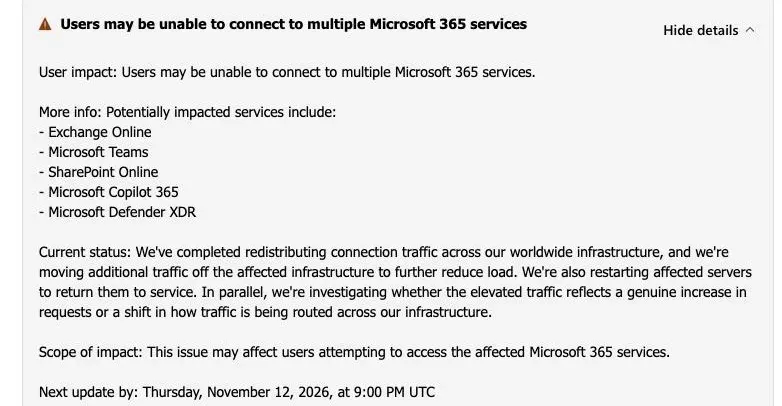 Photo: The Verge
Key points
A Microsoft 365 outage on 12 November disrupted Outlook, Teams, and Copilot for tens of thousands of users, with recovery ongoing.
On 12 November, a Microsoft 365 outage disrupted Outlook, Teams, and Copilot for users worldwide, with nearly 83,000 outage reports logged by 1 p.m. ET. Microsoft acknowledged the issue on its status page, saying a portion of infrastructure was experiencing elevated load across multiple regions. The company later clarified that the load was not due to increased traffic but to servers becoming unexpectedly unavailable.
The outage affected a range of services, including Exchange Online, Microsoft Teams, SharePoint Online, Microsoft Copilot 365, and Microsoft Defender XDR. Microsoft's own admin tools, such as Intune and the Microsoft 365 Apps Admin Center, also went down, hampering administrators' ability to diagnose the problem. The company's status page itself was inaccessible for a period, adding to the confusion.
What went wrong
Microsoft's initial investigation indicated that a core process on the affected servers became overwhelmed, causing them to stop responding and contribute to capacity loss. The company also noted that servers were failing automated health checks, which are designed to ensure they are functioning properly. Microsoft said it had not spotted any changes to its systems that might have sparked the incident.
The outage began around 10:40 a.m. ET when Microsoft posted on X that it was investigating issues with Teams in North America. By just before 1 p.m. ET, it expanded the scope to include Exchange Online mailboxes. Downdetector showed a large spike in reports around noon, with Outlook reports peaking at nearly 83,000 before falling to under 75,000 by 2:38 p.m.
Microsoft's recovery efforts included restarting affected servers and redistributing connection traffic across its worldwide infrastructure. In an update at about 6 p.m. ET, the company said it had begun returning a portion of affected servers to service and had observed limited recovery in some regions. However, a later status page note said that actions taken so far had not provided the anticipated relief.
Recovery attempts
The company also said it was implementing protective traffic management measures in a specific location to reduce load on the affected infrastructure. Microsoft paused all deployments to focus on recovery. Despite these efforts, the company did not offer a timeline for full restoration, leaving many users uncertain about when services would return to normal.
A Microsoft spokesperson, Ben Hope, said in a statement: "We are aware and investigating reports of users experiencing issues with Microsoft 365 services, primarily issues with Exchange Online. We appreciate our customers' patience while we work to restore services as soon as possible." The statement was echoed by a Microsoft spokesperson in a WIRED report.
The outage had real-world consequences. One person ZDNET spoke to at a law firm said she couldn't send or receive mail as of 2 p.m. ET on 12 November, though inbox search seemed to work. She said her firm told her the outage was global. Friends and family of The Register's writers also reported severely disrupted working days.
Microsoft's status page offered contradictory information at times, saying the company was assessing whether reverting recent configuration updates could help. By around 22:00 UTC, Microsoft said it had found an alternative service health check method that allowed a subset of affected servers to return to service. The company continued to explore ways to expedite the process.
The outage is reminiscent of past incidents, such as the July 2024 CrowdStrike update that caused Windows machines to crash, though Microsoft said there was no indication of a cyberattack this time. As of 12 November night, Microsoft was still working to restore services, with no ETA for full recovery. The company said it would continue to monitor the situation and provide updates.
Microsoft's next steps include validating a potential recovery by isolating a portion of infrastructure, restarting affected components, and reintroducing traffic to confirm stability before applying changes more broadly. The company has not announced a date for full restoration. Users are advised to check the Microsoft 365 status page for the latest information.
Frequently asked questions
What caused the Microsoft Outlook outage on 12 November?
Microsoft said a core process on affected servers became overwhelmed, causing them to stop responding. The company also noted servers were failing automated health checks, but it had not identified any changes that sparked the incident.
Which services were affected by the Microsoft outage?
Services including Exchange Online, Microsoft Teams, SharePoint Online, Microsoft Copilot 365, and Microsoft Defender XDR were unavailable. Microsoft's admin tools like Intune and the Microsoft 365 Apps Admin Center also went down.
When did the Microsoft outage start and end?
The outage began around 10:40 a.m. ET on 12 November when Microsoft acknowledged issues with Teams. As of 12 November night, Microsoft had not provided a timeline for full restoration, with recovery still ongoing.