Four planes land in Gomel with Oleshky evacuees as ceasefire holds
Evacuees from Russian-occupied Oleshky landed in Gomel, Belarus, on Saturday 31 October 2026, after leaving on Friday under a Kherson ceasefire brokered by Melania Trump that runs through Sunday 1 November.
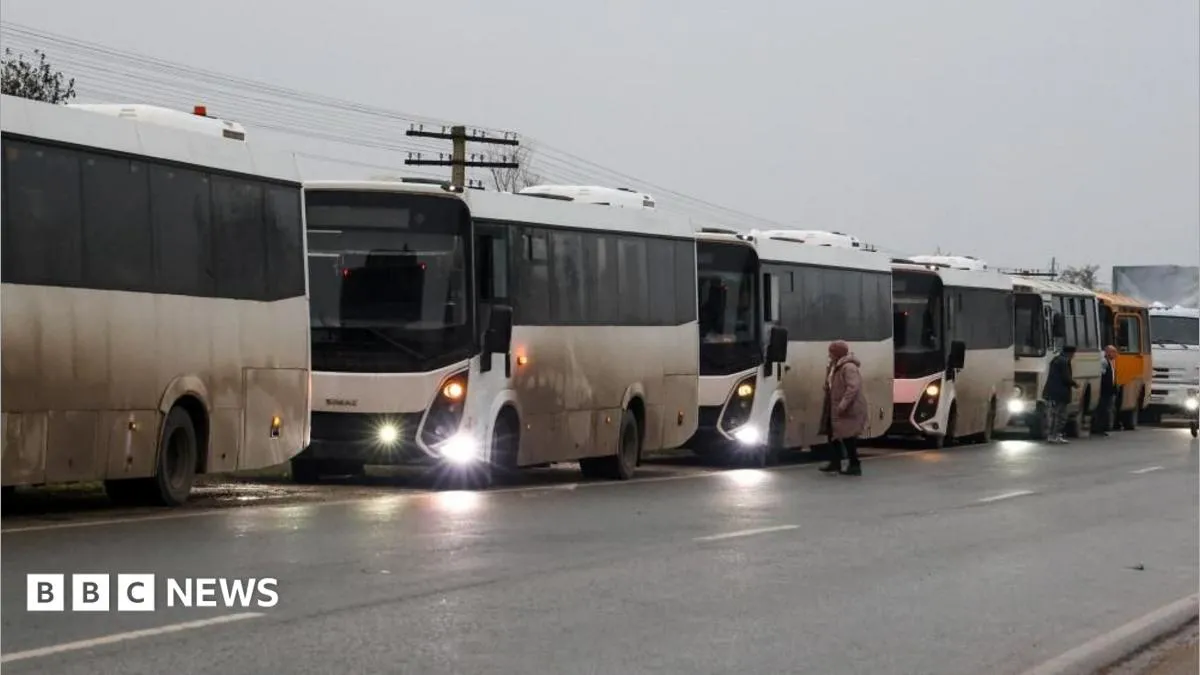 Photo: BBC News
Key points
Four planes carrying evacuees from Russian-occupied Oleshky landed in Gomel, Belarus, on Saturday, with a ceasefire holding through Sunday 1 November.
Evacuees from the Russian-occupied city of Oleshky landed in Gomel, Belarus, on the morning of Saturday 31 October 2026, after leaving the city on Friday under a humanitarian ceasefire in the Kherson region. The fourth and final plane touched down in Gomel, and a bus convoy carrying residents then left the airport toward the Ukrainian border, according to Belarusian state agency Belta.
The evacuees are expected on Ukrainian territory within hours of landing, Ukrainian official David Arakhamia said. The ceasefire, which began at 3 a.m. on Tuesday and is expected to continue through Sunday evening, is the most significant truce since Russia's full-scale invasion of Ukraine began in February 2022. It has held since Tuesday without violations, according to both Ukrainian and Russian officials.
How the convoy reached Belarus
Evacuees faced a long route out of Oleshky because the frontline runs just a few kilometres away. They travelled by bus through Crimea to the Russian town of Anapa, then flew to Gomel, from where they will continue to Ukraine via a border crossing, Belta reported. Bridges across the nearby River Dnipro have been destroyed, and the riverbank has been mined.
The ceasefire allowed the road out of Oleshky to be cleared of mines. Residents had a four-hour window to leave before a convoy of 25 buses, with space for 750 people, departed on Friday afternoon, along with ambulances for people with limited mobility. US First Lady Melania Trump said the convoy included 25 buses, 50 medical professionals, and ambulances.
The localised ceasefire was brokered with help from US First Lady Melania Trump, the White House said, with the involvement of Pope Leo XIV, who pressed Russian and Ukrainian leaders to allow aid deliveries and civilian evacuations. The truce allowed de-mining of roads and the delivery of food, medicines and other supplies into Oleshky, which had been cut off by fighting and drones.
Who brokered the ceasefire
Ukraine's human rights ombudsman Dmytro Lubinets and his Russian counterpart Yana Lantratova travelled to Oleshky together on Friday, setting off from Armiansk in Russian-occupied Crimea. Lubinets is the first Ukrainian official since the start of the war to visit Russian-occupied parts of Ukraine. Some in Ukraine criticised the sight of him standing beside a representative of the Russian occupying power.
Ukrainian officials have said around 1,700 people remained in Oleshky from a pre-war population of about 24,000, with several hundred understood to have decided to stay despite widespread devastation and the lack of gas, electricity and running water. The city was seized by Russia during the first days of its full-scale invasion. Lubinets said those who stayed would receive humanitarian assistance.
Russia said on Thursday it had prepared dozens of tonnes of aid for residents who did not wish to leave, including food, medicine, hygiene products and fuel for generators. Lantratova said buses also transported Oleshky residents who wanted to live in Russia, and Russian media showed civilians arriving at a temporary accommodation site in Simferopol in Crimea.
Who stayed behind in Oleshky
Relatives waited on Saturday at the Ukrainian-Belarusian border, along with aid tents, coffee stands and provisions for pets. Volunteers from the Red Cross, Doctors Without Borders and World Central Kitchen were present. Liza Paliy, 19, waited for her father, whom she last saw more than two and a half years earlier when her family fled.
The ceasefire is due to remain in place until the end of Sunday 1 November. Ukrainian President Volodyr Zelenskyy said on Saturday that Russian strikes overnight left around 280,000 households without power across the Dnipro and Kyiv regions, and that more than 30 Russian strikes had hit the power grid in the first two weeks of October.
Frequently asked questions
How many people were evacuated from Oleshky?
A convoy of 25 buses with space for 750 people left Oleshky on Friday, and US First Lady Melania Trump said the convoy could evacuate more than 750 people. Ukrainian officials say around 1,700 people remained in the city.
When does the Oleshky ceasefire end?
The ceasefire in the Kherson region began at 3 a.m. on Tuesday and is expected to continue through Sunday evening, remaining in place until the end of Sunday 1 November.
How did evacuees travel from Oleshky to Belarus?
Evacuees travelled by bus through Crimea to the Russian town of Anapa, then flew to Gomel in Belarus, from where a bus convoy carried them toward the Ukrainian border.