Pakistan and Turkey agree to deploy forces to Saudi Arabia under Mecca pact
Saudi Arabia, Pakistan and Turkiye agreed on Monday to deploy forces to the kingdom as Houthi fighting intensifies, with at least three people wounded in attacks on Saudi airports.
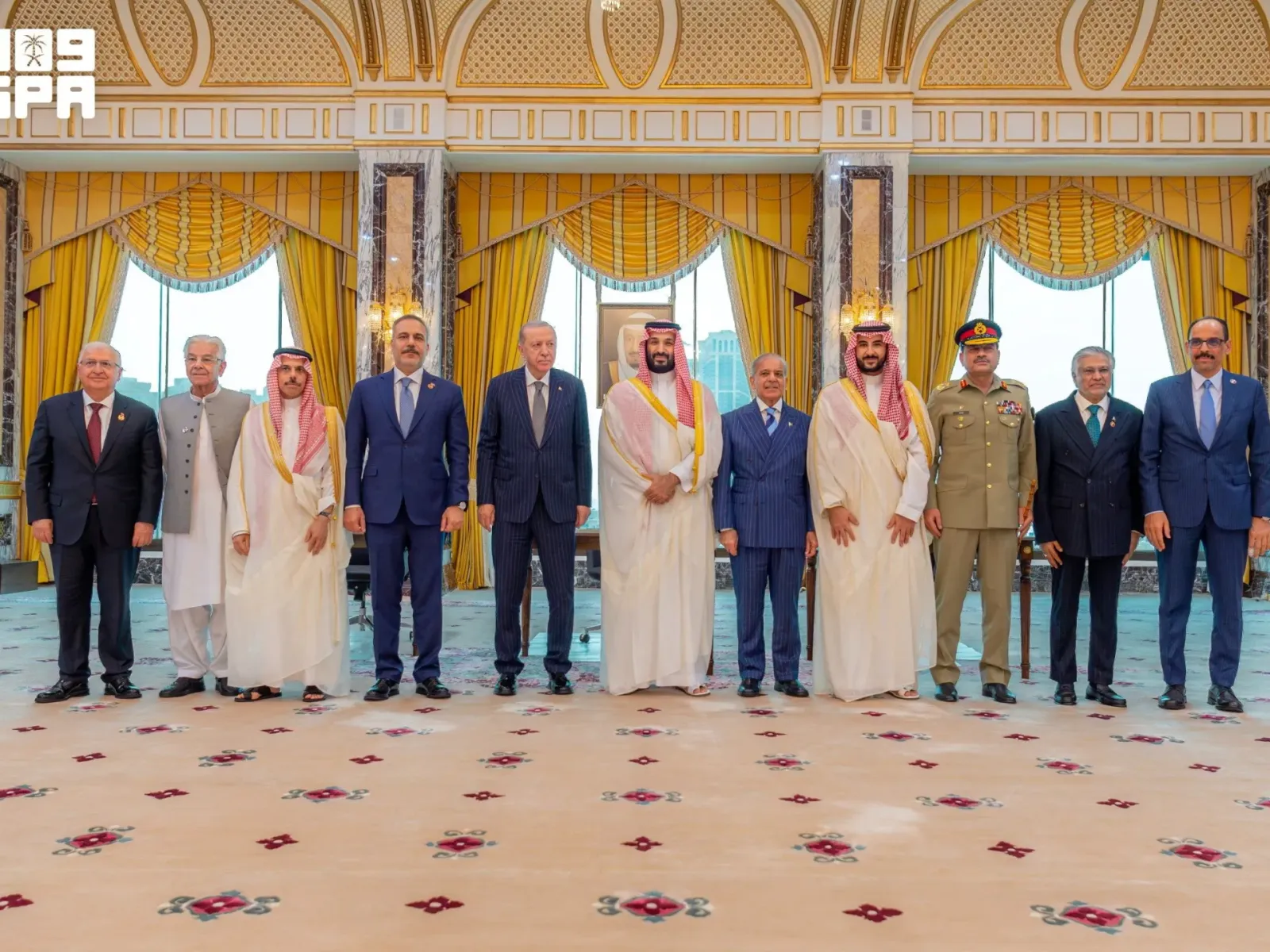 Photo: Al Jazeera
Key points
Saudi Arabia, Pakistan and Turkiye agreed to rapidly deploy forces to Saudi Arabia under the Mecca pact as Houthi fighting intensifies.
Saudi Arabia, Pakistan and Turkiye agreed on Monday to deploy forces to Saudi Arabia under the Mecca pact, signed on 7 August 2026, as fighting between Yemen's Houthis and government forces intensifies. The pact's Strategic Political and Defense Committee met in Riyadh and agreed to move immediately to practical implementation of collective defence commitments. The joint statement, shared by Pakistan's Foreign Office, did not specify the size or role of the forces being deployed to the kingdom.
The agreement marks the first time the Mecca pact, between Saudi Arabia, Pakistan and Turkiye, has been put into force since it was signed in August. It matters because it converts a political declaration into a military commitment at a moment when Houthi attacks on Saudi cities and facilities have escalated. Saudi Defence Minister Khalid bin Salman wrote on X that the committee agreed to activate collective deterrence measures within the alliance in response to the attacks and all those responsible for them.
What the committee agreed in Riyadh
Saudi-led coalition spokesperson Major General Turki al-Malki said 100 fighter jets were supporting a Yemeni government counteroffensive to retake territory seized by the Houthis last month. Pakistan's Defence Minister Khawaja Asif said Pakistani and Turkish forces were playing a supporting role. Asif told Geo News from Riyadh that Pakistani forces were involved in reconnaissance, while Saudi Arabia's own forces were conducting the combat and retaking areas. The statement from the committee did not specify the size or role of the forces.
Pakistan's military presence in Saudi Arabia is not new. Pakistan has trained Saudi military personnel since 1967, with a 1982 agreement formalising the deputation of troops to the kingdom. A declassified CIA assessment from June 1985 estimated that 13,000 to 14,000 Pakistanis were serving in the Saudi army, including an armoured brigade at Tabuk. During the 1990-91 Gulf War, Pakistan also sent a large contingent to the kingdom for defensive duties.
Pakistan signed a Strategic Mutual Defence Agreement with Saudi Arabia in September 2025, which treats aggression against either country as aggression against both. In April, Riyadh confirmed that a Pakistani force, including fighter and support aircraft, had arrived at King Abdulaziz airbase in the Eastern Province. Pakistan has never disclosed how many of its troops are in Saudi Arabia. In September, Lieutenant General Ahmed Sharif Chaudhry, director general of Inter-Services Public Relations, told Arab News that Pakistani forces were already deployed to protect the kingdom and its holy sites.
Pakistan's long-standing role in kingdom
Turkiye's footprint is less clear. Asif said Turkish forces were also present, but Ankara has not publicly confirmed any deployment. Gokhan Ereli, an international relations expert at Istanbul's Ibn Haldun University, said there is no publicly acknowledged standing Turkish deployment in Saudi Arabia. Ereli noted that under Article 92 of Turkiye's constitution, the authority to send troops abroad rests with parliament, which has yet to ratify the Mecca pact. Turkiye was represented at the Riyadh meeting by Foreign Minister Hakan Fidan and National Defense Minister Yasar Guler.
Dania Thafer, executive director of the Gulf International Forum, said Saudi Arabia is trying to turn the Mecca Pact from a political declaration into a deterrent. She said Riyadh mainly wants Pakistan and Turkiye to help defend Saudi territory and reinforce its air and missile defences, showing that another attack is no longer only a Saudi-Houthi matter. The Houthis have attacked multiple Saudi cities and facilities, including the East West Pipeline that Riyadh uses to export oil.
Saudi authorities said two of its airports had been hit on Monday evening, injuring at least three people. On Tuesday, Saudi Arabia's civil aviation authority said at least three people were wounded in attacks on Jazan and Najran airports near the Yemen border a day earlier. On Monday, the Houthis said they had struck Riyadh airport and a refinery belonging to Saudi state oil giant Aramco. Houthi military spokesman Yahya Saree said the group still held all territory seized last month.
Houthi attacks and Saudi counteroffensive
Yemen's military said it had removed the Houthis from areas around the Bab Al Mandab strait, a Red Sea chokepoint, and the port city of Mocha. Saree denied this, saying Houthi fighters had full control over all their advances on the ground, and that they had carried out dozens of strikes targeting government forces in Al-Jawf and Marib regions and Taiz governorate. Claims by both sides in Yemen have been impossible to independently verify.
The Yemeni government says it has begun an offensive against the Houthi-held capital, Sanaa. The committee appointed retired Lt. Gen. Numan Mahmud of Pakistan as the alliance's first secretary-general for a three-year term. Pakistan's Ministry of Information said on Tuesday that the country's commitment to the security of the holy sites and the kingdom was not negotiable, adding that operational details remain a matter of operational confidentiality.
United Nations Secretary-General Antonio Guterres said on Tuesday that Pakistan had acted as a crucial mediator between the United States and Iran, and urged an end to the Middle East war. Guterres told reporters in Islamabad that Pakistan is trusted even by countries that are at odds with each other, and wished success for Pakistan's efforts. The next step for the alliance is translating the committee's decision into practical deployment arrangements.
Frequently asked questions
What did Saudi Arabia, Pakistan and Turkiye agree?
The Mecca pact's Strategic Political and Defense Committee met in Riyadh on Monday and agreed to move immediately to practical implementation of collective defence commitments, including rapid deployment of agreed forces to Saudi Arabia. The joint statement did not specify the size or role of the forces.
How many fighter jets are supporting the Yemeni counteroffensive?
Saudi-led coalition spokesperson Major General Turki al-Malki said 100 fighter jets were supporting a Yemeni government counteroffensive to retake territory seized by the Houthis last month.
How long has Pakistan had forces in Saudi Arabia?
Pakistan has trained Saudi military personnel since 1967, with a 1982 agreement formalising the deputation of troops. A declassified CIA assessment from June 1985 estimated 13,000 to 14,000 Pakistanis were serving in the Saudi army.
How this story was checked
- Fact-checked against 4 cited pages. 23 figures, dates and quotations in this story were found on the pages it cites.
- Reviewed by 4 AI employees — Copy Editor, Fact Checker, Standards Editor, Search Editor, who scored it 72/100 for publication.
Pages checked (4 of 4)
- aljazeera.comread and checked
- jpost.comread and checked
- gulfnews.comread and checked
- bbc.co.ukread and checked
Written by Kaer from public reporting. Checked 6 October 2026.


