Paraguay's Senate removes Santiago Peña over Ueno Bank collapse
Paraguay's Senate voted 44-0 to remove President Santiago Peña on Friday, placing him under house arrest over the Ueno Bank collapse that locked out millions of depositors.
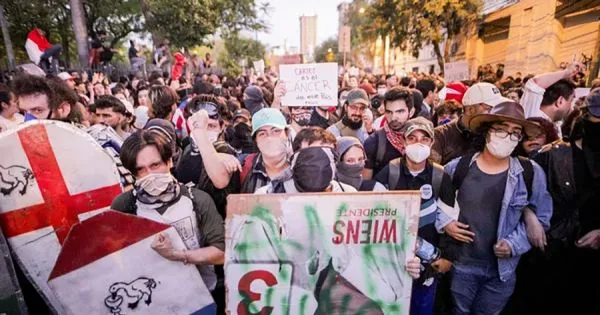 Photo: MercoPress
Key points
Paraguay's Senate removed President Santiago Peña on Friday over the Ueno Bank collapse, and Vice President Pedro Alliana was sworn in as his successor.
Paraguay's Senate voted 44-0 on Friday to remove President Santiago Peña from office over the collapse of Ueno Bank, and Vice President Pedro Alliana was sworn in that evening as the country's 53rd president. The vote turned a resignation offer that Congress had rejected a day earlier into a removal. Peña, 47, was placed under house arrest on suspicion of breach of trust and influence peddling, among other charges.
The Senate's unanimous vote, with one abstention, stripped Peña of his parliamentary immunity. Had Congress accepted his resignation, he would have become a senator for life, with protections from prosecution. Peña did not attend the hearing, sending lawyers instead after asking for a 72-hour extension to prepare his defense. In a statement afterward, he said it was his responsibility to 'place the country above my own personal fate.'
What the Senate decided
The crisis began Tuesday, when the Central Bank took over Ueno Bank, which had received large amounts of public funds during Peña's term, and froze its deposits. The bank had more than 2.9 million customers in a country of 6.1 million people, and its collapse locked nearly half the country's population out of their savings. The central bank initiated liquidation proceedings after Ueno's capital adequacy ratio fell below half of the required minimum.
Lawmakers accused Peña of using his political influence to steer hundreds of millions of dollars in public funds into Ueno while regulators overlooked risky insider lending. The impeachment charges cited Peña's stake in Ueno's holding company, which he divested under pressure last year, and his appointment of Carlos Carvallo to run the central bank that regulated it. Carvallo ran the finance company that became Ueno until Peña named him central bank chief in 2023.
Prosecutors opened three criminal cases against Peña and other former officials related to the bank crisis. An arrest warrant was also issued for Carvallo, who resigned as central bank governor this week. At least 27 people face criminal charges, including Ueno's founder and former CEO, Miguel Vázquez, over allegations that include attempted fraud, breach of trust, misappropriation of funds and influence peddling. A judge ordered six former directors, Vázquez among them, to be held in pretrial detention.
The bank's collapse
The state pension fund had deposited $355 million at Ueno, beyond legal limits, according to lawmakers. About $800 million in public money had helped fuel the bank's growth, which made it one of Paraguay's largest banks by deposits in just a few years. Ueno had aggressively courted the poor and unbanked, and more than 1 million Paraguayans opened their first bank account there. Even players on the national soccer team, which Ueno sponsored, say they can't reach their money.
The fallout has spread beyond savers. A ride-hailing app that relied on Ueno shut down, leaving 3,000 drivers without work. The state power company says $21 million in loans from the Inter-American Development Bank and Taiwan, earmarked for public works, is trapped at the bank. Paraguay's bonds have posted some of the worst losses in emerging markets this week, and the guaraní has slid against the dollar.
Some depositors began recovering their money Thursday, starting with those holding up to 10 million guaraníes (about $1,500). Deposits are insured up to about $35,000, which the central bank says covers 97% of Ueno's customers. It calls the collapse an isolated case and insists the broader financial system is safe. Alliana announced after being sworn in that those affected by the bank's closure 'will be fully compensated,' without saying how.
Who leads now
Alliana, 52, takes over a government that has been in crisis for four days. Born in Pilar, in southern Paraguay, he rose through the Colorado Party as governor of Neembucu department and then spent nearly a decade in the Chamber of Deputies, including three years as its president, before joining Peña's ticket as the vice-presidential candidate in 2023. The lower house declined Thursday to open impeachment proceedings against him, clearing the way for him to serve out the term that runs through August 2028.
The removal was driven as much by party politics as by law. Peña's own Colorado Party, which has dominated Paraguayan politics since 1948, turned on him after former president Horacio Cartes, the party's most powerful figure, said it supported impeachment. Peña, a former finance minister and International Monetary Fund economist, had been welcomed in Washington only weeks ago as a key ally of the Trump administration. He is the second Paraguayan president removed through impeachment, after Fernando Lugo in 2012.
Peña denies wrongdoing. In a farewell message before the verdict, he said that he did not want his 'presence to be a cause of greater division or instability.' He has said he will cooperate with investigators, and no court has convicted him of any crime. Peña was ordered to remain at one of his homes in Asunción until he appears before prosecutors Saturday morning on charges that carry up to 10 years in prison.
The next tests arrive quickly. Alliana must steady a central bank whose leadership is in flux after Carvallo's exit and decide how to handle the pension money tied up in Ueno. Prosecutors must show whether Peña's detention becomes formal charges, and his lawyers must decide whether to contest a verdict reached in a single day. For the millions of Ueno customers still locked out of their accounts, the question is whether their balances come back before the anger now aimed at the departed president finds a new target.
Frequently asked questions
Why was Santiago Peña impeached?
Paraguay's Senate removed Peña over the collapse of Ueno Bank, which had received hundreds of millions in public funds and locked out millions of depositors. Lawmakers accused him of using his influence to steer funds to the bank and of conflict of interest due to his stake in its parent company.
What happens to Peña now?
Peña was placed under house arrest on suspicion of breach of trust and influence peddling. He is scheduled to appear before prosecutors on Saturday morning. The charges carry up to 10 years in prison. He has said he will cooperate with investigators.
Who is the new president of Paraguay?
Vice President Pedro Alliana was sworn in as president on Friday. He is a member of the Colorado Party and will serve out the term until August 2028. He faces pressure to compensate depositors and punish those responsible for the bank's collapse.