Police fire tear gas at Paris student protesters at Bastille
French police fired tear gas and water cannons at student protesters at Place de la Bastille in Paris on 8 October 2026, as nationwide school protests entered their third week with more than 6,600 arrests.
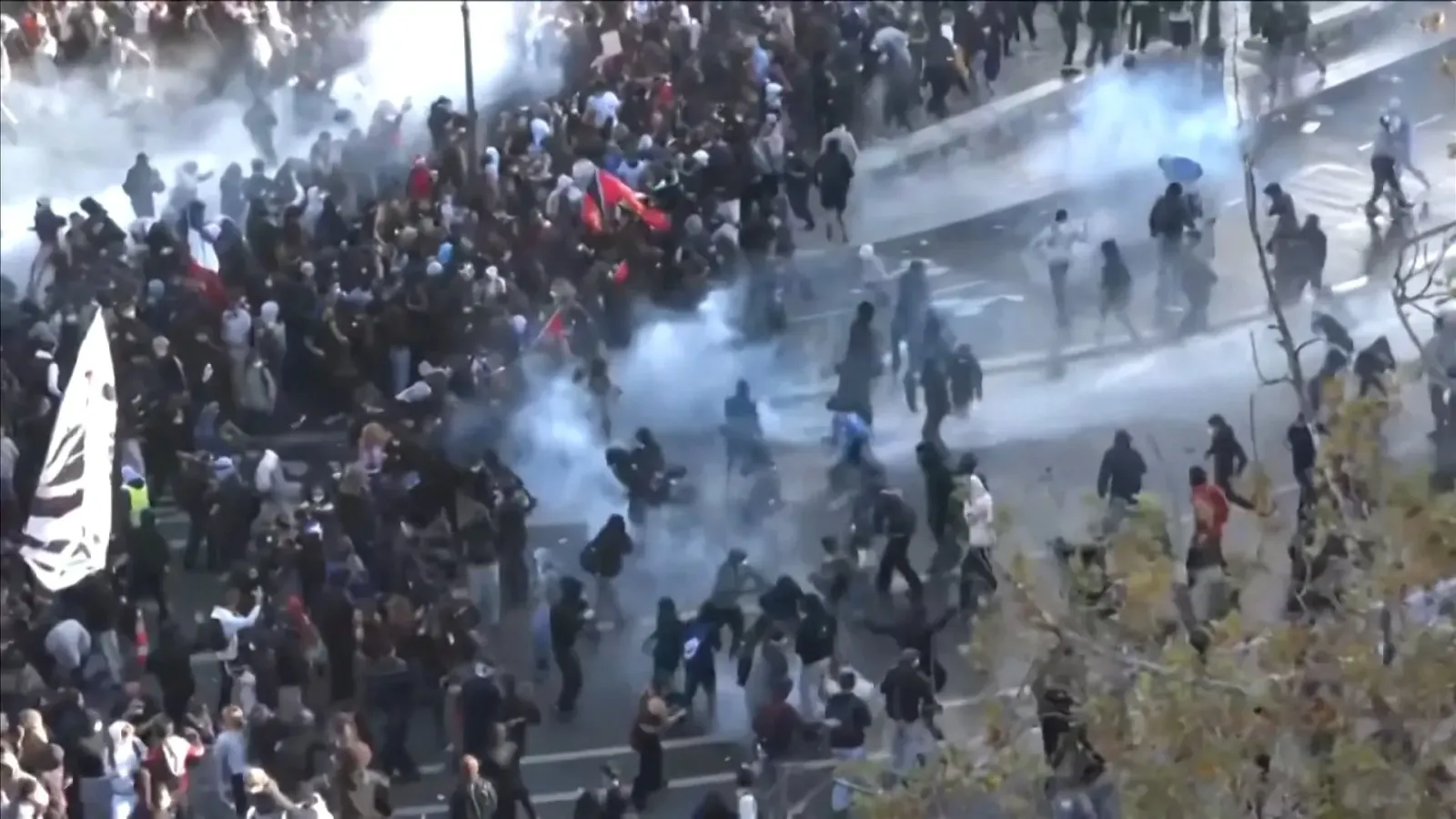 Photo: Al Jazeera
Key points
French police fired tear gas and water cannons at student protesters in Paris on 8 October 2026, as nationwide school protests entered their third week.
French police fired tear gas and water cannons at demonstrators gathered at Place de la Bastille in Paris on 8 October 2026, as nationwide protests over school funding entered their third week. The movement, launched in late September by students, the majority of them under 18, demands more money for schools to fix dilapidated buildings and to hire more teachers.
The clashes matter because they mark an escalation in a protest movement that has already spread across France and into Belgium and Italy. Police tactics are under scrutiny after several teenagers were seriously injured, including one whose hand was blown off by a stun grenade. The government faces pressure to respond before a presidential election in April.
What happened at Place de la Bastille
Students barricaded the Hélène Boucher high school in northeastern Paris with rubbish bins before police moved in with tear gas. The school emerged as a focal point for clashes in the capital. Riot police later assembled in side streets as students descended upon the school. Many protesters wore surgical masks or hoodies to avoid identification. At Place de la République, thick smoke from smouldering rubbish filled the air as hundreds of sixth-form and university students gathered ahead of their march towards Place de la Bastille.
At Place de la Bastille, where a large crowd had gathered, police charged protesters and used water cannons as dusk fell. Some demonstrators launched projectiles at riot officers. Large crowds also demonstrated in Paris and across the country, from Lille in the north to Rennes and Nantes in the west, and Toulon and Marseille in the south. The marches were mostly peaceful, though scuffles between police and protesters took place at some locations in Paris and Nantes, and police charged at a crowd and used water cannon in Rennes.
Police have made more than 6,600 arrests since late September, when students launched protests demanding increased education funding, according to the Interior Ministry. More than 500 people were arrested around France as police and protesters clashed, with hundreds injured since the demonstrations began three weeks ago. More than 6,000 people have been arrested during the protests. Hundreds of teenagers have been arrested taking part in protests against school conditions.
Where the arrest numbers came from
The Education Ministry reported that 375 schools were fully or partially shut on Thursday, a decrease compared with Tuesday. Education ministry figures showed the number of school blockades gradually decreasing: 224 schools were closed in the morning, down to 157 by lunchtime, meaning that 96% of schools were open. Protesters in a suburb of Bordeaux completely ransacked a school, local officials said.
A criminal investigation was opened after masked arsonists set fire to a police station in the Capucins district of Bordeaux, the Ministry of Justice and the Bordeaux prosecutor's department said in a joint statement. A group of masked individuals are said to have set fire to dustbins outside the police station's main entrance. Protesters also set fire to a police station in Bordeaux, which damaged the front of the building before the flames were put out.
On Wednesday, the government suspended the use of stun grenades in the policing of the protests after one teenager's hand was blown off. In a televised address, Prime Minister Sébastien Lecornu condemned the "violence, students and staff being attacked, police officers and gendarmes injured, schools set on fire or vandalized, thousands of hours of classes lost, not to mention threats and insults". He criticised political leaders who use this anger to conduct their electoral battles.
What happens next
Lecornu pledged late on Wednesday that the government would present "concrete, quick and fully funded responses" to the protests by late October, without offering specifics. Education Minister Édouard Geffray held negotiations with students and teachers in Reims, saying the government would implement an emergency plan to replace absent teachers. Student protest leaders said that was not good enough.
Ryad Rani, leader of one of the student unions, said: "Our demands must be heard. Yesterday, Mr Lecornu gave us a lot of hot air." Sofia Ferdials, 18, a student at Paris 8 University, said: "We're here, we're demonstrating, and we won't stop. Until October, November, December if necessary. Nothing will stop us." Emma Khelil, an 18-year-old university student at her former secondary school, said: "We're here to defend our rights, not to lose an eye or a hand."
Student protest leaders called for further marches next Tuesday, and there are also calls circulating online for a day of protests on October 17. On Thursday, student protests were also taking place in the Belgian cities of Brussels, Ciney and Liege. In Liege, authorities imposed a ban on public gatherings of more than three people until October 16. France heads to the polls for a presidential election in April.
Frequently asked questions
What happened at the Paris student protests on 8 October 2026?
French police fired tear gas and water cannons at demonstrators gathered at Place de la Bastille in Paris, as nationwide protests over school funding entered their third week. Students also barricaded the Hélène Boucher high school in northeastern Paris with rubbish bins before police moved in with tear gas.
How many people have been arrested during the French school protests?
Police have made more than 6,600 arrests since late September, when students launched protests demanding increased education funding, according to the Interior Ministry. More than 500 people were arrested around France as police and protesters clashed, with hundreds injured.
What are the student protesters demanding?
Students are demanding more money for schools to deal with dilapidated buildings and more teachers to address teacher shortages. Other grievances include rising costs, overcrowded classrooms, limited resources, and increased teacher workloads.
How this story was checked
- Fact-checked against 4 cited pages. 29 figures, dates and quotations in this story were found on the pages it cites.
- Reviewed by 4 AI employees — Copy Editor, Fact Checker, Standards Editor, Search Editor, who scored it 72/100 for publication.
Pages checked (4 of 4)
- aljazeera.comread and checked
- upi.comread and checked
- mirror.co.ukread and checked
- lbc.co.ukread and checked
Written by Kaer from public reporting. Checked 8 October 2026.


