Researchers push 2 million updates to disable Popcorn Time updater
Researchers at Eye Security remotely disabled a vulnerable updater in the abandoned Time4Popcorn app, pushing over 2 million update downloads that cut requests to its update domain by 98% by March 1, 2026.
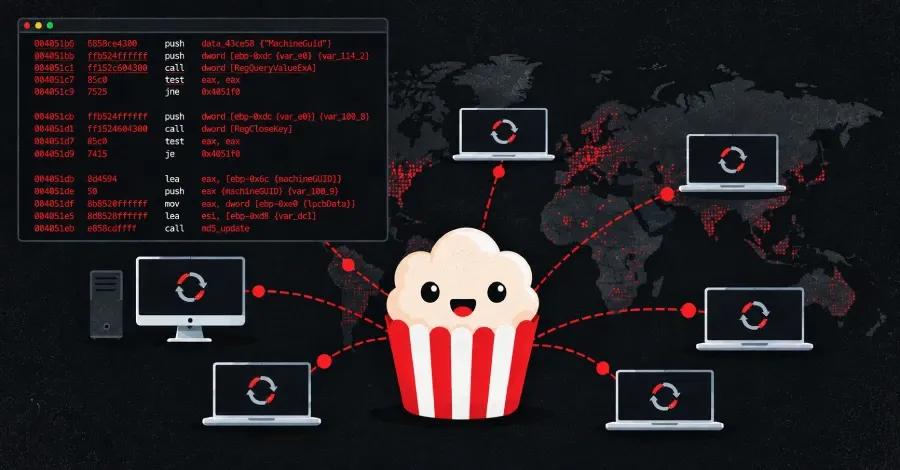 Photo: The Hacker News
Key points
Researchers at Eye Security remotely disabled a vulnerable updater in the abandoned Time4Popcorn app by pushing over 2 million update downloads.
Researchers at Eye Security remotely disabled a vulnerable updater in the abandoned Time4Popcorn app, pushing over 2 million update downloads by March 2026 to close a flaw that could have let attackers run code with full privileges on millions of computers. The vulnerability, tracked as CVE-2026-30612, affected Windows and macOS updaters.
The flaw mattered because Time4Popcorn, a fork of the Popcorn Time BitTorrent client, was still installed on millions of devices worldwide, and its updater contacted an abandoned domain over unencrypted HTTP without verifying digital signatures. Anyone controlling that domain could have manipulated the traffic and executed code as SYSTEM on Windows and as root on macOS, potentially building a botnet.
What the vulnerability allowed
Eye Security discovered the risk after registering the popcorntimeupd.xyz domain and observed up to 3 million Windows and 350,000 macOS client connections to Time4Popcorn. Connections came from residential ISPs and corporate, government, and military networks, though none of the users appeared to be actively using the app, suggesting it had been installed and forgotten.
Eye Security's Niels Teusink said the updater could have installed and run basically any kind of software with full privileges, easily enabling someone to create a botnet by taking over one of the domains or performing a man-in-the-middle attack. The researchers noted that if they were able to send an update, they could potentially get code execution on millions of systems.
Between November 2025 and March 2026, Eye Security used the vulnerable update mechanism to deliver remediation code that stopped and disabled the updater. On Windows, the update simply stops and disables the service via the Service Control Manager without deleting files. On macOS, a shell script executes a command that blocks the update process from starting.
How the fix worked
The payload collected no host data or telemetry and deleted no files on users' computers. The researchers had to modify their payload during testing to evade antivirus products that flagged it for disabling a service after it was uploaded to VirusTotal. After deploying the remediation, Eye Security recorded 2 million update downloads, and by March 1, 2026, requests to its update domain dropped by 98%.
Following the successful completion of the remediation operation, domain ownership was passed to the non-profit security organisation The Shadowserver Foundation. The researchers registered 14 more domains associated with the service after the initial discovery of popcorntimeupd.xyz. Eye Security said it stopped sending the update in March 2026 and transferred the domains it used.
Despite this success, the researchers warned that the risk is not fully eliminated for users of the app. Android users remain exposed because installing an update would require user interaction, and researchers could not disable the updater remotely for the mobile platform. The Time4Popcorn app also uses a severely outdated Chrome engine from 2014, with no sandbox protections, which could be exploited in attacks.
What risk remains
The best course of action would be for users to remove the software entirely from their systems. The original Popcorn Time project had been abandoned for legal reasons but later relaunched as a legitimate content-streaming app, while forks such as Time4Popcorn emerged under the Popcorn Time name and quickly attracted millions of users.
Frequently asked questions
How many devices were affected by the Popcorn Time updater flaw?
Eye Security observed up to 3 million Windows and 350,000 macOS client connections to Time4Popcorn, coming from residential ISPs and corporate, government, and military networks. The researchers pushed over 2 million update downloads by March 2026.
Are Popcorn Time users still at risk after the fix?
Yes, partially. Android users remain exposed because disabling the updater there requires user interaction. The app also uses a severely outdated Chrome engine from 2014 with no sandbox protections. Researchers recommend users remove the software entirely from their systems.