Spain high-speed train crash kills at least 68 near Toledo
Two high-speed trains collided near Toledo on Wednesday morning, killing at least 68 people and injuring 77, in Spain's deadliest rail disaster since 2013.
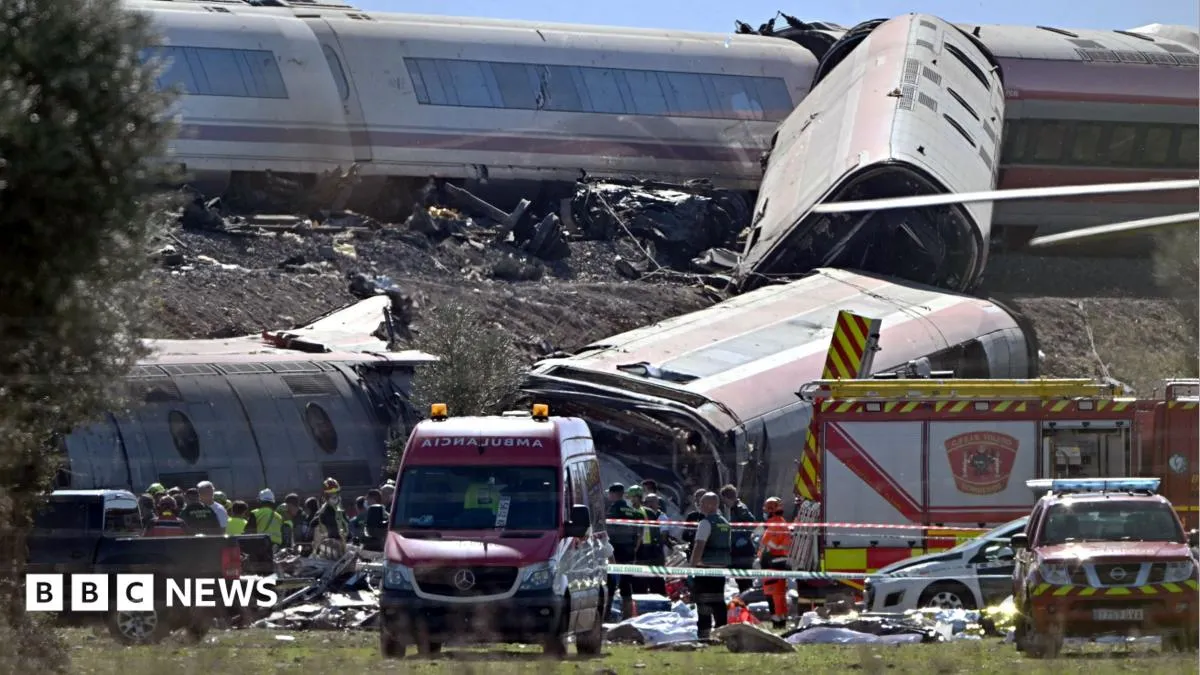 Photo: BBC News
Key points
At least 68 people were killed and 77 injured when a Renfe high-speed train struck a stationary Iryo train near Toledo on Wednesday morning.
A high-speed train crash killed at least 68 people and injured 77 in central Spain on Wednesday morning, when a Renfe train travelling from Madrid to Seville struck a stationary Iryo train. The collision happened just after 09:00 (08:00 GMT) around 140km (100 miles) south of Madrid, near Toledo. Several carriages fell down an embankment. There were 544 people on board the two services: 397 on the Renfe train and 147 on the Iryo train.
Spain's Transport Minister Óscar Puente said a computer failure first stopped the Iryo train on the tracks, then human error compounded it. When a system failure occurs, a 24-hour control centre in Madrid takes over; Puente said it made an "inexplicable" decision to instruct trains to move again without speed restrictions. The crash is one of the worst in Europe's modern history and Spain's deadliest train disaster in 13 years.
Why the trains were moving
Rescue crews reached the site between the villages of Urda and Los Yébenes, a flat stretch surrounded by olive fields, within about 20 minutes, according to a passenger interviewed by Cadena SER radio. Dozens of ambulances attended and a helicopter evacuated those with the most serious injuries. A sport centre in Urda was converted into a triage hub. Spain's Civil Guard said DNA samples from relatives would be needed to identify some victims.
The force of the impact was described as "brutal" by 62-year-old passenger Salvador Arriza, who was on the Renfe train. Passengers broke windows to escape; a long piece of railway track speared through one carriage. One carriage caught fire. Tangui Binier, 22, on the Iryo train, said that "suitcases started flying and people were screaming", and described seeing the train "completely flipped over" once outside.
The two trains carried a combined 544 people, with 397 on the state-run Renfe service and 147 on the privately run Iryo service, according to the operators. At least 68 people were killed and 77 injured. The crash is the worst in Spain since 2013, when 80 people died when a high-speed train derailed near Santiago de Compostela. Spain's railway safety authority recorded accidents rising from 45 in 2016 to 57 in 2024 and 69 last year.
Where the numbers came from
The Iryo train had been stationary due to a signal fault, citing a person briefed on the disaster. Puente said the Renfe train was authorised to continue despite an active red signal because of a stationary train ahead, breaking protocol. The Spanish government's early statements indicated as many as six trains on the same line had been stopped on Wednesday morning due to signalling system problems.
Iryo has contradicted the minister's account. The company told El Mundo its driver received no order to resume movement, and said the train had been instructed by the control centre at Atocha, Madrid's main railway station, to reset its systems after the signalling safety system failed — a reset taking several minutes. Iryo said its train was "struck from behind" by the Renfe service. Spanish trade union CSIF has demanded Puente resign, accusing him of "scapegoating" a traffic manager.
Prime Minister Pedro Sánchez visited the crash site and said "The whole of Spain is grieving", adding that lives had been shattered and families torn apart. He called it "unacceptable" for Spain to have two serious train crashes in one year and vowed to "get to the bottom of this". Opposition People's Party leader Alberto Núñez Feijóo said Spain had a right to know what was happening with its infrastructure. Hundreds protested outside the Ministry of Transport in Madrid, calling for Puente to resign.
Disputed account of the order
Spain has had two major rail crashes this year. On 18 January near Adamuz, in the province of Cordoba, a high-speed train derailed and collided with an oncoming one, killing 46 people and injuring more than 120. A preliminary Civil Guard report in February pointed to defects in the track, rail or weld between two sections as the main hypothesis, while keeping seven other theories open. That investigation continues.
Andalusian politician Juanma Moreno declared three days of official mourning in Andalusia, from 2pm on Wednesday until 2pm on Saturday. Sánchez and other Spanish politicians cancelled all public engagements on Wednesday, including campaigning for next month's parliamentary elections. The prime minister said any failures in the security system would be addressed with the utmost firmness. The government has promised a full investigation into the crash.
Frequently asked questions
How many people were killed in the Spain train crash?
At least 68 people were killed and 77 injured when two high-speed trains collided near Toledo on Wednesday morning. There were 544 people on board the two services between Madrid and Seville.
What caused the collision between the two trains?
Transport Minister Óscar Puente said a computer failure stopped the Iryo train, then a 24-hour control centre in Madrid made an 'inexplicable' decision to let trains move again without speed restrictions. Iryo says its driver received no order to resume movement.
When was Spain's last deadly train disaster?
Spain's deadliest prior crash was in 2013, when 80 people died after a high-speed train derailed near Santiago de Compostela. Earlier this year, on 18 January, 46 people were killed near Adamuz in Cordoba province.