Trump's 250-foot arch wins final approval as lawsuits threaten construction
The National Capital Planning Commission voted 8-4 on 5 November to approve Trump's 250-foot triumphal arch, despite legal challenges and opposition.
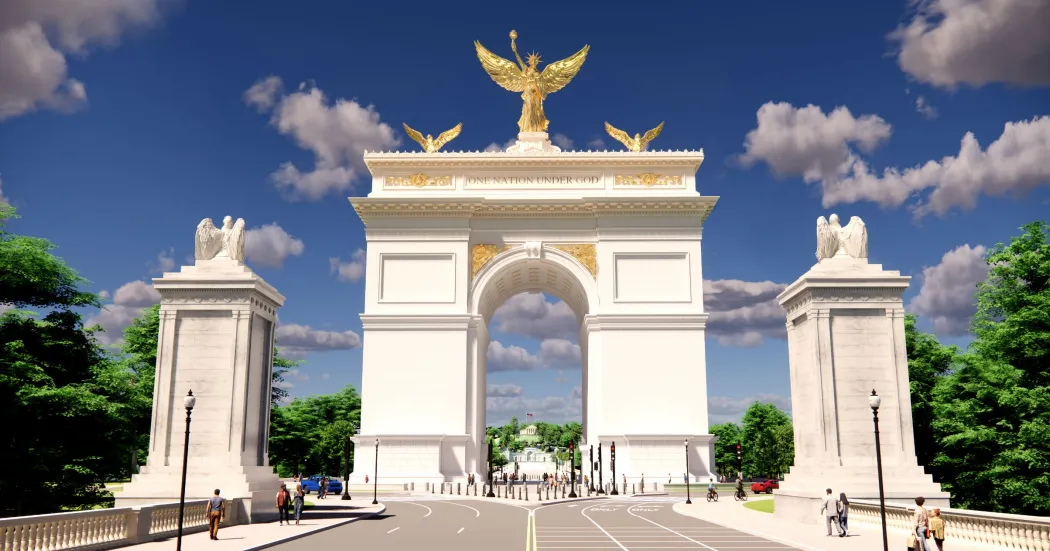 Photo: CBS News
Key points
The National Capital Planning Commission voted 8-4 on 5 November to approve Trump's 250-foot triumphal arch, despite pending lawsuits.
The National Capital Planning Commission voted 8-4 on Thursday to approve President Donald Trump's 250-foot (72m) triumphal arch in Washington, giving the final go-ahead for the monument despite legal challenges that could still block construction. The vote came after nearly nine hours of public comment, the commission said. The arch, which the Trump administration has said could begin construction as early as this week, is one of the president's efforts to remake the capital city in his style and is meant to commemorate the country's 250th anniversary. It would be situated across the Potomac River from the Lincoln Memorial on a highway roundabout near the entrance to Arlington National Cemetery.
What the approval allows
The structure would stand 250 feet tall, topped with a 60-foot-tall gold, winged female figure flanked by gold flying eagles, according to documents filed with the NCPC. The phrases "One Nation Under God" and "Liberty and Justice for All" are inscribed in gold on either side of the structure, and it would include an eternal flame and floodlights to make it visible to pilots.
Mark Paoletta, the chairman of the NCPC and one of the Trump appointees, said at Thursday's meeting that the president understood "it's important to our national identity to display who we are through grand monuments." He added that the arch would honour the nation, its veterans and "provide the sacred ground of Arlington National Cemetery with the monumental gateway it deserves."
Opponents argue the arch will block the view of Arlington National Cemetery, the resting place of thousands of US soldiers and servicepeople, and disrupt sightlines of the Lincoln Memorial. Democratic Congressman Jared Huffman said the arch would fracture "a view meant to underscore the unity and sacrifice of the American people, and doing that with a structure we often associate with emperors or kings who built grand arches as tributes to themselves."
Why opponents object
Anne Wright, who spent 29 years in US military and also worked in the diplomatic service, said she would try to stop any construction. "We'll tie ourselves to the bulldozer, we've got veterans in wheelchairs and we'll chain the wheelchairs to these things," she said. Fellow veteran John Pomeroy, who served in the Air Force for six years including during the Vietnam War, said the arch "would lessen the solemn nature of a visit to the cemetery."
The Trump administration has said the arch would double as a complex to store military equipment, complete with the ability to deploy snipers and drones. "There will be no facility like this anywhere in the World," Trump previously wrote on his Truth Social platform, adding that Washington is "the only one in the world that does not have a triumphal arch."
Lawsuits have been filed against the plans, raising concerns about the environment, traffic congestion and safety. The state of Virginia and the District of Columbia sued the National Park Service and the Department of the Interior on Saturday, seeking to halt the start of construction, calling it "legally indefensible" and arguing that Congress has not approved it. The government contends Congress approved the arch more than 100 years ago when it also authorized construction of a bridge across the Potomac River.
What happens next
A federal judge is weighing whether to temporarily block construction of the arch. In an order Tuesday, U.S. District Judge Tanya Chutkan required the government to provide her notice within one hour of any NCPC vote and a thirty-minute notice to any preparation for construction to give her time to issue a decision on whether to block construction.
If the arch gets an all-clear, the Justice Department has said it expects an initial six to eight months of construction focused on excavation and foundation work could begin this week. Above-ground construction would start in May 2027 at the earliest, with the job expected to take 33 to 39 months total. The National Park Service may also issue a permit or other authorization on Thursday, and launch construction this week, the government said in a court filing.
The arch is among several costly projects Trump is pushing in Washington despite opposition from local officials and preservationists. They include rebuilding the Reflecting Pool at the Lincoln Memorial, constructing a massive White House ballroom and overhauling the Kennedy Center for the Performing Arts. The commission received more than 1,300 public comments about the project, most of which were in opposition, it said.
Frequently asked questions
What did the National Capital Planning Commission vote on?
The NCPC voted 8-4 on 5 November to approve the final site and building plans for Trump's 250-foot triumphal arch in Washington, after nearly nine hours of public comment.
Why are opponents trying to block the arch?
Opponents argue the arch will block views of Arlington National Cemetery and the Lincoln Memorial, disrupt sightlines meant to underscore unity, and could be a target for terrorist attacks. Veterans and lawmakers have filed lawsuits.
When could construction of the arch begin?
The Justice Department said construction could begin as early as this week, with six to eight months of excavation and foundation work. Above-ground construction would start in May 2027 at the earliest.