Trump defends Iran war and 250-foot arch at Arlington ceremony
President Trump used Veterans Day at Arlington National Cemetery to defend his Iran war and promote his 250-foot arch, facing new lawsuits.
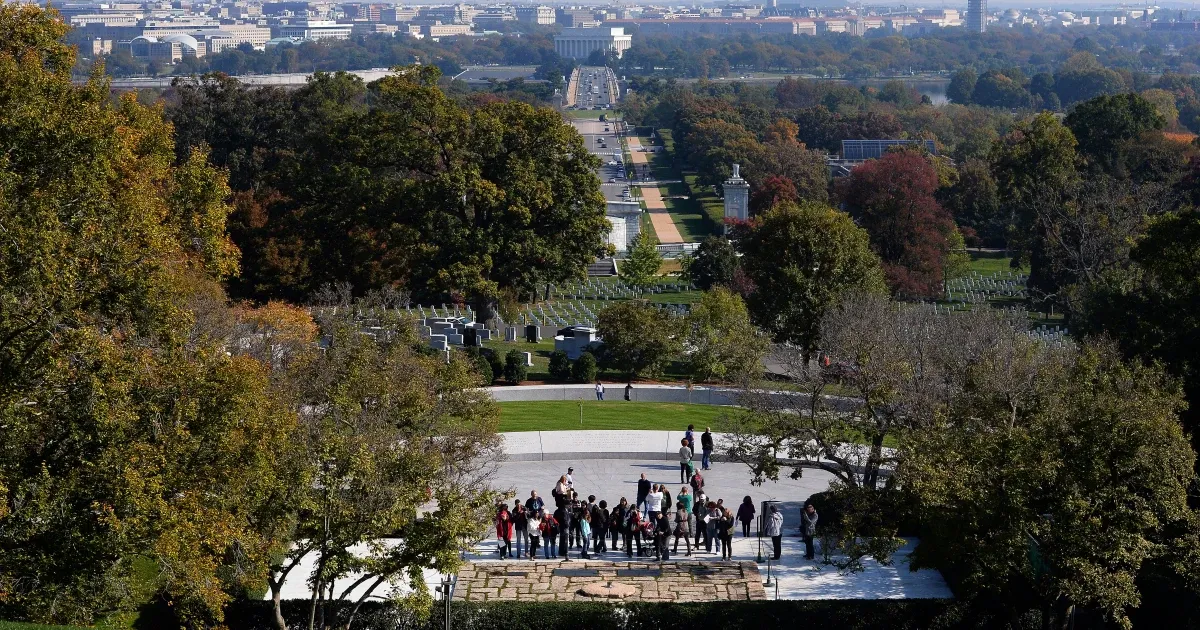 Photo: NPR
Key points
Trump used Veterans Day to defend his Iran war and promote his 250-foot arch, facing new lawsuits.
President Donald Trump used the national Veterans Day ceremony at Arlington National Cemetery on Wednesday to defend his war with Iran, telling an audience of veterans and their families that the United States had already won it and that the only open question was 'when we want to end it.' Speaking in the cemetery's Memorial Amphitheater, Trump inserted the partisan remarks towards the tail-end of his remarks after devoting most of them to commemorating the service of American veterans.
Trump's visit came as his proposal to build a 250-foot triumphal arch in a traffic circle just outside the cemetery's main entrance faces growing opposition. The arch project is being challenged in court by a trio of Vietnam War veterans, Arlington County, Virginia, the District of Columbia, and as of Tuesday, members of the Kennedy family, whose relatives' graves sit at the emotional heart of the cemetery. A common thread throughout the suits is the contention that the giant arch would loom over the nearly 640-acre military cemetery.
War and arch remarks
Trump set up his argument by introducing Dale Garner, a Marine veteran who survived the 1983 bombing of the barracks in Beirut by Iranian-backed Hezbollah militants, an attack that killed 241 American service members. Garner, the president said, was 'a veteran who reminds us why that mission really matters.' After describing Garner's collapsed lung, broken back and burns, Trump asked him to stand. 'You look good, Dale. He looks good. A handsome guy. What's going on here?' he said.
He then gave his own account of the current conflict. 'We began operations against Iran seven months ago, of which only a few weeks were active hard fighting. We lost 18 beautiful souls,' Trump said, referencing the casualties sustained by U.S. forces in the days after American strikes on Iran began on February 28. The president said the war would be over 'soon,' as he has said repeatedly since the spring while offering no evidence to support the claim. 'It'll take them 25 years to rebuild back what we have destroyed,' he added.
Standing a short walk from the graves of Americans killed in Korea, Vietnam, Iraq and Afghanistan, Trump listed the length and death toll of each of those wars and said the country 'got very little from any of these wars.' He contrasted those wars with the U.S. operation in Venezuela to remove dictator Nicolas Maduro this past January, which he said was won 'in 48 minutes' while boasting of the petrodollars the U.S. has supposedly taken in from getting preferred access to Venezuelan oil.
Kennedy family lawsuit
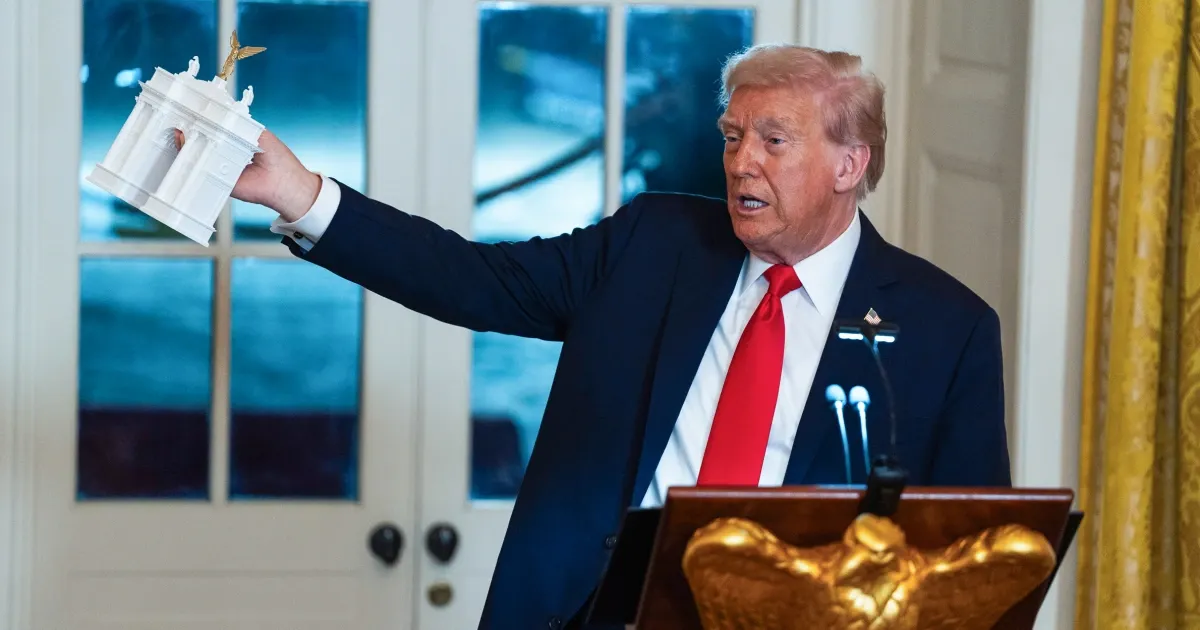
Near the end of his remarks, Trump turned to the 250-foot gilded arch his administration plans to build between the Lincoln Memorial and the cemetery where he was speaking. 'Soon we're going to dedicate a magnificent triumphal arch to our veterans, and that's in honor of our great veterans and our great militaries,' he said. 'They've been waiting for it for 200 years.' The project is being challenged in court, and critics say it would disrupt historic sightlines in the capital.
Nine members of the Kennedy family filed suit in federal court on Tuesday to block the 250-foot structure, saying it would obstruct their relatives' gravesites, including the John F. Kennedy Eternal Flame, at nearby Arlington National Cemetery. 'A towering arch casting shadows across the graves of our father, mother, and uncles, as well as the graves of so many who have served our country, would also cast a shadow over our democratic principles,' Rory Kennedy and Maxwell Kennedy said in a statement on behalf of the family.
The plaintiffs include children of Sen. Robert F. Kennedy and Ethel Kennedy and a son of Sen. Edward M. Kennedy, all three of whom are buried at Arlington National Cemetery. There is one noticeable absence: Health and Human Services Secretary Robert F. Kennedy Jr., did not join his siblings in the lawsuit against his own administration. 'It is unfortunate to see that some members of the Kennedy family have joined the litigation against the Arch as the project is intended to honor our heroes who rest in Arlington Cemetery,' White House spokesperson Davis Ingle said.
Legal and political context
The Kennedys' motion, filed hours before Veterans' Day, adds a highly personal layer to the ongoing legal fight. '[The arch] constitutes nothing less than a permanent denigration of the Kennedy Gravesites and the final resting place for Plaintiffs' parents and grandparents,' they wrote in their 27-page filing. The Kennedys seek to join the existing federal lawsuit against the arch, which combines two cases: one brought by Vietnam War veterans and an architectural historian earlier this year, and another filed by the governments of D.C. and Virginia late last month.
The Trump administration has raced its arch through the federal approvals process over the past year, culminating in a final green light from the National Capital Planning Commission on Thursday. But within moments of the late-night approval, District Court Judge Tanya Chutkan stepped in with an order blocking construction for two weeks while she evaluates the broader legal challenges. One of the main arguments against the arch is that its construction is unlawful without congressional approval, which the Trump administration has not sought.
The administration maintains that the arch is justified by a century-old authorization of two never-built columns at that same location, which did not seem to convince the judge: Chutkan wrote last week that 'merely to state this argument is to reveal its flaws.' The administration has also argued that the case should be thrown out because of plaintiffs' lack of standing, which was the Supreme Court's reasoning in the White House ballroom case. But Chutkan has said D.C. and Virginia likely have standing to sue over the arch.
The speech came eight days after voters handed control of both chambers of Congress to Democrats in an election Trump himself has said was shaped in part by the war. About six in 10 voters told the AP's Election Day survey that the decision to use military force against Iran was the wrong one. Trump did not mention last week's elections by name. The closest he came was in his final minute at the lectern: 'We're doing things that nobody ever thought possible, and yes, we'll have some minor setbacks. We'll handle them very nicely.'
Frequently asked questions
What did Trump say about the Iran war at Arlington?
Trump claimed the U.S. 'won' the war with Iran, saying it was 'just a question of when we want to end it.' He said operations began seven months ago and that 18 U.S. service members were lost.
Why are the Kennedy family members suing over the arch?
Nine Kennedy family members filed suit to block the 250-foot arch, saying it would obstruct views and cast shadows over their relatives' graves, including JFK's Eternal Flame, at Arlington National Cemetery.
What is the status of the arch project?
The National Capital Planning Commission approved the arch, but Judge Tanya Chutkan blocked construction for two weeks. The administration argues it is justified by a century-old authorization, but opponents say it needs congressional approval.