UK and EU agree Brexit reset deal in Brussels worth £17bn a year
Britain and the EU agreed on 20 November to scrap some food checks, link carbon markets and let 100,000 young adults a side live and work abroad, with Andy Burnham claiming a £17bn-a-year boost.
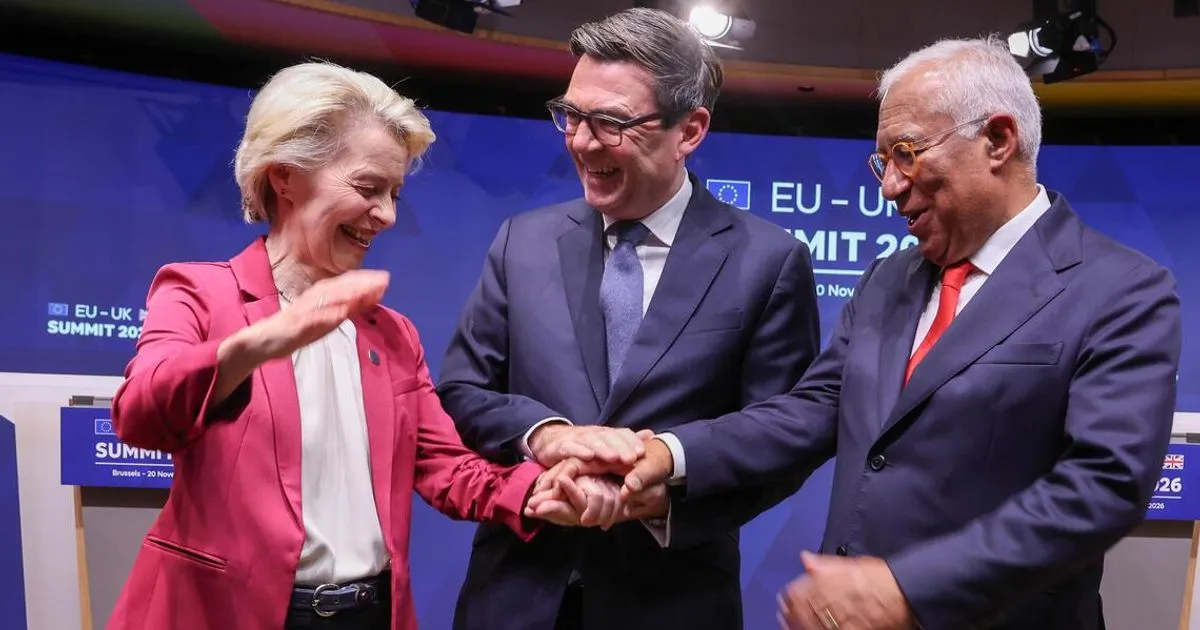 Photo: The Straits Times
Key points
The UK and EU agreed on 20 November to cut trade barriers, link emissions trading schemes and let 100,000 young adults from each side live and work abroad for up to three years.
Britain and the European Union agreed on 20 November to scrap some food checks, link their carbon markets and let 100,000 young adults from each side live and work in the other's country for up to three years. The summit in Brussels was only the second EU-UK summit since Britain became the first country to leave the world's biggest trading bloc, and both sides pledged to rebuild strained ties with what they called an "ambitious and dynamic" relationship.
The package scraps border checks on plant and animal products and links the two sides' emissions trading schemes to cut carbon taxes on some exports. Britain also returns to the Erasmus student exchange programme under the agreement. The youth mobility programme will be operational at earliest in 2028 and at latest in 2030, because work permits for young people remain a national competence of member states.
What the package contains
European Commission President Ursula von der Leyen called the deal "a turning point" in EU-UK relations. Prime Minister Andy Burnham called it a "historic moment" and said: "This is a good day for Britain, and this is a good day for Europe." European Council President Antonio Costa said the EU "remains open to have the closest possible relationship" with Britain.
Burnham pitched the agreements as a way of "cutting costs, keeping prices down in the supermarkets and creating opportunities for young people." He said the deals could bring in £17 billion a year and add 0.5% to Britain's economic output. He gave the example of British salmon exports that currently cost up to £1,400 to export per single shipment, overheads he said would now be substantially reduced.
Retailers welcomed the removal of checks on food and agricultural products. Alex Freudmann, managing director of food at Marks and Spencer, said getting "our spaghetti bolognese from Lincolnshire onto a shelf in Dublin takes hundreds of extra miles, mountains of paperwork, a vet's signature and even the Latin name of a cow." He called the announcement "a major step forward."
The £17 billion claim
Helen Dickinson, chief executive of the British Retail Consortium, called the sanitary and phytosanitary deal a "big win" for UK retailers but warned that businesses need "at least 18 months" to transition to the new arrangements. She said the priority now must be to get the detail right and give businesses clear and early guidance to avoid unnecessary cost or disruption.
Big decisions were left for another day. The two sides gave themselves six months to reach an agreement on the level of university fees for EU students in the UK and vice versa. EU negotiators want European students to pay domestic fees if they study in Britain rather than the higher fees for foreign students, something the UK has resisted.
Talks also continue on Britain's desire to be included in the bloc's "made in Europe" rules, which favour European manufacturers for public projects over rivals from China or elsewhere. The joint statement confirms the youth mobility programme will be operational at earliest in 2028 and at latest in 2030, because work permits for young people remain a national competence of member states.
Farage calls it a first step
Critics say the deals weaken Brexit. To get them, the UK must accept some EU rules and standards that it has no role in setting. Nigel Farage, leader of Reform UK, told reporters in Brussels that Burnham had taken "the first step, incrementally, to take us back into membership of the European Union." He claimed the agreements were in direct contradiction of the Labour manifesto on which the party was elected in 2024.
Burnham rejected that reading, saying there is "a clear democratic mandate for what has been done today" and that "there will be nothing beyond the significance of this in this parliament." He said reversing Brexit was not on the table now and that the British people would be the boss of what happens next. He challenged opponents to justify rejecting a deal he said would boost growth and lead to cheaper food and electricity.
The agreement also covers illegal migration, with a new dialogue on Channel crossings and intelligence and data-sharing to disrupt people-smuggling gangs. The two sides agreed to deepen co-operation on defence capabilities, military mobility and protection of critical infrastructure, opening the way for British participation in EU civilian security and defence missions.
Burnham said the summit was a step towards undoing a decade of damage caused by the divorce, and that the two sides are "rebuilding the bridges that were broken all of those years ago." He said a bill on the deal will be presented to parliament next week, where opponents will have to decide whether to support it.
Frequently asked questions
What did the UK and EU agree on 20 November?
They agreed to scrap border checks on plant and animal products, link emissions trading schemes to cut carbon taxes on some exports, let 100,000 young adults from each side live and work abroad for up to three years, and return Britain to the Erasmus programme.
How much will the deal boost the UK economy?
Prime Minister Andy Burnham said the deals could bring in £17 billion a year and add 0.5% to Britain's economic output. Critics dispute the framing, and the two sides left university fees and wider trade rules for later talks.
When will the youth mobility scheme start?
The joint statement confirms the scheme will be operational at earliest in 2028 and at latest in 2030, because work permits for young people remain a national competence of member states rather than Brussels.