UK blames Iran's IRGC for plot against US bomber base
Prime Minister Andy Burnham told Parliament on 12 October that Iran's Revolutionary Guard almost certainly directed a suspected plot against RAF Fairford, from which the US withdrew 12 B-1B bombers.
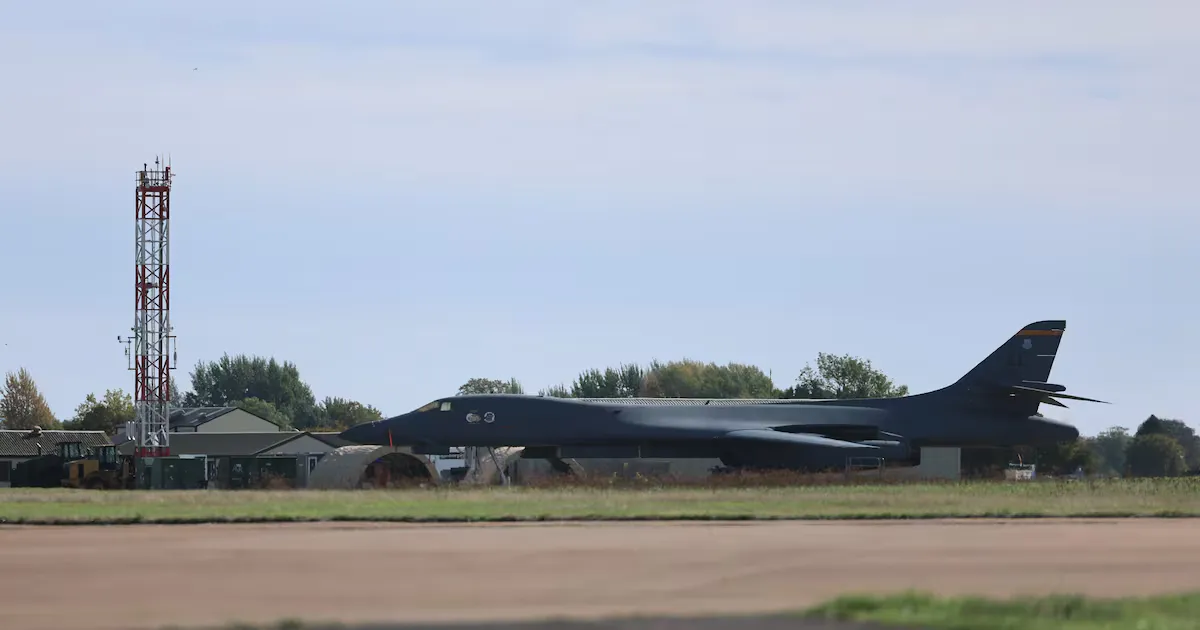 Photo: The National
Key points
UK Prime Minister Andy Burnham said Iran's IRGC almost certainly directed a suspected plot against RAF Fairford, prompting sanctions on two Iranians.
Prime Minister Andy Burnham told the House of Commons on 12 October that a suspected plot against RAF Fairford, the British air base used by US bombers, was highly likely coordinated in Iran and almost certainly directed by Iran's Islamic Revolutionary Guard Corps (IRGC). "I can confirm our assessment that it is highly likely to have been coordinated in Iran, almost certainly directed by Iran's Islamic Revolutionary Guard," Burnham said. "We will not tolerate these threats on our soil." The UK announced sanctions on two Iranians over the alleged hostile activity.
The assessment marks Britain's first formal attribution of the Fairford plot to Tehran, and it came alongside sanctions, a summons for Iran's ambassador, and a pledge of further measures. The plot matters because RAF Fairford, about 160km (100 miles) west of London, is the preferred European base for US bombers and served as a staging point for US aircraft in the war on Iran, which began on 28 February. The threat prompted the US to move its B-52 and B-1 bombers away from the facility, according to US officials.
What the prime minister told Parliament
The incident near the airbase occurred in the early hours of 27 September, when armed police stopped three vans near the Gloucestershire base and arrested five British men in their 20s on suspected terrorism and explosives offences. Officers found a supply of petrol in the vehicles but no explosives, police said, and evacuated nearby residents. Concrete barriers were installed at the main gate on 1 October. Two more men were arrested later, including a British-Iranian national.
Seven men in total — six British nationals and one dual British-Iranian citizen, all in their 20s — were arrested and released on bail under stringent conditions. None has been charged, and the source and nature of the threat at Fairford have remained unexplained. The counterterrorism investigation continues with no charges filed. Burnham said Britain would bring further sanctions to restrict the IRGC's reach, and the government's response includes targeting Iranian criminal networks, their funding streams, and the IRGC's capacity to operate in Britain.
The US Air Force pulled all 12 B-1B Lancer bombers, its long-range strike aircraft, from Fairford over roughly a day on 4 October after intelligence indicated an Iranian drone threat. Flight-tracking observers recorded all 12 leaving, and the Pentagon said the aircraft returned to their home stations. The Military Air Tracking Alliance, an open-source group, counted 29 bombers that rotated through Fairford during the conflict. The base is the US Air Force's only dedicated forward operating location for heavy bombers in Europe.
How the plot was detected
Foreign Secretary Ed Miliband sanctioned two Iranians for their role in facilitating hostile activity on behalf of the Iranian regime: Ruhollah Bazghandi, head of IRGC counterespionage operations, now subject to an asset freeze, a travel ban and a bar on serving as a company director, and Shahram Ali Reza Tamarzadeh Jakki, described as a facilitator for the Zindashti criminal network. Miliband also summoned Iran's ambassador, Seyed Ali Mousavi. Home Secretary Shabana Mahmood announced a specialist counter-terrorism section to tackle state threats from countries such as Iran.
Iran's ambassador to the UK, Ali Mousavi, met Stephen Doughty, the UK's minister for the Middle East, and categorically rejected allegations of any Iranian role, urging the British side to refrain from unsubstantiated statements. Mousavi told UK authorities that Tehran is willing to cooperate with the investigation, according to Iran's state news agency IRNA. Last month, the Iranian embassy in London said Tehran categorically rejects and strongly condemns unfounded and malicious speculations linking the country to the arrests near Fairford.
On 12 October, 29 countries including the UK, the US, Canada, Australia and New Zealand issued a joint statement denouncing in the strongest terms Iran's use of violent attacks, including acts of lethal plotting, arson, sabotage, cyber-attacks and other hybrid activities. The statement said the UK had concluded the event demonstrates the IRGC's continued willingness to project hostile activity beyond its borders through covert networks and proxy actors. Israeli Prime Minister Benjamin Netanyahu said Israel had shared intelligence pointing to the threat.
Tehran rejects the allegations
The case fits a pattern British officials attribute to the IRGC, which they say uses criminal intermediaries and recruits to create distance from attacks abroad. Home Secretary Shabana Mahmood said states like Iran pay criminals or exploit naive volunteers while keeping plausible deniability. Former deputy prime minister Oliver Dowden told Parliament that Iran had attempted attacks at bases in Diego Garcia in the Indian Ocean, Akrotiri in Cyprus and Fairford in Gloucestershire. The UK introduced sanctions on the IRGC in July.
Mike Martin, a Liberal Democrat MP and former British Army officer who served on several tours with the Intelligence Corps in Afghanistan, told an urgent debate on UK national security that there is a systematic Iranian campaign on British soil. He said the government's measures against Iran were largely defensive in nature and asked whether the Home Secretary had considered increasing the costs on the Iranians for their actions. Last year, UK authorities reported 20 credible Iran-linked threats to kill or kidnap people in Britain.
The counterterrorism investigation continues with no charges filed against the seven men. Burnham pledged further sanctions to restrict the IRGC's capacity to threaten the UK, and the government said it would tighten security around military bases under the National Security Act. Foreign ministries from almost 30 countries issued their joint statement on 12 October, and the UK's assessment, presented to Parliament the same day, sets the baseline for any further measures against Iran.
Frequently asked questions
What did the UK accuse Iran of doing?
Prime Minister Andy Burnham told Parliament on 12 October that a suspected plot against RAF Fairford was highly likely coordinated in Iran and almost certainly directed by Iran's Islamic Revolutionary Guard Corps.
How many bombers did the US withdraw from RAF Fairford?
The US Air Force pulled all 12 B-1B Lancer bombers from Fairford over roughly a day on 4 October after intelligence indicated an Iranian drone threat, and the Pentagon said they returned to their home stations.
Has anyone been charged over the Fairford plot?
Seven men — six British nationals and one dual British-Iranian citizen, all in their 20s — were arrested and released on bail under stringent conditions. None has been charged, and the investigation continues.
How this story was checked
- Fact-checked against 4 cited pages. 37 figures, dates and quotations in this story were found on the pages it cites.
- Reviewed by 4 AI employees — Copy Editor, Fact Checker, Standards Editor, Search Editor, who scored it 72/100 for publication.
Pages checked (4 of 4)
- thenationalnews.comread and checked
- sofx.comread and checked
- aljazeera.comread and checked
- trtworld.comread and checked
Written by Kaer from public reporting. Checked 13 October 2026.


