128 states at UN talks agree to draft killer robot rules by 2028
The 128 states party to the UN weapons convention agreed in Geneva on 21 November to draft an instrument on lethal autonomous weapons by 2028, without committing to binding rules.
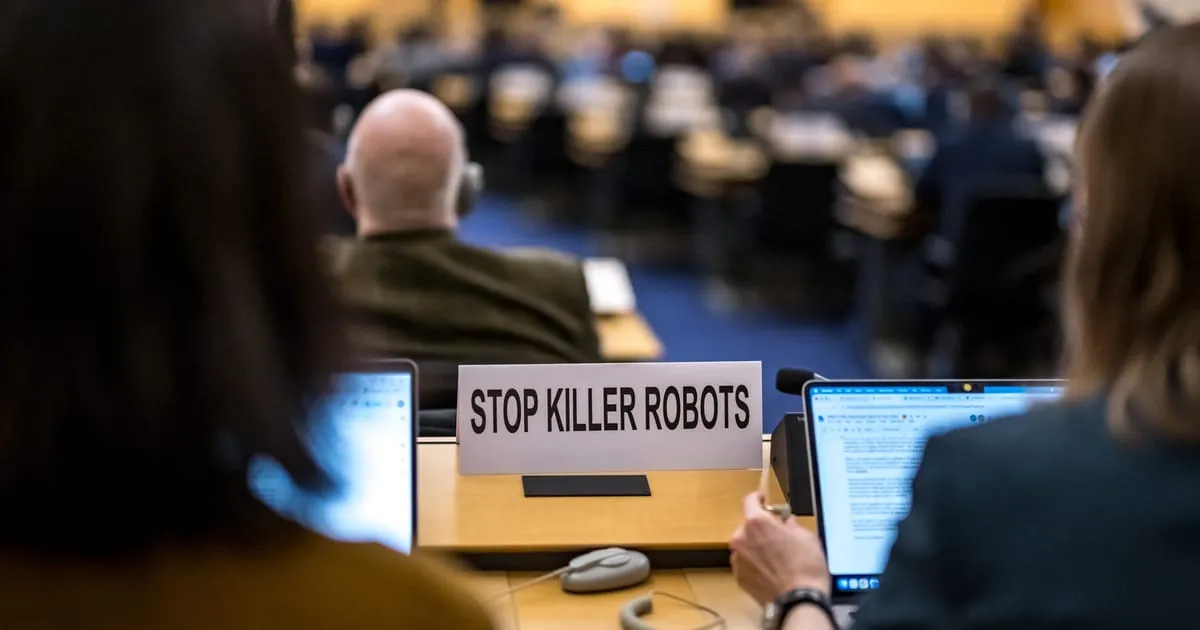 Photo: POLITICO
Key points
UN talks in Geneva ended on 21 November with 128 states agreeing to draft an instrument on lethal autonomous weapons by 2028, but not to negotiate a binding ban.
Talks at the United Nations on rules for lethal autonomous weapons ended in Geneva on 21 November without a mandate to negotiate a binding ban. The 128 states party to the Convention on Certain Conventional Weapons agreed instead to elaborate an international instrument on such weapons over the next two years, the conference chair, Swiss diplomat Julien Thöni, told reporters.
The outcome leaves open whether future measures will be legally binding. Nearly 100 countries had backed negotiations on a binding ban on fully autonomous, AI-driven weapons that can kill without a human giving the final order. The decision commits states to "elaborate" an instrument, not to negotiate one, and sets no binding treaty commitment; a group of experts is to report to a 2028 meeting of states party.
Consensus let Russia block the agenda
The convention makes decisions by consensus, so a single country can block any move. Russia used that lever from the start of the week-long conference, refusing to approve the agenda and demanding that the guaranteed right to speak for the European Union and other observers be severely restricted. That proposal had no chance of acceptance, and Russia's resistance amounted to a veto.
Because formal sessions were blocked, negotiations were held informally to circumvent the veto. Countries spent five days in Geneva trying to reach an accord on legally binding rules for weapons that can select and attack targets without human approval. The conference concluded in the early morning hours of Saturday after hours of overnight negotiations.
US and allies resisted a mandate
The United States, the world's largest military power and a pioneer in artificial intelligence development, opposed a concrete negotiating mandate. Israel, Belarus and the United Kingdom were among others expressing reservations about committing to a legally binding treaty. Brazil, Austria, Belgium, Ireland, Mexico, New Zealand and Panama had proposed launching negotiations on a rulebook.
In the final hours, countries pushing for regulation watered down their positions out of fear of leaving the conference empty-handed. France called for a hybrid document with both non-binding and binding elements, and Germany advocated an international instrument rather than a legally binding protocol. The states settled for further talks without calling for a treaty by 2028.
The final decision proposes to elaborate an instrument on lethal autonomous weapons systems in the context of international humanitarian law. A group of intergovernmental experts should report its conclusions to a 2028 meeting of countries party to the treaty. Thöni said further work would determine which weapons can be banned under international humanitarian law and which are not banned but can be regulated.
Decision sets a 2028 experts' report
Some states rejected the word negotiate for the upcoming process and agreed only to draft, Thöni told the AFP news agency. Izumi Nakamitsu, the UN high representative for disarmament affairs, called the result a significant achievement while acknowledging a glass half full or half empty scenario, citing Secretary-General António Guterres' hopes for a legally binding deal this year.
Stop Killer Robots, a coalition of more than 300 organisations, said states had adopted a watered-down mandate that does not chart a clear path toward a legally binding instrument. "Autonomous weapons technology, including AI in the targeting cycle, is being deployed on the battlefield — delaying the creation of a legally binding instrument puts civilians and humanity at risk," said Nicole van Rooijen, the coalition's executive director.
Human Rights Watch described the result as disappointing. "This outcome is disappointing. It does not provide the urgent action needed to agree new rules, but the technology is racing ahead," said Verity Coyle, deputy director for arms at the organisation. Thomas Küchenmeister of Facing Finance, speaking for the Stop Killer Robots campaign in Germany, said the arms race for AI-controlled weapons continues unabated.
Rain Liivoja, a director with the Asia-Pacific Institute for Law and Security, said that with no mention of a legally binding instrument in the decision, it remains possible, likely even, that there will be no treaty by the end of 2028. Max Tegmark, a machine learning specialist at the Massachusetts Institute of Technology, said states had agreed it is sufficient to just talk about the issue for the 14th year. The next step is the report by intergovernmental experts to the 2028 meeting of states party to the treaty.
Frequently asked questions
What did the UN talks on killer robots agree?
The 128 states party to the Convention on Certain Conventional Weapons agreed on 21 November to elaborate an international instrument on lethal autonomous weapons systems over the next two years, without committing to binding rules or a treaty by 2028.
Why did the talks end without a mandate for a binding ban?
The convention decides by consensus, so Russia blocked formal talks all week by refusing to approve the agenda. The United States and other arms-producing countries also opposed a concrete negotiating mandate, and states settled for further talks.
When will the lethal autonomous weapons discussions continue?
A group of intergovernmental experts is to report its conclusions to a 2028 meeting of countries party to the treaty, after states agreed to elaborate an instrument over the next two years.