Rubin telescope identifies icy candidate dwarf planet 2026 ED138 beyond Pluto
The Vera C. Rubin Observatory in Chile identified candidate dwarf planet 2026 ED138, 600 to 1,500 km wide and about 46 times Earth's distance from the Sun, announced on 27 October 2026.
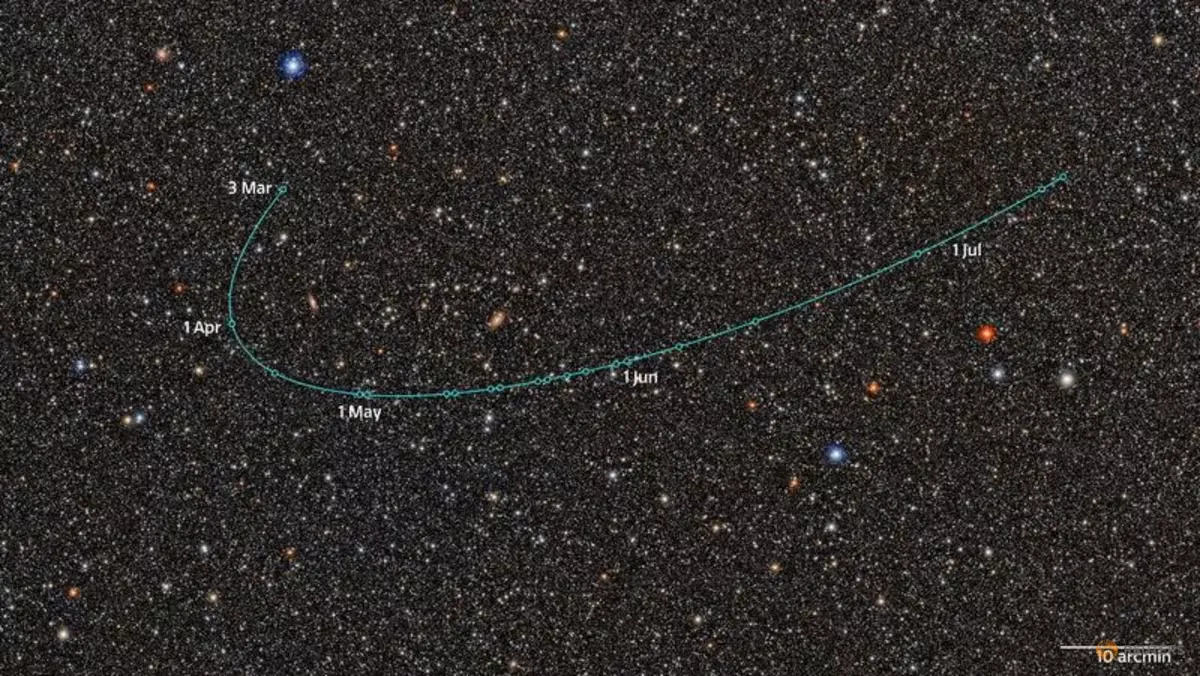 Photo: Channel NewsAsia
Key points
Astronomers using the Vera C. Rubin Observatory identified 2026 ED138, an icy object beyond Pluto that may be a sixth dwarf planet, though its size and shape remain unconfirmed.
The Vera C. Rubin Observatory, a telescope on the Cerro Pachón mountain in central Chile, has identified an icy object orbiting beyond Pluto that may be a new dwarf planet. The candidate, named 2026 ED138, is estimated at 600 to 1,500 kilometres in diameter and orbits about 46 times farther from the Sun than Earth, compared with Pluto's average of about 40 times.
If confirmed, 2026 ED138 would join the five dwarf planets recognised by the International Astronomical Union: Pluto, Eris, Haumea and Makemake beyond Neptune, and Ceres in the asteroid belt between Mars and Jupiter. Based on current data, the candidate would be among the largest of them, and the scientists say it is among the seven largest objects identified in the outer solar system so far.
Why the object stayed hidden
Astrophysicist Matt Holman of the Center for Astrophysics, Harvard & Smithsonian, spotted the object on 13 October 2026 while analysing Rubin observations with software he developed with colleague Kevin Napier. The programme compared detections from different nights to find moving objects. Mario Jurić, an astronomer at the University of Washington who leads Rubin's solar system team, then examined the observatory's records and confirmed 30 images of ED138 across 20 nights between 4 March and 11 July 2026.
The object had escaped notice for a decade because it sits close to the apparent plane of the Milky Way, where millions of background stars make faint moving objects hard to spot. Archival images from the Dark Energy Camera on the Victor M. Blanco Telescope in Chile, found through the Asteroid Institute's ADAM Precovery service, showed ED138 had been photographed in 2016, 2017, 2018, 2019 and 2023 without being recognised.
Its orbit also works against detection. According to the Minor Planet Center, ED138 takes about 281 years to circle the Sun, ranging from 36.86 astronomical units at its closest approach to 49.04 AU at its farthest, where one astronomical unit is the average Earth-Sun distance. Its orbit is tilted roughly 24.5 degrees from the plane most planets follow, so it spends most of its time above or below the band of sky where most telescopes point.
What still needs confirming
The size of 2026 ED138 remains uncertain because brightness alone does not determine dimensions. Holman explained that a smaller, highly reflective object can appear as bright as a larger, darker one. The diameter estimate of 600 to 1,500 kilometres reflects that range. To pin it down, astronomers plan infrared observations with ALMA, the Atacama Large Millimeter/submillimeter Array in Chile, which detects light the object emits rather than reflects.
Astronomers have also not established whether ED138 is round enough to qualify as a dwarf planet under the International Astronomical Union's definition, which requires an object to orbit the Sun, be nearly round under its own gravity, and not have cleared its orbital neighbourhood. Jurić suggested observing occasions when the object passes in front of distant stars to learn about its shape. Jurić called finding an object roughly 1,000 kilometres across 'once in a generation'.
The Rubin Observatory's 3.2-billion-pixel camera photographs an area of sky equal to roughly 45 full moons in a single exposure, and its eight-metre mirror collects light quickly enough to reveal faint objects. Every three nights it can observe the entire visible sky from its Chilean site. Napier described the search as connecting dots across nights to estimate an orbit around the Sun.
The discovery was announced on 27 October 2026 at the 59th Annual Division for Planetary Sciences meeting of the American Astronomical Society in Spokane, Washington. Holman said the object is bright enough that capable amateur astronomers can see it, and that it shows treasures in the solar system remain unfound. He said the main task is establishing the physical size of 2026 ED138.
Rubin's wider survey is already turning up objects: in April 2026 the observatory reported more than 11,000 newly discovered asteroids, including about 380 beyond Neptune. Its ten-year survey began in June 2026 and will repeatedly image the southern sky. Holman said Rubin will image the whole southern sky again and again, bringing within reach any other objects hiding where earlier surveys skipped.
Frequently asked questions
What is 2026 ED138?
2026 ED138 is an icy object orbiting beyond Pluto, identified by the Vera C. Rubin Observatory in Chile. It is estimated at 600 to 1,500 kilometres in diameter and orbits about 46 times farther from the Sun than Earth.
Is 2026 ED138 confirmed as a dwarf planet?
No. It is a candidate. Astronomers have not established whether it is round enough under its own gravity to meet the International Astronomical Union's definition, and more observations are needed to fix its physical size.
How did astronomers find 2026 ED138?
Matt Holman spotted it on 13 October 2026 analysing Rubin observations with software developed with Kevin Napier. The team traced 30 detections across 20 nights between 4 March and 11 July 2026, plus archival images back to 2016.