Alphabet shares sink 10% after search revenue misses forecast
Alphabet shares fell 10% in after-hours trading on 28 October 2026 after third-quarter revenue of $127.6 billion missed the $128.2 billion forecast and free cash flow turned negative at $9.1 billion.
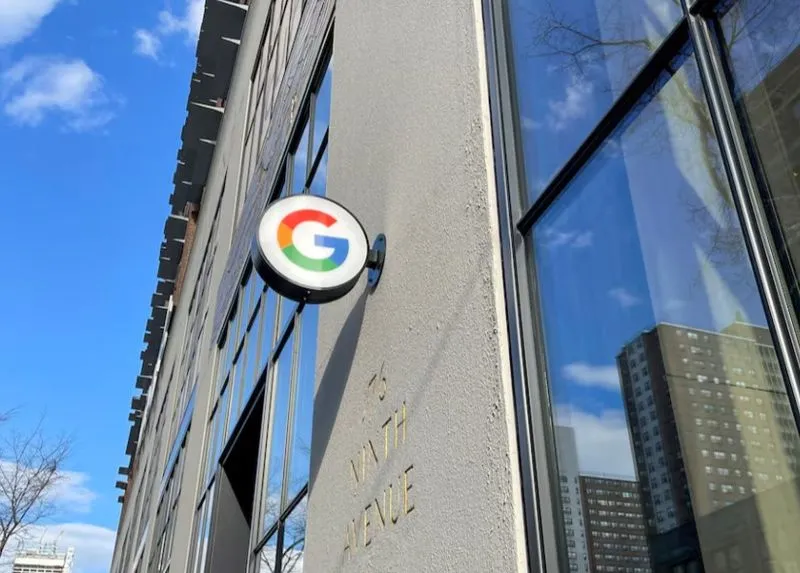 Photo: Daily Maverick
Key points
Alphabet shares fell 10% in after-hours trading after third-quarter revenue and search advertising missed forecasts while free cash flow turned negative at $9.1 billion.
Alphabet shares fell 10% in after-hours trading on 28 October 2026 after the Google parent reported third-quarter revenue of $127.6 billion, below the $128.2 billion analysts had forecast, and negative free cash flow of $9.1 billion. The drop wiped nearly $400 billion from the company's market value, according to CNA. Adjusted earnings per share of $2.67 fell short of the $3.02 Wall Street target, and net income available to common shareholders dropped 25% to $26.17 billion.
The results matter because they mark Alphabet's first top-and-bottom line miss in almost four years, and its second consecutive quarter of negative free cash flow — a sharp reversal for a company long among the tech sector's most prolific cash generators. Advertising revenue of $82 billion missed the $83.4 billion expectation, and search revenue growth slowed to 12% from 17% in the previous quarter, raising investor concern that AI tools may be diverting the search traffic that funds Alphabet's AI buildout.
Why the miss matters now
Chief business officer Philipp Schindler told analysts that a larger-than-expected deceleration in search advertising growth was driven by greater use of AI Mode, a chatbot interface for the search engine on which the company is still experimenting with ads. Schindler said Google would begin rolling out advertisements in AI Mode to international markets. Dave Wagner, portfolio manager at Aptus Capital Advisors, said investors need to see search accelerating rather than decelerating in a market worried about AI cannibalising the franchise.
The cash burn reflects the scale of Alphabet's spending on artificial intelligence infrastructure. Capital expenditures totalled $51.36 billion in the quarter, short of the $55.09 billion analysts expected, yet still more than double the $24 billion spent a year earlier. The company raised $28.7 billion by selling bonds and $12.4 billion by issuing new shares during the quarter to help fund its AI ambitions, and long-term debt rose to $125.1 billion from $21.6 billion a year earlier.
Free cash flow of negative $9.1 billion came in far below the $2.7 billion analysts had expected. The shortfall was driven by spending that outpaced cash generated by the businesses for a second straight quarter, leaving a $9.1 billion gap. Thomas Monteiro, an analyst at Investing.com, said the headline miss looks worse than the underlying business because it was driven mainly by financial rather than operating losses, but noted that operating profit also came up short at $40.58 billion against a $43.19 billion target.
How AI Mode slowed search ads
Chief financial officer Anat Ashkenazi told analysts the company is maintaining its full-year capital spending forecast of between $195 billion and $205 billion and plans to significantly increase 2027 capital expenditures. Jeremy Saltsburg, senior investment officer at Check Capital, said a $300-billion capex number could potentially scare the market because free cash flow is now finally negative. Ashkenazi also cautioned that building up TPU inventory would further pressure free cash flow.
Google Cloud provided the clearest offset to the advertising weakness. Cloud revenue more than doubled to $30.71 billion in the quarter ended 30 September, surpassing the $28.7 billion analyst target, and operating income for the unit tripled to $11.1 billion. Thomas Kurian, chief executive of Google Cloud, appeared on the earnings call for the first time and said sales of Google's tensor processing units — custom AI chips that compete with Nvidia's graphics processing units — had become a meaningful contributor to the unit.
Cloud backlog grew to $561 billion, and Alphabet expects to recognise more than 55% of it as revenue in the next 24 months, Ashkenazi said. Kurian told analysts the unit is seeing extraordinary demand from AI labs, capital markets, financial service institutions and enterprises. Forrester Research analyst Tracey Woo said there are questions about how much of that demand reflects broad enterprise adoption versus the concentrated spending of a handful of AI firms. Valoir analyst Rebecca Wettemann asked whether Alphabet can build capacity fast enough at what cost.
Cloud growth offsets some weakness
The results rippled through markets on 29 October. Asian shares gave up earlier gains, with MSCI's broadest index of Asia-Pacific shares outside Japan dropping 0.7%, as Alphabet's after-hours drop drove Nasdaq futures 1% lower, CNA reported. Microsoft, which also reported results on 28 October, saw shares rise more than 5% on positive free cash flow that beat estimates. Jamie Hannah, deputy head of investments at VanEck, said Alphabet's traditional ad-generation revenue has been impacted by the AI boom itself.
Markets react the next day
Alphabet moved to counter perceptions of falling behind in the AI race. Chief executive Sundar Pichai said the company was again leading at the frontier after unveiling the Gemini 4 Carbon model, and told analysts the Gemini app reached more than 1 billion users globally for the first time, making it the fastest-growing product in the company's history. Google's AI models now process nearly 32 billion tokens per minute, more than four times the level a year ago.
Bernance analysts asked in a note whether Google rushed the deployment of Gemini 4 models as an offset to softer financial metrics and whether the models are ready for commercial deployment. Pichai said the company's investments in AI helped drive the highest search query growth rate in the last five years. Alphabet also booked an $8.7 billion loss on equity investments, attributed to its stake in SpaceX, while gaining $99.03 billion in revenue from holdings in AI firms including Anthropic.
The next test comes as Amazon and Intel report results later on 29 October, CNA reported, raising the stakes for how investors judge AI spending across the sector. Alphabet, Microsoft, Amazon and Meta are projected to collectively spend well over $700 billion in 2026 to expand data centre footprints, chips and networking capacity. Markets remain 80% priced for a US rate rise in December, according to CNA, even after the Federal Reserve held rates steady on 28 October.
Frequently asked questions
Why did Alphabet shares fall 10%?
Alphabet shares fell 10% in after-hours trading on 28 October 2026 after third-quarter revenue of $127.6 billion missed the $128.2 billion forecast, advertising revenue of $82 billion fell short of $83.4 billion expected, and free cash flow turned negative at $9.1 billion.
How much did Alphabet's search revenue grow?
Search revenue rose 12% in the quarter to $63.35 billion, trailing the $64.96 billion forecast and slowing from 17% growth in the previous quarter. Chief business officer Philipp Schindler attributed the deceleration to greater use of AI Mode, a chatbot interface for search.
How much is Alphabet planning to spend on AI in 2027?
Chief financial officer Anat Ashkenazi said Alphabet is maintaining its 2026 capital spending forecast of $195 billion to $205 billion and plans to significantly increase 2027 spending. SiliconANGLE reported she reiterated plans for the 2027 figure to exceed $300 billion.