Australia and Philippines sign defence pact to bolster deterrence
Australia and the Philippines signed an updated defence pact on 15 November in Manila, covering maritime activities, information-sharing and infrastructure cooperation.
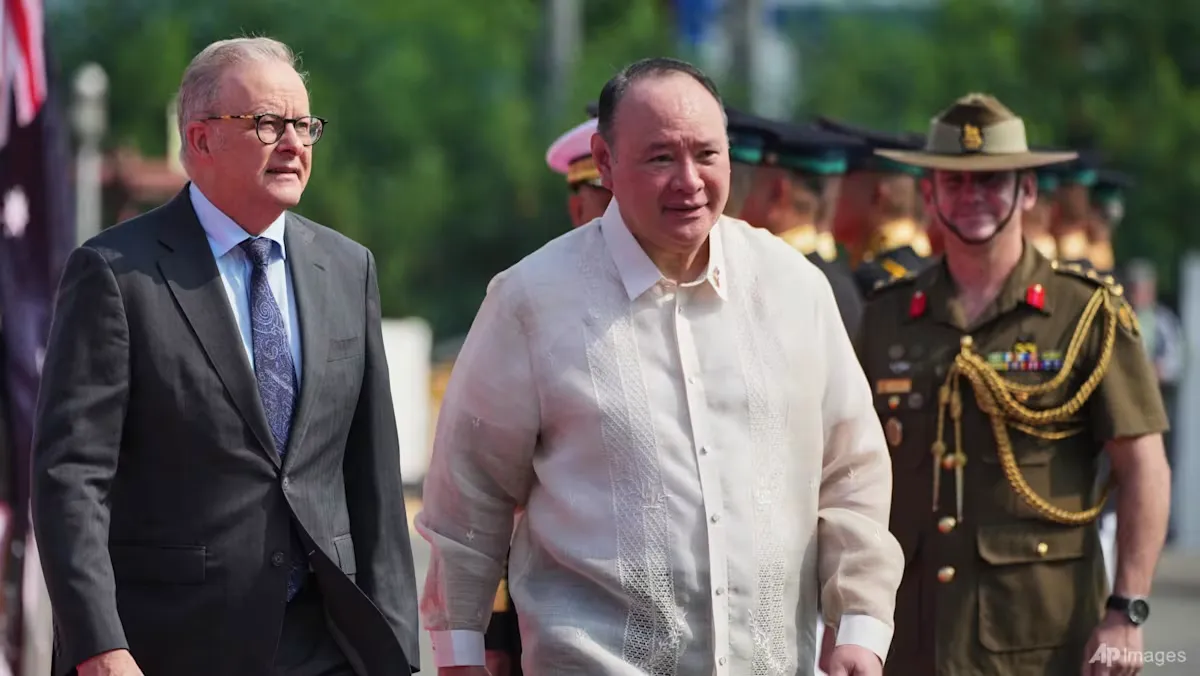 Photo: Channel News Asia
Key points
Australia and the Philippines signed an updated defence pact on 15 November to fast-track military cooperation and bolster deterrence in the South China Sea.
Australia and the Philippines signed an updated defence pact on 15 November in Manila, aiming to fast-track military cooperation and bolster deterrence in a region marked by China's growing military presence. The agreement was signed on the sidelines of the 49th Association of Southeast Asian Nations (ASEAN) summit, with Australian Prime Minister Anthony Albanese in attendance. Philippine Defence Secretary Gilberto Teodoro Jr welcomed Albanese to the ceremony.
The pact updates a decades-old memorandum and covers enhanced maritime activities, information-sharing, and defence infrastructure development. Teodoro told reporters after the ceremony that the agreement makes the forces 'faster, speedier' and streamlines the coordination process. He said it will 'bolster our credible deterrent posture in areas where we have jurisdiction,' referring to contested areas of the South China Sea.
What the pact covers
The agreement also allows Philippine forces to better familiarise themselves with Australian equipment and weaponry, streamlining processes for joint training. Australia and the Philippines have had a visiting forces agreement since 2012, allowing troops to train on each other's territory. The new pact builds on that foundation, adding intelligence sharing, coastguard operations, and joint training exercises.
Australian Defence Minister Richard Marles said in a statement that the pact would 'deepen practical cooperation between our defence forces and create new opportunities to work together in support of regional security.' The statement outlined enhanced maritime activities, information-sharing, and defence infrastructure development as key elements. Marles had said at an ASEAN defence chiefs' summit last month that China's military build-up was creating a 'condition of pressure' in Southeast Asia.
Albanese said the pact 'isn't aimed at any one country' but supports the sovereignty of every country and the importance of freedom of navigation. He noted that the majority of Australian trade goes through the South China Sea and that one in four Australian jobs depend on trade. The prime minister made the remarks during a press conference with travelling Australian media.
Reaction and context
The signing came as ASEAN leaders gathered in Manila for the summit, where a long-awaited code of conduct with China on the South China Sea is unlikely to materialise. Talks have dragged on for more than 20 years, and a 2023 deadline to finalise the accord within three years fell in 2026. Philippine Department of Foreign Affairs Secretary Maria Theresa Lazaro said on Saturday that 80 percent of the document is finished, but salient points remain.
The Philippines, Vietnam, Malaysia, Brunei and Indonesia have overlapping territorial claims in the South China Sea. Beijing claims nearly the entire waterway despite a 2016 international ruling that its position has no legal basis. Tensions between Manila and Beijing have escalated since Philippine President Ferdinand Marcos Jr took office in 2022, with the China Coast Guard repeatedly deploying water cannon against Philippine vessels.
Hunter Marston, South-East Asia program director at the Lowy Institute, said Australia and the Philippines already had robust defence ties, with Australia boosting its activities as the United States scaled down some military exercises. He noted that Australia has been providing more underwater and surface vessel unmanned aquatic vehicles to enhance Philippine coastguard abilities. The agreement locks in that strong security cooperation.
The pact was signed as Albanese arrived in Manila for the ASEAN summit, where he also held a meeting with Vietnam's Prime Minister Lê Minh Hung on Sunday. He is due to meet Philippine President Ferdinand 'Bongbong' Marcos Jr on Monday. Albanese also endorsed a historic meeting due later this week between US President Donald Trump, Chinese President Xi Jinping and Russian President Vladimir Putin.
Albanese said he would focus on de-escalating conflicts, including in private meetings with Trump, as wars in Ukraine and the Middle East continue to drive inflation worldwide. He said dialogue is a good thing and the coming days will be really important. The prime minister also stopped for lunch at a Jollibee franchise in Manila, part of his visit to the Philippines.
Frequently asked questions
What does the Australia-Philippines defence pact cover?
The pact covers enhanced maritime activities, information-sharing, and defence infrastructure development. It also includes intelligence sharing, coastguard operations, and joint training exercises, allowing Philippine forces to familiarise themselves with Australian equipment.
When was the defence pact signed?
The pact was signed on the sidelines of the 49th ASEAN summit in Manila. Australian Prime Minister Anthony Albanese attended the signing ceremony.
Why is the pact significant?
The pact updates a decades-old memorandum and aims to bolster deterrence in the South China Sea, where China claims nearly the entire waterway. It strengthens defence cooperation between Australia and the Philippines, a key US ally in the region.