Dusky shark Bukangi returns to Busan canal after rescue
A 3.5-metre female dusky shark nicknamed Bukangi returned to a Busan canal on 22 October 2026, hours after workers guided it to sea, prompting a fresh rescue attempt the same morning.
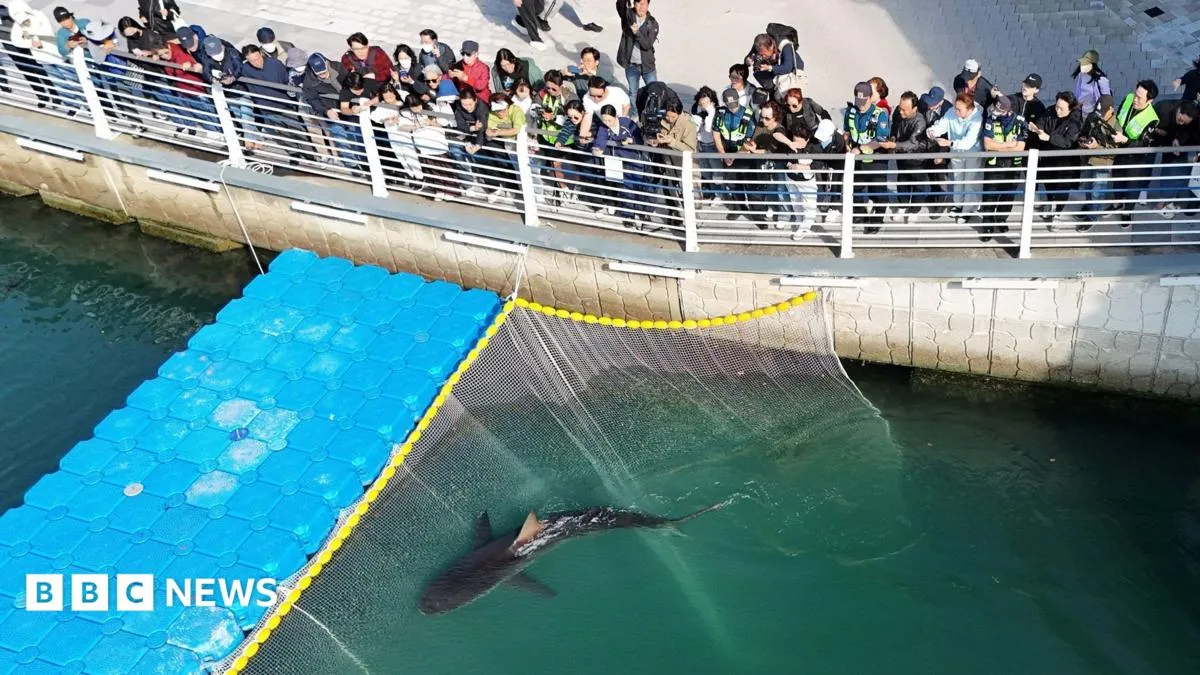 Photo: BBC News
Key points
A famed dusky shark returned to a Busan canal hours after workers guided it to sea, prompting a fresh rescue attempt on Thursday morning.
A famed 3.5-metre female dusky shark nicknamed Bukangi returned to a Busan canal on 22 October 2026, hours after workers guided it to sea, authorities said. The shark had been stuck in the artificial waterway in the south-eastern port city for a month after being first spotted on 18 September. A fresh attempt to guide the shark back to the sea began on Thursday morning, an oceans ministry official said.
The shark's return matters because it undid what authorities described as a successful operation on Wednesday, and because the animal's presence has become a major event for Busan. Officials initially planned to wait for the shark to leave on its own but shifted to a more proactive approach over concerns about its well-being, since it appeared injured and was not eating. Environmental groups link the shark's appearance to warming seas pushing warm-water fish northwards.
Why the shark came to the canal
Environmental groups and experts point to warming seas as the reason a tropical species turned up in a Busan canal. Rising temperatures push warm-water fish northwards, with subtropical sharks following in pursuit, environmental groups said. The shark might have been drawn to the canal by unusually warm waters and plenty of fish, and experts say Busan may host more sharks in the future as the sea gets warmer each year. The fisheries institute recorded 46 large sharks off the east coast in the first half of this year, nearly four times as many as a year earlier, which it attributed to warmer seas and more of the fish that sharks feed on.
The shark's popularity has grown with each failed attempt. More than 1.6 million visitors have visited the park in Busan to catch a glimpse of the shark since it was first spotted on 18 September. The affection has become an industry, with a commemorative soju, a baseball mascot in a shark cape and an honorary city ambassadorship, and nearby shops reporting a surge in sales. Busan Mayor Chun Jae-soo thanked the shark for generating publicity he said would otherwise have cost 'trillions'. South Korea's president, Lee Jae Myung, visited the canal in mid-October.
The Wednesday operation used nets fixed to floating pontoons to guide the shark gradually towards open water. Rescue workers took more than eight hours in a livestreamed effort to guide the three-metre-long shark with a net towards a harbour. Hundreds of fans cheered and waved goodbye, unaware the shark would still be in the canal the next day. The shark dived beneath a net and returned to the canal overnight, authorities said, having apparently broken through a barrier installed by authorities.
How the rescue attempt worked
An oceans ministry official said where the shark ended up after the escape. "The shark is now between the outer net and an inner net installed 30 to 40 metres ... further inside the canal," the official said. On Thursday morning, authorities raised the outer net to allow the shark to move from the canal, a fresh attempt that was under way, officials said. The shark's exact condition after the overnight return was not detailed by officials.
Before Wednesday's effort, authorities had twice tried and failed to steer the shark back to sea, using water jets and then nets. Each failure came as the shark amassed a huge following. Officials first opted to wait for the shark to leave on its own but took a more proactive approach amid growing concerns for its well-being, since it appeared injured, was not eating, and faced the risk of being further weakened by falling water temperatures. Another operation to relocate the shark has been scheduled for Thursday.
A fresh attempt to free the shark was under way on Thursday morning, officials said, with authorities raising the outer net to allow it to move from the canal. The relocation effort follows the failed Wednesday operation and two earlier attempts before it. The shark's fate after the Thursday attempt was not yet known, and officials have not said what they will do if the animal returns to the canal again.
Frequently asked questions
Why did the shark return to the canal?
Workers used nets fixed to floating pontoons on Wednesday to guide the shark towards open water, but it dived beneath a net and returned to the canal overnight, authorities said. Before Wednesday, authorities had twice tried and failed to steer it back to sea using water jets and then nets.
How many people have visited to see the shark?
More than 1.6 million visitors have visited the Busan canal to catch a glimpse of the shark since it was first spotted on 18 September. The affection has become an industry, with a commemorative soju, a baseball mascot in a shark cape and an honorary city ambassadorship.
Why was the shark in the canal?
Environmental groups link the shark's appearance to warming seas, saying rising temperatures push warm-water fish northwards, with subtropical sharks following in pursuit. The shark might have been drawn by unusually warm waters and plenty of fish. The fisheries institute recorded 46 large sharks off the east coast in the first half of this year, nearly four times as many as a year earlier.