China's economy grows 4.5% in third quarter as exports lead
China's economy grew 4.5% in the third quarter of 2026, the National Bureau of Statistics said on 19 October, beating a 4.4% forecast as AI-driven exports offset weak domestic demand.
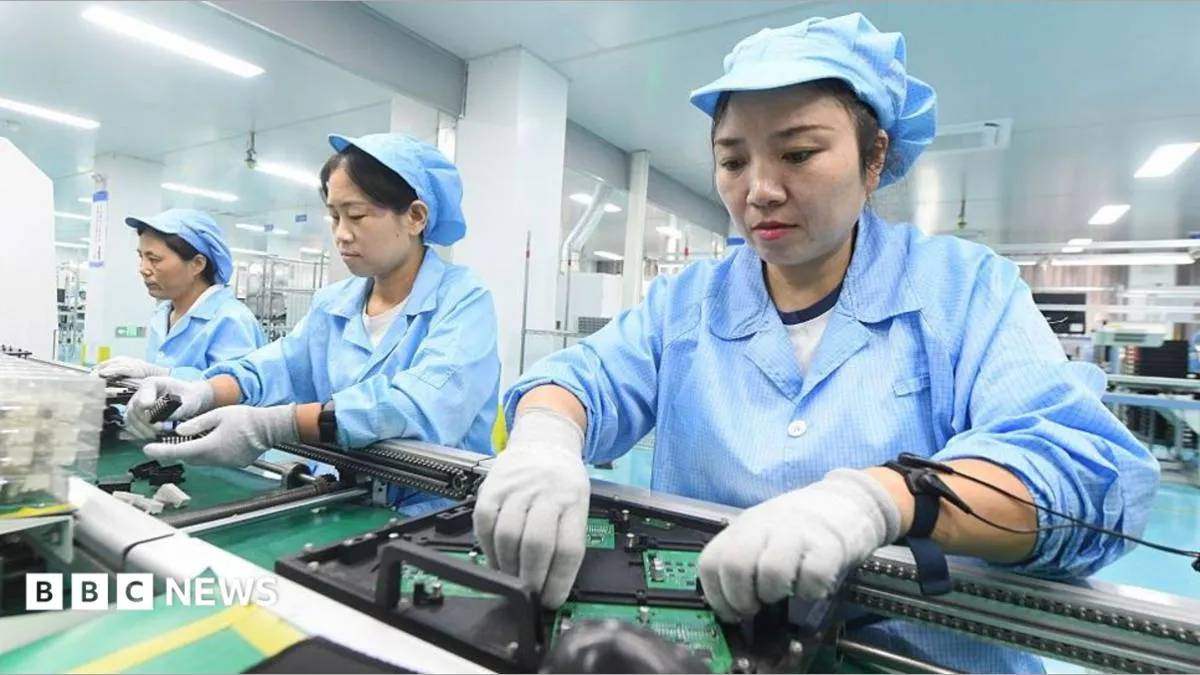 Photo: BBC News
Key points
China's economy grew 4.5% in the third quarter of 2026, up from 4.3% in the prior quarter, driven by exports.
China's economy grew 4.5% in the third quarter of 2026, the National Bureau of Statistics said on 19 October, beating a median forecast of 4.4% by economists surveyed by Bloomberg and rising from 4.3% in the April-to-June period. Growth in the first nine months reached 4.6%, within the government's annual target of 4.5% to 5%.
The rebound matters because it eases pressure on policymakers to roll out aggressive stimulus to hit the annual goal. The National Bureau of Statistics said the economy "sustained steady development against pressure" and showed "momentum with new growth drivers and improving structure". The reading sits at the bottom end of Beijing's target range, giving policymakers room to address economic challenges, according to official Chinese data cited.
Why the rebound matters
Xing Zhaopeng, senior China strategist at Australia & New Zealand Banking Group, said bigger fiscal spending helped both fixed asset investment and retail sales, but added that the recovery remains unsolid because the fiscal outlook is not stable. He said the question will be how much fiscal expansion can do in the future, and that his team still sees a downside risk to 2027.
Exports are the main engine of the rebound. China's trade surplus widened more than expected in September as exports surged, keeping the country on track to surpass last year's record surplus of $1.2 trillion. Global demand for computer chips and components used to build artificial intelligence data centres has cushioned the impact of sluggish domestic consumption.
The mechanism runs through factory shipments: Chinese businesses have leaned heavily on exports as a prolonged property slump, weak wage growth and high youth unemployment have weighed on consumer spending at home. Oxford Economics researcher Sheana Yue said manufacturing and high-tech exports have boosted China's growth despite weak investment and domestic spending, and that there are still no signs the property slump will end soon.
Exports carry the load
Domestic demand remains weak. Fixed-asset investment declined 7.2% in the first nine months, dropping at the same pace as in the January-to-August period, while infrastructure investment shrank 4.2%. Property investment fell 20.6% in the first nine months, official data showed. Retail sales grew 1.1% in September, improving from 0.4% in August and marking the quickest growth since March.
Industrial output expanded 5.5% in September, accelerating from 5.2% growth in August and marking the fastest growth in six months. On a quarterly basis, the economy expanded 1.2% in the third quarter, surpassing expectations for a 1.1% rise and accelerating from 0.9% in April-June, according to the National Bureau of Statistics data.
Trade tensions cloud the outlook. Talks this month between European Union trade chief Maros Sefcovic and Chinese counterpart Wang Wentao ended with an agreement to limit exports of Chinese hybrid vehicles to Europe. Higher energy prices and "protracted uncertainty and structural headwinds" led the International Monetary Fund to slightly downgrade its projection for China's annual growth this year to 4.5 percent.
Domestic demand still lags
The International Monetary Fund's Asia and Pacific department director, Krishna Srinivasan, said the long-awaited rebalancing of the Chinese economy towards domestic consumption has yet to materialise. IMF officials gathering in Bangkok described Beijing's recent support measures as "limited". Guo Shan of Hutong Research said exports seem to be the only outperformer and that Beijing will need to work faster to deploy funds to hit the growth target.
Beijing has expanded support for home buyers, unveiled measures to steer cheaper credit into infrastructure and technology, and allocated 550 billion yuan in unused government debt quotas to ease local governments' financial strain. Policymakers refrained from releasing large-scale stimulus, as strong goods exports aided by a global AI-fuelled tech boom should help the country reach its annual growth target. The next scheduled milestone is the annual growth figure for the full year.
Frequently asked questions
How much did China's economy grow in the third quarter?
China's economy grew 4.5% year-on-year in the third quarter of 2026, according to National Bureau of Statistics data released on 19 October. That beat a median forecast of 4.4% and improved on 4.3% growth in the April-to-June period.
What is driving China's growth?
Exports, particularly of AI-related products such as computers, semiconductors and data centre equipment, are the main driver. China's trade surplus is on track to surpass last year's record $1.2 trillion, while domestic demand remains weak.
Is China on track to meet its annual growth target?
Growth in the first nine months of 2026 reached 4.6%, within the government's annual target of 4.5% to 5%. The International Monetary Fund slightly downgraded its projection for China's full-year growth to 4.5%.