COP31 opens in Turkey with electrification goal and ocean focus
Representatives from nearly 200 countries gather in Antalya on 9 November for two weeks of climate talks centered on electrifying a third of the global economy by 2035.
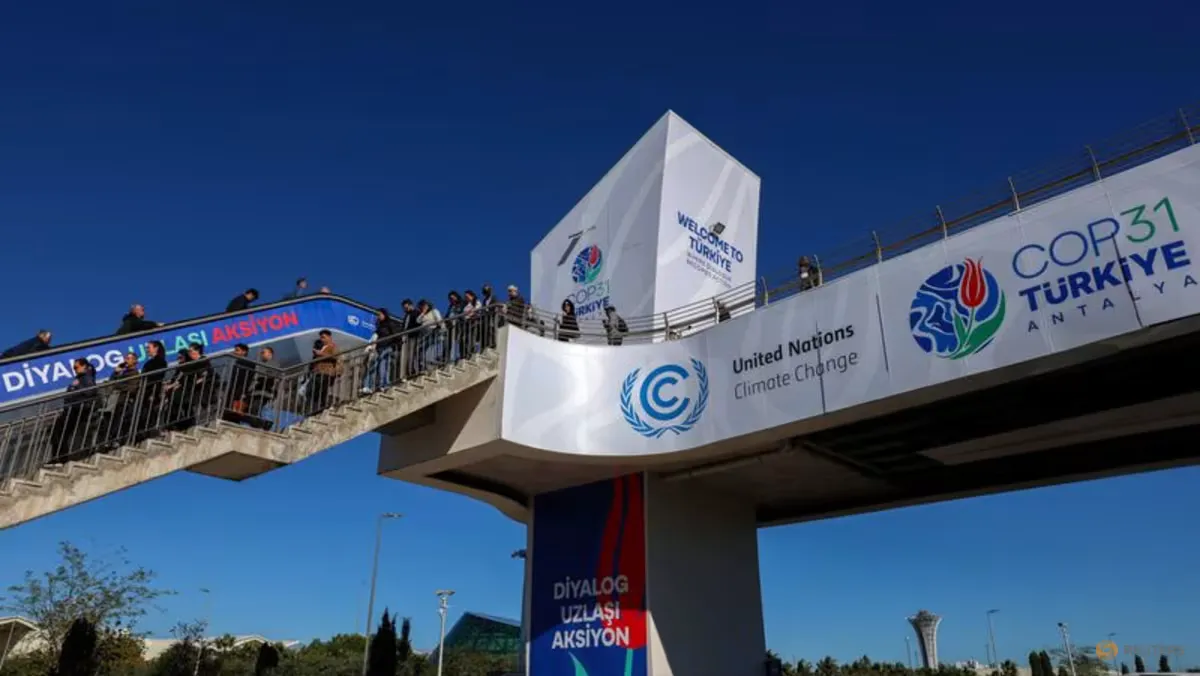 Photo: Channel News Asia
Key points
COP31 opened in Antalya, Turkey, on 9 November with nearly 200 countries negotiating an electrification pledge and ocean action.
Representatives from nearly 200 countries gathered on Türkiye's Mediterranean coast on Monday for two weeks of climate talks, as war-driven energy security fears, surging AI power demand and US disengagement put new pressure on the fight against global warming. The US war with Iran has nations scrambling for oil cargoes and firing up coal plants; the rapid rollout of AI is pumping up power demand; and the world's top historic greenhouse gas emitter is shunning climate cooperation for the second year running.
All that has created a challenging backdrop destined to complicate efforts by COP31 host Türkiye to land a strong deal, according to observers. "It's hard to be optimistic," said John Holdren, a professor of environmental policy at Harvard University. Türkiye's COP31 presidency has centered this year's UN-sponsored summit on a goal to electrify more than a third of the global economy by 2035, up from around a fifth today. It is asking nations to sign onto a pledge supporting that target.
Electrification pledge
Theoretically, such a goal could help reduce planet-warming emissions by speeding the global shift away from fossil fuel-powered vehicles, furnaces, boilers, cookstoves, and other greenhouse gas-emitting equipment. But climate advocates have criticised the pledge because it does not require that the additional electricity come from low-carbon sources. This has set up an early fight over whether electrification alone should count as climate progress.
A coalition of countries, including South Pacific island nations most vulnerable to sea level rise, are pushing more generally for a clearer global roadmap away from fossil fuels – a perennially controversial topic at climate summits. Many oil- and gas-producing nations, including Saudi Arabia, argue that fossil fuels can still form a substantial part of the global energy mix in a climate-friendly world, provided they are paired with technologies that reduce or capture emissions.
Pressure is mounting for faster action on climate change. A report by the United Nations Environment Programme published in October said the world is already set to overshoot 1.5°C of warming above pre-industrial times, the threshold set at the 2015 Paris climate summit. 2026 also stood out with a series of extreme heatwaves across Western Europe and a glacier collapse in Nepal that caused a catastrophic flood that killed more than 1,450 people, with thousands still missing.
War and AI pressures
"This year has proven to be one of the years with the highest casualties by the climate-induced disasters," said Manjeet Dal, an adviser to the Least Developed Country bloc and south Asia director of Climate Analytics. The Iran war, now in its ninth month, severely disrupted Middle East oil shipments through the Strait of Hormuz, lifting fuel prices around the globe and leading governments to scramble for new supplies.
US President Donald Trump's administration has encouraged policies maximizing oil, gas, and coal production to address the Mideast disruptions. South Korea, India, Thailand and other Asian nations, meanwhile, have increased their reliance on coal or taken steps to boost coal-fired power generation. "A lot of people who previously might have been embarrassed to argue for continuing very high use of fossil fuel are now feeling empowered to make that case," said Holdren of Harvard.
At the same time, the deployment of renewable energy has also risen, driven by surging exports of cheap clean tech from China, cheering advocates for ambitious climate action. "The war has strengthened the case for accelerating the energy transition. The United States is something of an outlier in this regard," said Andre Correa do Lago, a Brazilian diplomat who presided over last year's COP. AI has also added a wrinkle, driving a surge in global power demand and contributing to rising emissions.
Ocean and farmers
COP31 is being pegged as the "Blue COP" for its focus on the ocean, with Turkey leading negotiations with Australia. Australian Minister for Climate Change and Energy Chris Bowen, the president of negotiations at COP31, called the ocean "nature's greatest climate regulator." Ocean-based actions can close the emissions gap by up to 35%. Marine Lecerf, head of international policy at Ocean & Climate Platform, said the ocean was first explicitly mentioned in the preamble of the Paris Agreement in 2015.
In Turkey, farmers are already adapting. Farmer Mehmet Kabak, 59, who farms 900 decares in Soke, is planting wheat and sunflower instead of cotton because they require less water. Agriculture accounts for around 5% of Turkey's economic output and consumes 79% of the country's water, almost half of which is lost because of inefficient infrastructure. Turkey's seed cotton output is expected to fall 38% year-on-year to 1.2 million metric tons in 2026, according to the Turkish statistics institute.
Frequently asked questions
What is the main goal of COP31?
Türkiye's presidency aims to electrify more than a third of the global economy by 2035, up from around a fifth today, and is asking nations to sign onto a pledge supporting that target.
Why is COP31 called the 'Blue COP'?
It focuses on ocean-based climate action, with Turkey and Australia leading negotiations. Ocean-based actions can close the emissions gap by up to 35%.
How are war and AI affecting the climate talks?
The US war with Iran has nations scrambling for oil and firing up coal plants, while AI's rapid rollout is driving up power demand. Both add pressure on efforts to land a strong deal.