Pope Leo urges Milei to protect democracy in first Argentina visit in decades
Pope Leo XIV on Sunday told President Javier Milei that authority has limits and the economy must serve people, in his first Argentina visit since 1987.
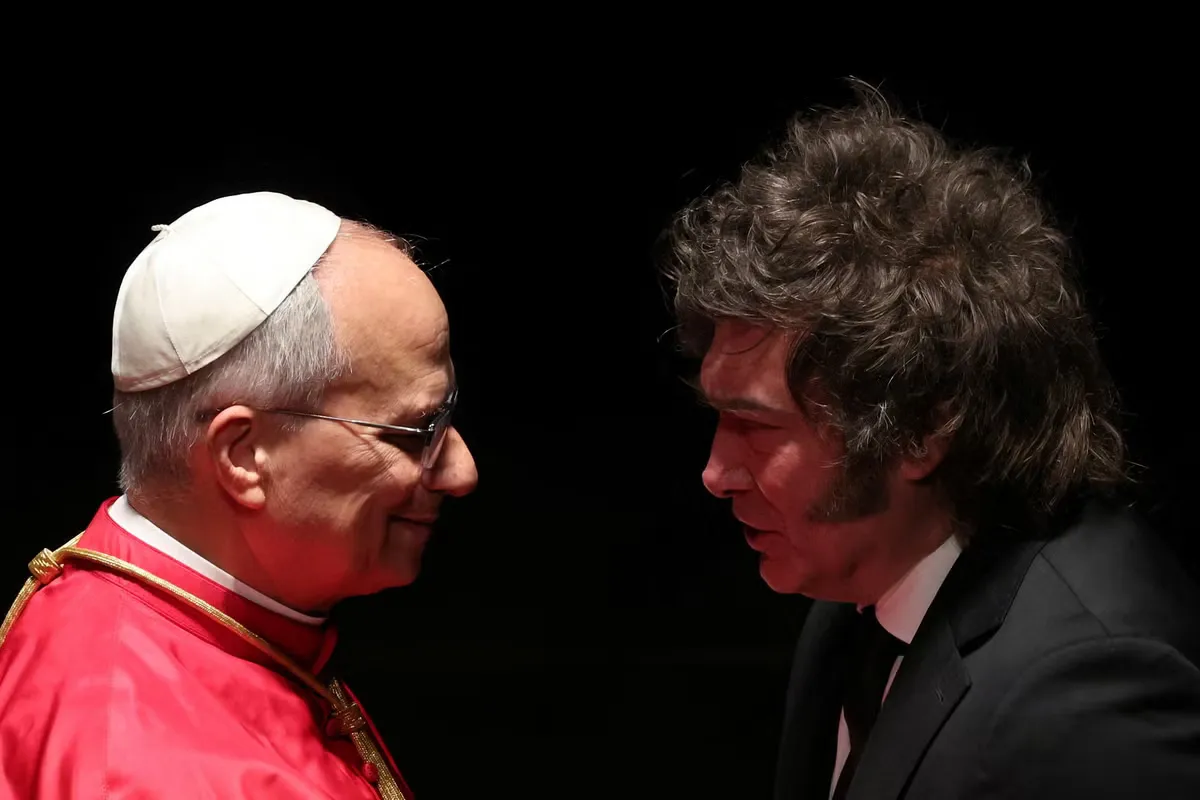 Photo: The Independent
Key points
Pope Leo XIV urged Argentina's president to protect democracy and put people before the economy during his first visit since 1987.
Pope Leo XIV arrived in Argentina on Sunday and immediately urged President Javier Milei to protect democracy, respect the limits of authority, and ensure the economy serves people, in the first papal visit to the country since 1987. Speaking at the Palacio Libertad cultural centre in Buenos Aires, the pope delivered a diplomatic but subtly strong critique of Milei's austerity measures and libertarian agenda, exposing differences over spending cuts, social justice, and artificial intelligence that the government had sought to play down.
“Those who exercise authority have a duty to act with prudence, to acknowledge the limits of the power entrusted to them, and to direct their decisions toward the good of the entire community,” Leo said. He added that democracy is “a part of Argentina's heritage that needs to be safeguarded,” reinforced by “the patient search for agreement, and through the ability to see those who think differently as fellow citizens with whom we share a common future.” The pope's address was closely watched by political observers, given Milei's alliance with US President Donald Trump.
A call for limits on power
Leo, the first US-born pope, also stressed that “the economy must be at the service of people, not people at the service of the economy.” He urged that economic stimulus measures in Argentina should not harm the most vulnerable, saying, “Efforts should be made to promote whatever creates opportunities, stimulates private initiative and ensures that economic growth also benefits those who are disadvantaged.” The pope's remarks came as Milei's austerity program has drawn criticism from the Church for heavily impacting the poorest.
Milei, a self-described anarcho-capitalist, has staked his presidency on slashing public spending to tame inflation, which has dropped from over 200 per cent to about 32 per cent annually. However, real wages remain below where they were when he took office in late 2023, and roughly 300,000 formal jobs have vanished. Retirees who say they can't afford medicine on an average monthly pension of $510 have protested outside Congress every Wednesday for more than two years, and poverty, while falling from its peak, remains a key issue.
Austerity's human cost
Milei, who once called Francis the “representative of evil on Earth,” paid homage to the late pope in welcoming Leo on Sunday. Interrupted by applause, he called Francis an “exceptional figure” and “undoubtedly the most important Argentine in history” whose teachings continue to resonate. He also struck a rare conciliatory tone, saying, “There are causes and occasions that transcend our differences,” and asked the pope to “pray for Argentina.” The president's relationship with Leo has so far been cordial, but the local Catholic Church has heavily criticised him for treating key social services solely as a budgetary constraint.
Leo's visit is by far the most politically delicate of his three-nation South American tour, and a place where he confronts the complicated legacy of Francis, who never returned home during his 12-year pontificate. The pope, who worked for decades as a missionary in Peru, is undertaking one of the most demanding foreign trips by a Catholic leader in decades, coming less than a month after undergoing lung cancer surgery. He will visit four Argentine cities through Wednesday, including a home for disabled people, a prison, and three open-air masses.
Ahead of Leo's arrival, Milei's officials had dismissed the prospect of a political clash. “There's no way the pope is coming here to comment on local politics,” Human Capital Minister Sandra Pettovello said in an interview with a Buenos Aires radio station last week. However, commentators expected domestic politicians to scrutinise his address to Milei carefully. “Any interventions by Leo, particularly on poverty, the limits of markets or confrontational political rhetoric, could be read as implicit criticism of Milei and amplify existing opposition to the government's approach,” said Nicolas Watson, a managing director at advisory firm Teneo.
A delicate political balance
The pope also revisited the topic of artificial intelligence, which Milei has advocated for, emphasizing that technological innovation must be accompanied by “ethical consciousness.” Leo has previously warned that AI could trigger perpetual conflict. The pope's address touched on Milei's ambition to transform Argentina into a major destination for data centres. Leo is conducting an intensive 50-event, three-nation trip until 17 November, having visited Uruguay before Argentina and moving on to Peru on Wednesday.
The Church has said it expects a total of seven million faithful at the various events, and the visit is seen as a litmus test of support for the Church in a country where 57.7 percent of people identified as Catholic in a recent University of Buenos Aires poll, down from around 90 percent in the 1960s. Fortunato Mallimaci, a sociologist at Argentina's Conicet research institute, said Leo's trip would offer unity and encouragement to those feeling sidelined by Milei's economic policies. The pope's next stop is Peru on Wednesday, where he will continue his tour until 17 November.
Frequently asked questions
What did Pope Leo tell Milei during his Argentina visit?
Pope Leo urged President Milei to protect democracy, respect limits on power, and ensure the economy serves people. He said authority is most authentic when exercised as service, and that growth must benefit the disadvantaged.
Why is the pope's visit to Argentina significant?
It is the first papal visit to Argentina since 1987, and the first by a pope to the homeland of Pope Francis, who never returned during his papacy. The visit is seen as a test of the Church's support in a deeply divided country.
How has Milei's austerity affected Argentina?
Annual inflation has dropped from over 200% to about 32%, but real wages are below 2023 levels, 300,000 formal jobs have vanished, and retirees protest over pensions of $510 a month. Poverty remains a key issue.