Costa Rica bars UN Palestinian rights expert Francesca Albanese
Costa Rica denied entry to UN special rapporteur Francesca Albanese on 26 November, citing an international alert, drawing criticism from UN human rights chief Volker Turk and a Supreme Court interim order.
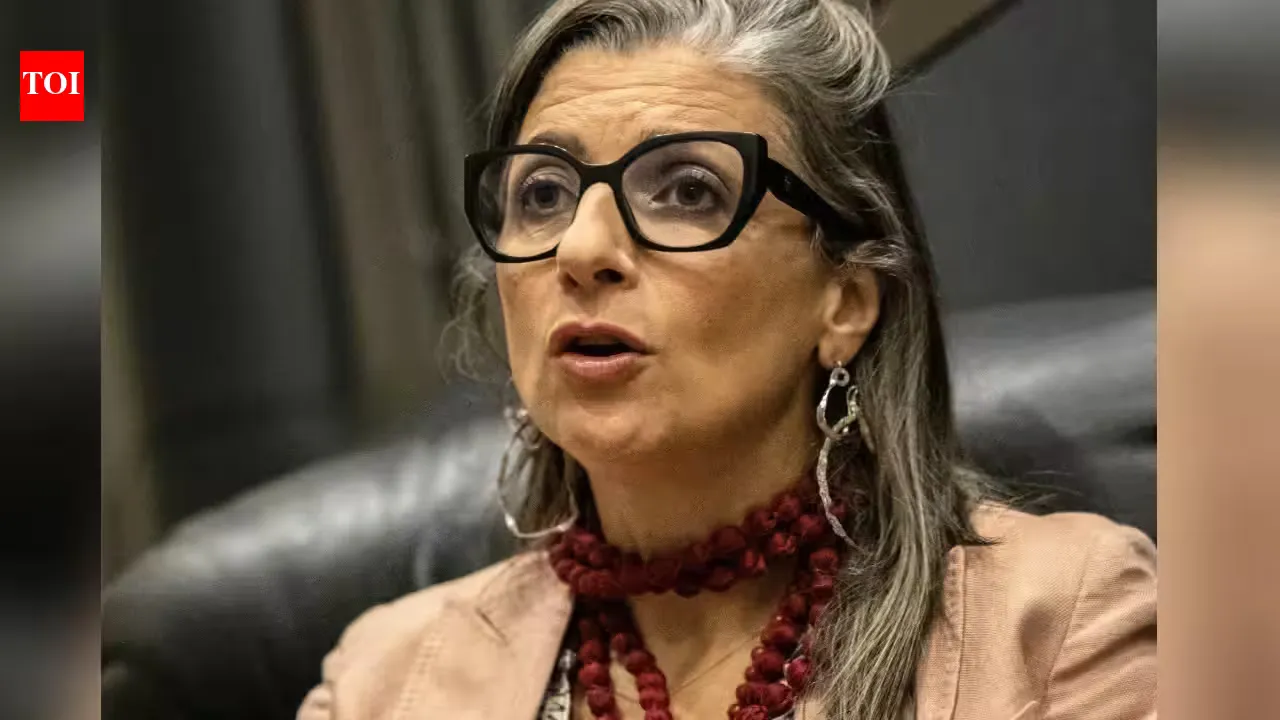 Photo: The Times of India
Key points
Costa Rica denied entry to UN special rapporteur Francesca Albanese on 26 November over an alleged international alert, drawing UN criticism and a Supreme Court interim order.
Costa Rica denied entry to Francesca Albanese, the United Nations special rapporteur on human rights in the Palestinian territories, over alleged links to terrorism. She was stopped at Juan Santamaria International Airport, which serves the capital San Jose, on 26 November. She had travelled to receive an honorary doctorate from the state-run University of Costa Rica. The UN human rights office said she was denied entry on 'claimed national security grounds'. Costa Rica's immigration authorities said she was the subject of an international 'alert' over alleged links to terrorist acts.
Albanese, an Italian lawyer and national, had arrived on 26 November to receive the honorary degree. She addressed the university ceremony virtually from the airport, rejecting the allegations. 'I am deeply indignant that the government of Costa Rica has spread false information that links me to terrorism,' she said. Her assistant, who was allowed into the country, accepted the honorary degree on her behalf. The UN human rights office said on X that the denial was on 'claimed national security grounds' and that Costa Rica's longstanding commitment to human rights was difficult to reconcile with the decision.
The airport stop and the ban
Omer Badilla, director-general of Costa Rica's immigration authority, said in a video posted on social media on 25 November that Albanese 'is the subject of an international alert over links to terrorist acts'. Israel's UN ambassador, Danny Danon, praised Costa Rica's decision in a post on X. Costa Rica's ombudsman criticised immigration authorities for 'automatically' denying her entry without assessing her case, official status or immunity as a UN rapporteur.
A habeas corpus petition was filed on Albanese's behalf before Costa Rica's Supreme Court Constitutional Chamber. The court issued an interim order allowing her to remain in the country and directed immigration authorities to explain their decision within 24 hours. A court on 27 November ordered the authorities to immediately return her passport. The constitutional chamber confirmed late on 27 November that her destination would be Mexico when it issued a second interim order, directing she be transferred to a hotel.
The legal challenge and the court orders
Albanese, speaking from the airport, rejected the allegations and warned that the government would be held accountable for linking her to terrorism. 'Defending human rights is not terrorism and the government must answer for these insinuations, as should be the case under the rule of law,' she said. In an interview with journalist Ahmed Shihab-Eldin, she said authorities had taken her passport and threatened to forcibly put her on a flight out of the country. 'I was almost forced to board the plane to be shipped back to Paris. I said no, and I opposed it... and they threatened to put me on the plane by force,' she said.
UN human rights chief Volker Turk said he was 'deeply concerned' by the move and called on Costa Rican authorities to reconsider the ban. In a post on X, the UN Human Rights office said the decision was 'difficult to reconcile with Costa Rica's longstanding commitment to human rights' and called on the authorities to reconsider urgently. Italy's Foreign Minister said the country had repeatedly asked the Costa Rican authorities to allow Albanese entry. Albanese also asked on 27 November 'what risk for public security is created by a UN human rights rapporteur whose responsibility it is to document complicity with crimes and impunity over the past four years?'
Costa Rica's former president and minister of the presidency Rodrigo Chaves criticised the court's intervention, calling it 'yet another usurpation by an increasingly arbitrary judiciary'. Albanese, appointed in 2022, has faced criticism from Israel and its allies over her statements on the war in Gaza. The United States sanctioned her in July 2025. US Secretary of State Marco Rubio accused her of conducting a 'campaign of political and economic warfare against the United States and Israel'.
The political backdrop
Costa Rica, under President Laura Fernandez, has deepened cooperation with the United States on security and moved closer to Israel. It signed a free trade agreement with Israel last year, and Fernandez, a close ally of US President Donald Trump, has pursued closer trade ties with Israel since taking office in May. Albanese criticised the free trade agreement on 27 November, saying it fuelled Israel's 'war machine', and accused the Costa Rican government of supporting what she called an Israeli apartheid regime in the Palestinian territories.
Albanese posted on X on 27 November that she was 'counting the hours till my flight tomorrow', and said 'This is where I will spend my first night in Costa Rica.' Costa Rican authorities later allowed her to spend the night at a hotel near the airport. She is expected to leave for Mexico on 28 November, while the legal challenge to the entry denial remains a point of contention. Costa Rica's Rebeca Grynspan, one of several candidates running to be UN Secretary-General when Antonio Guterres' term ends on 31 December, has topped eight of nine straw polls of UN Security Council members.
The Gaza war, triggered by Hamas' October 2023 attack on Israel, has killed more than 73,000 Palestinians, according to Gaza's Health Ministry, which is controlled by Hamas. Many of the Palestinians killed in Gaza are women and children. The 7 October 2023 attack killed 1,221 people, according to an AFP tally based on official Israeli figures. Albanese had accused Israel of genocide in Gaza and the occupied territories, and the US, a major ally of Israel, imposed sanctions on her after she criticised Washington's policy on Gaza.
Frequently asked questions
Why was Francesca Albanese denied entry to Costa Rica?
Costa Rica's immigration authorities said she was the subject of an international 'alert' over alleged links to terrorist acts and that the decision was consistent with national security measures. The UN human rights office said she was denied entry on 'claimed national security grounds'.
What did the Supreme Court do about the ban?
The Supreme Court Constitutional Chamber issued interim orders allowing her to remain in the country, directed immigration authorities to explain their decision within 24 hours, ordered the authorities to immediately return her passport, and directed she be transferred to a hotel.
When is Albanese expected to leave Costa Rica?
She is expected to leave for Mexico on 28 November, while the legal challenge to the entry denial remains a point of contention.