Delhi AQI turns severe after Diwali, 15 stations cross 400
Delhi's air quality index hit 404 on 9 November, a day after Diwali, with 15 monitoring stations recording severe pollution despite GRAP Stage III curbs.
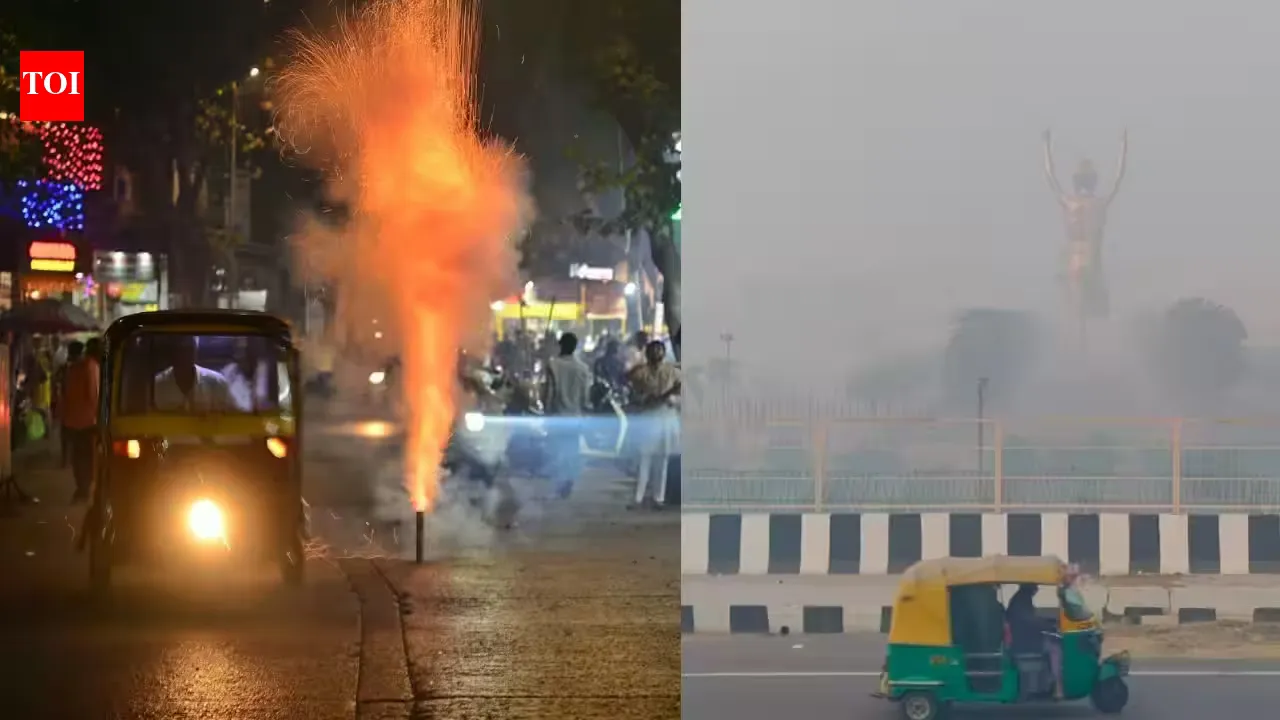 Photo: The Times of India
Key points
Delhi's air quality turned severe on 9 November, with AQI at 404 and 15 stations above 400, despite GRAP Stage III restrictions.
Delhi's air quality index (AQI) slipped into the 'severe' category on 9 November, a day after Diwali, with the citywide reading at 404, according to the Central Pollution Control Board (CPCB). At least 15 monitoring stations recorded severe pollution, with Sonia Vihar at 449 and Burari Crossing at 445 in the 7 am snapshot. The deterioration came despite the Commission for Air Quality Management (CAQM) invoking Stage III of the Graded Response Action Plan (GRAP) on 6 November, three days before the festival.
The 'severe' category, defined as an AQI between 401 and 500, triggers the strictest emergency measures under GRAP. Stage III restrictions, already in force across Delhi-NCR, include halting construction and demolition, closing stone-crushing units, and curbing older vehicles. The CAQM invoked the measures based on forecasts from the India Meteorological Department and the Indian Institute of Tropical Meteorology, which predicted worsening air quality. The action plan covers Delhi and adjoining districts of Haryana, Uttar Pradesh and Rajasthan.
Severe readings across the capital
The citywide average AQI stood at 376 on Sunday, compared with 369 on Saturday, according to CPCB data. By 10 pm on Sunday, 20 of 59 monitoring stations were in the 'severe' category, 33 in 'very poor' and six in 'poor'. The readings show a steady climb from the 'very poor' range into 'severe' territory overnight, as firecracker smoke and unfavourable weather trapped pollutants. The CPCB classifies an AQI of 301-400 as 'very poor' and 401-500 as 'severe'.
Firecracker emissions added to Delhi's pollution, with residents reporting reduced visibility and difficulty breathing. An analysis by Hindustan Times of CPCB's 15-minute data from 39 monitoring stations found average PM2.5 concentration rose from 190 micrograms per cubic metre in the 15-minute period beginning at 7.45 pm to 259 micrograms per cubic metre in the period beginning at 8 pm. India's national 24-hour PM2.5 standard is 60 micrograms per cubic metre, though the 259 figure is a 15-minute average and not directly comparable.
The Decision Support System projected that transport would account for 19 per cent of Delhi's pollution on Sunday, while stubble burning was expected to contribute 3.5 per cent. Its projection for stubble burning on Monday was 2.99 per cent. The Air Quality Early Warning System, operated by the Indian Institute of Tropical Meteorology, had forecast that Delhi's air quality could deteriorate to the 'severe' category from 9 November and remain there for the following few days, citing unfavourable weather conditions that could limit the dispersal of pollutants.
Firecrackers and stubble burning
Mumbai also experienced hazy conditions on 9 November, with a thick layer of smog blanketing Kalanagar and Bandra areas. The city's AQI stood at 170, placing it in the 'moderate' category, which is 30 per cent better than last year. Monitoring data showed Kherwadi-Bandra East at 264, Sewri at 226, Ghatkopar at 221 and Chembur at 216. In Uttar Pradesh, a thick layer of smog blanketed Lucknow as several parts of the city woke up to hazy conditions.
The Supreme Court is evaluating expert opinions on whether to order online classes if the AQI rises further, according to a report on the Delhi Pollution page. The average AQI has been categorised as 'very poor', with severe pollution levels reported in many areas. Authorities have noted that vehicular emissions significantly contribute to the region's pollution crisis. The implementation of measures, including truck-mounted water sprinklers, is part of the effort to improve air quality.
Curbs and what comes next
A third-party air-quality ranking cited by Oneindia recorded an AQI of 2,552 in Sunder Vihar and 1,713 for Delhi overall at around 2 am on 9 November. These figures were based on the US AQI system, which differs from the Indian National AQI used by the CPCB and has a standard reporting range of 0 to 500. Oneindia did not name the platform that provided the readings.
Frequently asked questions
What is the AQI in Delhi on 9 November?
Delhi's AQI stood at 404 on 9 November, placing it in the 'severe' category. At least 15 monitoring stations recorded severe pollution, with the highest reading at Sonia Vihar at 449.
Why did Delhi's air quality turn severe after Diwali?
Firecracker emissions, stubble burning, and unfavourable weather conditions contributed. PM2.5 levels rose sharply in the evening, and the Air Quality Early Warning System forecast severe conditions from 9 November.
What restrictions are in place under GRAP Stage III?
Stage III restrictions include halting construction and demolition, closing stone-crushing units, and curbing older vehicles. The CAQM invoked these measures on 6 November, and they remain in force across Delhi-NCR.