Interior ministry counts 320,000 protesters across France on Saturday
France's interior ministry estimated 320,000 people protested nationwide on 31 October 2026, with 70,000 in Paris, as police fired tear gas in Marseille, Lyon and Toulouse during a third consecutive weekend of marches.
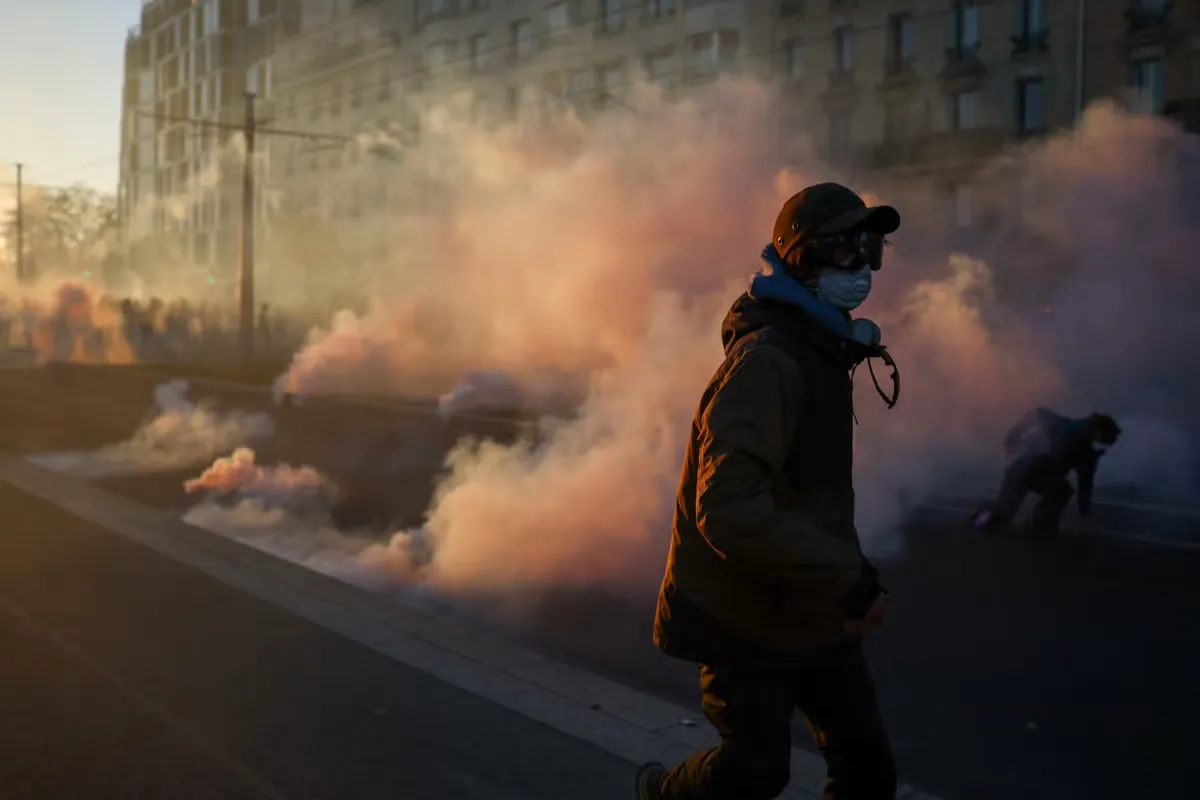 Photo: The Independent
Key points
Some 320,000 people protested across France on Saturday, the interior ministry estimated, with 70,000 in Paris and clashes in Marseille, Lyon and Toulouse.
France's interior ministry estimated that some 320,000 people protested across France on Saturday, with about 70,000 demonstrating in Paris, according to police in the capital. It was the third consecutive weekend of nationwide marches by trade unions, students and Yellow Vest activists over living costs and education. Police had made 27 arrests by 2:00pm, compared with 217 arrests a week earlier.
The turnout figure marks a decline from the two previous weekends. Authorities counted 410,000 protesters across France the previous Saturday, including 110,000 in Paris, and about 550,000 on 17 October, when rioters looted hundreds of shops. A coalition of youth organisations and unions representing high school and university students put Saturday's nationwide figure at nearly half a million, including 200,000 in Paris — roughly three times the police estimate for the capital.
Turnout fell from the previous week
Interior Minister Laurent Nuñez warned of a "very high risk" of coordinated disorder, saying Halloween would not be accepted as an excuse to wear masks or trigger street violence. An aide to Nuñez said police had prepared for street violence on a scale "comparable" to the unrest two weeks earlier, when shops were looted and public buildings set ablaze. Nuñez said authorities had detected social media calls for Halloween gatherings urging protesters to spark a "revolution."
Around 70,000 police officers and gendarmes were deployed across France. Paris police banned union and Yellow Vest marches through the city centre on Friday, ordering demonstrations onto a single route along the capital's outer boulevards, from Porte de Bagnolet to Porte de Charenton. Unions and student groups challenged the restrictions in court. France's top court banned a Halloween protest in the heart of Paris while permitting a route on the outskirts.
Tension flared at the end of marches in Paris, Marseille, Lyon and other cities, with tear gas fired at some people on the sidelines. In Paris, dozens of masked people dressed in black used hammers to pry up paving stones and hurled them at police, and at least one incendiary device was thrown at security forces. The Paris police prefecture said "a hard core of several hundred rioters" at the rear of the march attacked police with projectiles, including a Molotov cocktail.
Clashes flared in several cities
In Marseille, demonstrators clashed with police. In Lyon, people threw projectiles at police, prompting officers to fire tear gas, according to a journalist at the scene. In Toulouse, police used water cannon against an unauthorised protest that drew several thousand people, mostly young demonstrators, some of them in costume. In Paris, thousands marched through eastern Paris in costumes ranging from Spider-Man to Frankenstein, with placards reading "No need for tear gas to make our future look bleak."
The movement began last month when secondary school pupils walked out over staff shortages, deteriorating school buildings and a university admissions system seen as unfair to disadvantaged students. It has since widened into a broader challenge to President Emmanuel Macron's government, drawing in trade unions and left-wing groups opposing economic reforms. Hard-left presidential candidate Jean-Luc Mélenchon joined the Paris march, and the presidential elections are less than six months away.
Police crowd-control tactics have drawn criticism from trade unions and legal monitors after the repeated use of tear gas, water cannon and dispersion grenades. Anger mounted earlier in the month after a 15-year-old student had a hand blown off after picking up an explosive stun grenade. Nuñez confirmed that all intermediate crowd-control weapons remain authorised if officers face targeted assaults, though France previously suspended stun grenades for student rallies.
What happens next
In Paris, police barred access to Place de la République and Les Halles between 23:00 and 06:00, while unaccompanied minors face a 21:00 curfew around the Champs-Élysées. President Emmanuel Macron ordered marches kept out of central commercial districts to protect shops. Alain Di Crescenzo, president of France's chamber of commerce, said business owners were worried, telling broadcaster France Inter: "Shopkeepers can't wait for Saturday to be over."
Two French student unions called on students to blockade high schools and universities on Tuesday and Thursday, demanding that the government reform the education system and improve learning conditions. The unions said they would blockade again on Thursday before joining a demonstration on 5 November called by workers and trade unions. Similar youth-led demonstrations took place across Europe on Saturday, including in Germany, Albania, Italy and Spain.
The demonstrations come as France's economy, the eurozone's second-largest, sits on the brink of recession under pressure to rein in its debt, limiting the government's scope to appease protesters through additional spending. In Germany, the youth campaign "Gen Z regelt" called for demonstrations across roughly 30 cities, with organisers saying more than 140,000 people signed up online and Berlin police expecting about 10,000 at the Brandenburg Gate.
Student unions' blockades of high schools and universities are scheduled for Tuesday and Thursday, ahead of the demonstration on 5 November called by workers and trade unions. Police made 27 arrests by 2:00pm on Saturday against 217 a week earlier, and the interior ministry said earlier in the day that the situation remained "generally calm" with the third weekend unfolding "without any notable incidents."
Frequently asked questions
How many people protested in France on 31 October?
France's interior ministry estimated some 320,000 people protested nationwide on Saturday, including about 70,000 in Paris. A coalition of youth organisations and unions counted nearly half a million nationwide, including 200,000 in Paris.
Why did protests take place across France?
The movement began with secondary school pupils walking out over staff shortages, deteriorating school buildings and a university admissions system seen as unfair to disadvantaged students. It widened to include trade unions and left-wing groups opposing economic reforms and the rising cost of living.
What happens next in the French protests?
Two French student unions called for blockades of high schools and universities on Tuesday and Thursday, followed by a demonstration on 5 November called by workers and trade unions.