Google rolls out Gemini 4 Neon for AI Pro with frontier reasoning
Google rolls out Neon on 18 November offering Carbon quality at Flash speeds for AI Pro subscribers in the US.
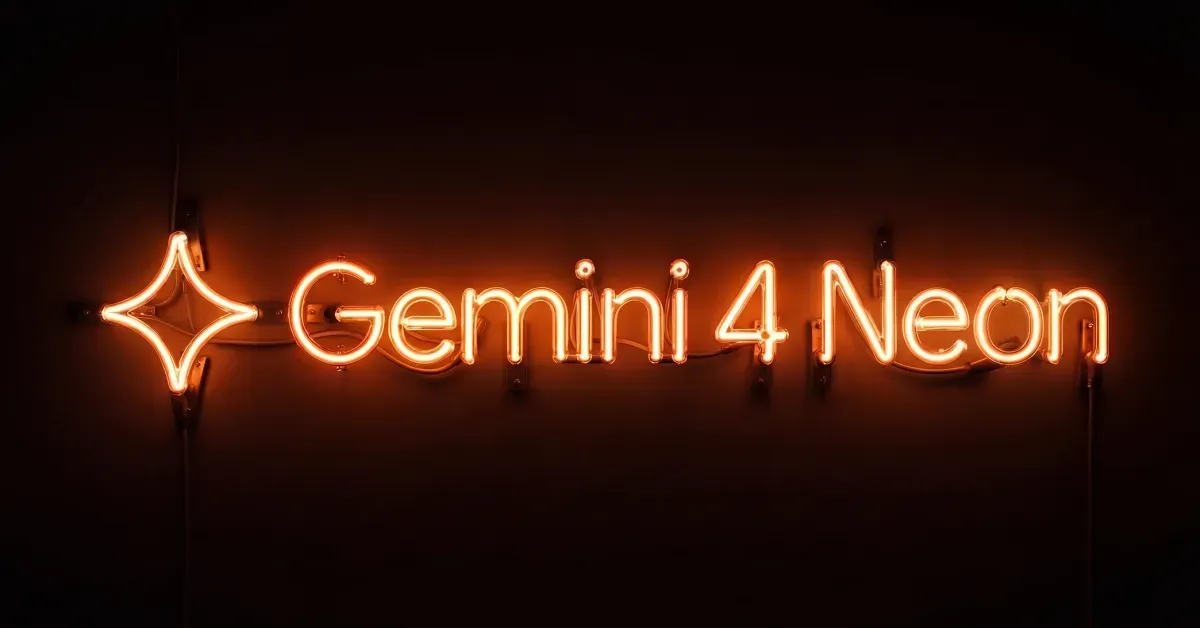 Photo: 9to5Google
Key points
Google rolled out Gemini 4 Neon on 18 November 2026 for AI Pro users at $3 per million input tokens.
Google launched Gemini 4 Neon on 18 November 2026 for AI Pro and AI Ultra subscribers. The model brings frontier-level reasoning for complex coding and analysis while delivering faster task completion. Neon is available in the Gemini app and Google Antigravity. It replaces 3.1 Pro and Argon in the model picker for paid users. The rollout targets complex software engineering and knowledge workflows.
Neon sits between Hydrogen and Carbon in the Gemini 4 family. Hydrogen handles everyday help and routine execution. Carbon tackles the most complex work and long-horizon projects. Neon balances depth and efficiency for production-grade workflows. The new model writes clearly with well-structured responses. It reads uploads like spreadsheets and PDFs more precisely and pulls details from Gmail and Docs.
Positioning in the lineup
Independent evaluations rank Neon third overall on the Artificial Analysis Intelligence Index with a score of 61 at its xhigh thinking level. The model ranks second on steerability on the Agent Arena Index. Neon also ranks first on both the Legal Research Bench and Tax Agent Bench. It shows strong wins across finance and accounting benchmarks on Surge AI.
Neon scores 73.5 percent on Chartography for reading dense professional charts. The model performs on par with leading models on Agents’ Last Exam v1.1. It achieves first overall on Zapier’s AutomationBench and Andon Labs’ Vending-Bench 2. Neon debuts second globally with a score of 1336 on Arena’s Agent Arena Index across more than 4200 real-world agent sessions.
On scientific and mathematical reasoning Neon is best in class on Terminal-Bench Science. The model scores 84.0 percent on RiemannBench and 71.3 percent on HLE-Diamond. Neon ranks first overall on the Artificial Analysis Coding Agent Index with a score of 58.6. It also scores 65.2 percent on Terminal-Bench 4.1 and 46.2 percent on FrontierCode 2.0 at its default high setting.
Performance benchmarks shown
Neon is engineered for long-running agent workflows and sustains performance through complex tool-heavy tasks. It cuts down on redundant file reads and shares progress as it works. In Google Antigravity Neon wrote a first-person WebGL2 freeride ski simulator from scratch on real Mont Blanc and Chamonix elevation terrain. The project combined over 10200 lines of custom shaders with dynamic carved tracks and spatial Web Audio.
Using /swarm in Google Antigravity Gemini 4 Neon pulled archival photos to recreate Alan Turing’s 1936 study at King’s College Cambridge in interactive 3D. It built a photorealistic 3D lab bench visualizing model names with elemental accuracy. Neon also turned a single image into a 100000-cell Google Sheet using over 500000 live spreadsheet formulas to run edge detection and map 3D depth.
Neon is priced at $3 per million input tokens and $15 per million output tokens. This is twice as expensive as Hydrogen but 25 percent cheaper than the standard pricing for Carbon and Argon. Argon and Carbon cost $2 per million input and $10 per million output until 30 November. After the promotional pricing Carbon and Argon will be $4 per million input and $20 per million output.
Pricing and billing details
Cached input tokens for Neon cost $0.15 per million representing a 95 percent discount on repeated context. The model has the same 1 million token context window as Hydrogen with four thinking levels. Neon is available via the Gemini API in Google AI Studio and for paid AI Pro subscribers in the Gemini app. Batch and Flex processing tiers may lower Neon’s cost for asynchronous pipelines.
Koray Kavukcuoglu SVP of Google DeepMind said Neon brings frontier-level intelligence with fast end-to-end task completion. Neon ranks second on the Vals Index and lands on the Pareto frontier. Internal Google Antigravity testing shows Neon has the lowest fabrication rate yet. Neon also shows strong wins across categories on Surge AI for spreadsheet modeling and complex constraint following.
Frequently asked questions
What is the cost of Gemini 4 Neon per million tokens?
Neon is priced at $3 per million input tokens and $15 per million output tokens. Cached input tokens cost $0.15 per million which is a 95 percent discount.
When does Neon launch and who can access it?
Neon launched on 18 November 2026 for AI Pro and AI Ultra subscribers. It is available in the Gemini app and Google Antigravity.
How does Neon compare to Carbon on benchmarks?
Neon ranks third on the Artificial Analysis Intelligence Index with a score of 61 compared to Carbon. Neon also leads on Zapier’s AutomationBench and ranks first on the Artificial Analysis Coding Agent Index.