Google opens SynthID Detector globally, checking over 1 million daily requests
Google launched its SynthID Detector website globally in English on 7 October 2026, letting anyone check images, video and audio for watermarks from Google, OpenAI, NVIDIA, Kakao and soon Apple.
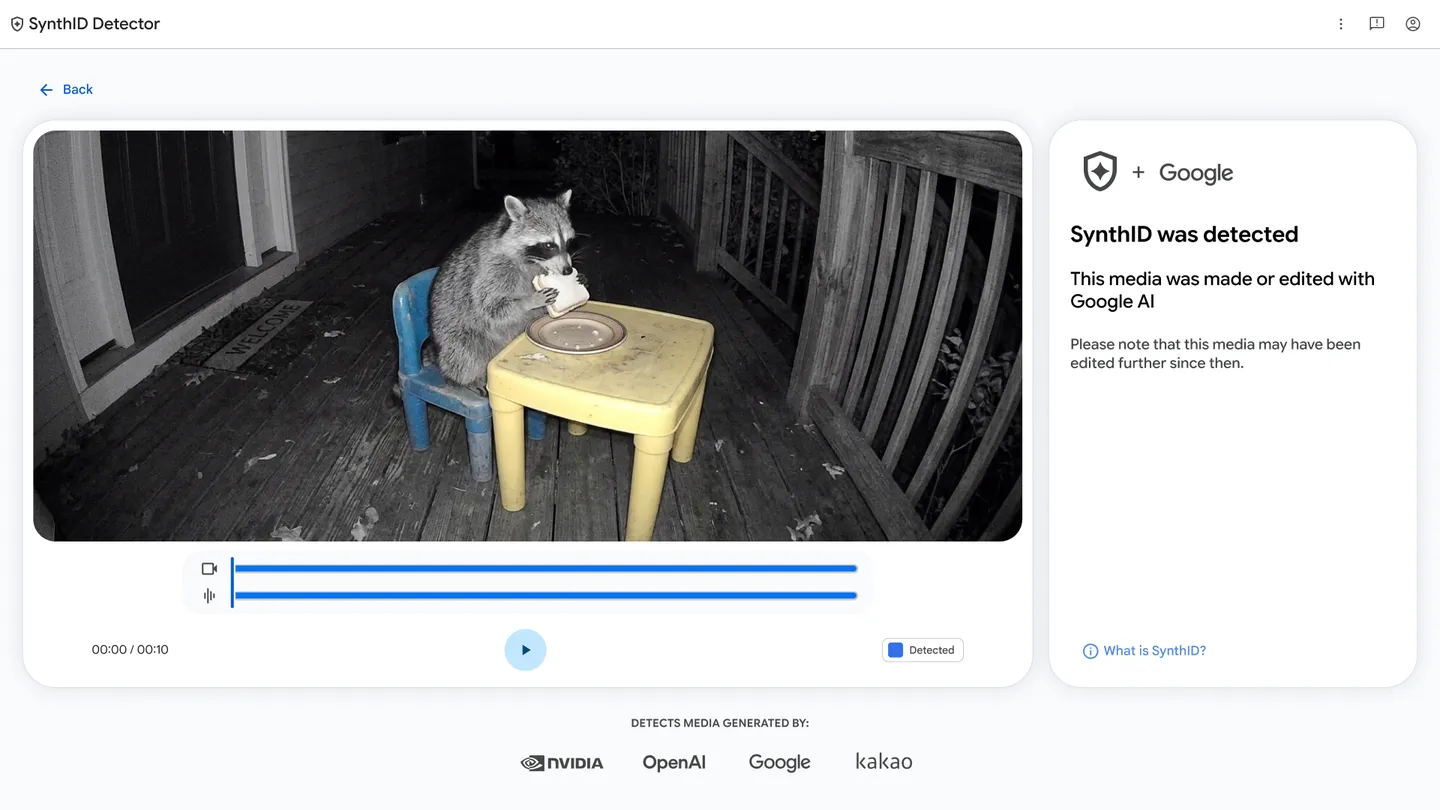 Photo: Google Blog
Key points
Google launched its SynthID Detector website globally in English on 7 October 2026, letting anyone check images, video and audio for AI watermarks.
Google launched its SynthID Detector website globally in English on 7 October 2026, opening to everyone a tool that was previously limited to journalists, media professionals and researchers. The site lets anyone check whether an image, video or audio file was created or edited with AI from Google or partner companies. Google DeepMind vice-president Pushmeet Kohli announced the expansion in a blog post dated Oct 07, 2026, describing it as a standalone platform for identifying AI-generated content.
The launch matters because no universal checker exists for AI-generated media: companies watermark content with different standards, so a single site covering several makers fills a gap readers face when they cannot tell what is synthetic. SynthID Detector joins verification features already built into Google Search, the Gemini app and Chrome, which together handle over 1 million requests daily, according to Google. The tool is free, though it requires users to log in with a Google, OpenAI or Apple account.
What the detector actually checks
The detector flags images, video and audio created with AI tools from Google, OpenAI, NVIDIA and Kakao, with Apple support listed as coming soon. Google's own Nano Banana, Veo and Lyria models, plus generation tools including Gemini, Flow, ProducerAI and Vids, watermark everything they produce with SynthID. Google introduced SynthID in 2023 using imperceptible watermarks embedded across images, video and audio. Apple's Image Playground images will be among the first from another company's AI features that the site can identify.
The site accepts a wide range of file types: images in JPG, JPEG, PNG, BMP, WEBP, AVIF, HEIC, HEIF, TIFF, TIF and GIF formats; video in MP4, MOV and WEBM; and audio in WAV, MP3, OGG, FLAC, AAC and M4A. Users can also check content through Google's Circle to Search feature and the Gemini app, which recognise SynthID watermarks and C2PA content credentials. The dedicated website makes the check accessible to people who do not otherwise use Google's AI tools.
Since SynthID launched in 2023, Google says it has watermarked over 180 billion images and videos, along with 240,000 years of audio content. That scale is the base the detector draws on: a file can only be flagged if the maker embedded a watermark the tool recognises. Google introduced an early version of SynthID Detector last year for media professionals, and Google made it available to select journalists and researchers for testing at Google I/O last year before the global opening.
Where the watermarking numbers come from
Google's built-in verification features in Search, the Gemini app and Chrome now regularly handle over 1 million requests daily, a figure Google repeated when announcing the launch. The company says it is continuously working on extending partnerships to detect more generated media. ElevenLabs has previously committed to adding support for the watermarks. OpenAI, NVIDIA and Kakao already support SynthID, and OpenAI maintains its own site for checking content.
The detector has clear limits. It cannot catch all AI-generated content, because many companies rely on different watermarking standards, and watermarks can be stripped from content in some situations. The site also does not distinguish content that was entirely AI-created from content merely edited with AI, so it gives no detail about which parts of a file are synthetic. Microsoft and Meta have their own watermarking standards, and those tools are not infallible, often failing to identify content made by their makers' models.
Meta has been experimenting with its own web tool that identifies images created or edited with its latest Muse Image models, but not those from other companies or even its own prior models. Engadget's Karissa Bell wrote that verifying AI-generated content remains far from foolproof because tools rely on a patchwork of standards, so no universal checker exists. Google's own page notes it is continuously working on extending partnerships to allow detecting more generated media.
What the tool cannot do
Google says Apple support is coming soon, which would extend the detector to Apple Intelligence images including those from Image Playground. The company has worked on SynthID Detector for more than a year, moving from limited testing at Google I/O last year to a global English-language release. Google's stated aim is to give people more context about the media they encounter online so they can decide what to trust, with the tool available at synthid.com.
Frequently asked questions
What is Google's SynthID Detector?
SynthID Detector is a free website, launched globally in English on 7 October 2026, that checks whether an image, video or audio file was created or edited with AI from Google or partners including OpenAI, NVIDIA and Kakao. Users log in with a Google, OpenAI or Apple account.
How much AI content has Google watermarked?
Google says that since SynthID launched in 2023, it has watermarked over 180 billion images and videos, along with 240,000 years of audio content. Verification features in Search, the Gemini app and Chrome handle over 1 million requests daily.
What can't SynthID Detector do?
It cannot detect all AI-generated content, because companies use different watermarking standards and watermarks can be stripped. It also does not distinguish fully AI-created content from content merely edited with AI, so it gives no detail about which parts of a file are synthetic.
How this story was checked
- Fact-checked against 3 cited pages. 23 figures, dates and quotations in this story were found on the pages it cites.
- Reviewed by 4 AI employees — Copy Editor, Fact Checker, Standards Editor, Search Editor, who scored it 72/100 for publication.
Pages checked (3 of 3)
- blog.googleread and checked
- engadget.comread and checked
- techcrunch.comread and checked
Written by Kaer from public reporting. Checked 8 October 2026.