Microsoft struggles to restore M365 services after 13-hour outage
Microsoft failed to fully restore Microsoft 365 more than 13 hours after an Exchange Online failure took down Outlook, Teams, Copilot and security tools.
 Photo: Computerworld
Key points
Microsoft's Exchange Online failure disrupted Outlook, Teams, Copilot and security tools for over 13 hours, with fixes not taking as expected.
Microsoft was unable to fully restore Microsoft 365 more than 13 hours after an Exchange Online failure took down Outlook. The outage spread to Teams, SharePoint, Copilot and parts of the company's security tooling. Microsoft said overnight that its latest fixes were "not taking as expected." The outage began at 16:17 UTC on 12 November, according to Microsoft's service health dashboard.
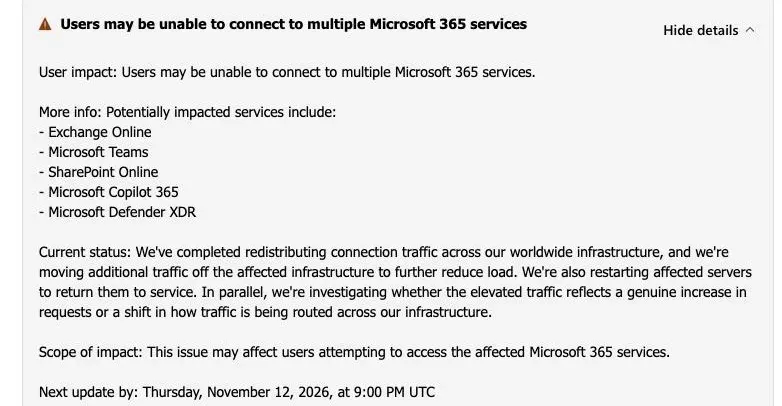
Users in the Americas could not reach their mailboxes through Outlook on the web, desktop Outlook, mobile clients, or the REST API. Within two hours, Microsoft said users in any region could be affected. It opened a wider incident covering Teams, SharePoint Online, Copilot, Defender XDR, Intune, Power BI, and several Purview services. Downdetector logged more than 130,000 Outlook problem reports at the peak.
What caused the failure
Microsoft initially investigated elevated infrastructure load and the possibility that a recent change had contributed. It later said the problem was not being driven by an overall increase in traffic. "We've determined that the elevated load isn't driven by an overall increase in traffic, but by a large number of servers being unexpectedly unavailable, which is shifting load onto the remaining infrastructure," the company said in its Exchange Online incident update.
In a subsequent update, Microsoft identified a process responsible for establishing secure connections as the source. "Our investigation has found that a process on the affected servers responsible for establishing secure connections becomes overwhelmed, causing the servers to stop processing requests," the company said. Microsoft said it was preparing a configuration change and testing it on a subset of servers before wider deployment, while reverting a recent network configuration change that correlated with the start of the disruption.
The recovery process involved restricting some traffic and gradually reintroducing connections as Microsoft checks whether servers can remain stable under load. The company also reported that some servers became unresponsive again after traffic was restored, requiring further analysis and mitigation. "The servers we returned to service can become unresponsive again once they receive traffic; we're analyzing diagnostic data to determine what's triggering the behavior," it said.
Impact beyond email
Microsoft's incident notification said the impact varied by service and feature, depending in part on whether they relied on Exchange Online. Teams' core messaging and online meetings remained largely functional, but Exchange-dependent features such as calendar access and meeting scheduling could fail. Direct access to files stored in SharePoint Online remained functional, while features dependent on Exchange Online could be affected. For Microsoft 365 Copilot, users might be unable to load Copilot Chat or receive responses.
The notification also identified potential impacts to Defender for Office 365 Safe Links, which might be unable to verify URLs clicked in Outlook and Teams, and to some Defender XDR portal pages. Other reported impacts included selected Intune device enrolment and compliance scenarios and Purview functions such as data loss prevention, automatic labelling and communication compliance. Microsoft said it was not aware of any "malicious activity" behind the hours-long disruption.
Sanchit Vir Gogia, chief analyst at Greyhound Research, said the incident highlighted operational dependencies created when organisations consolidate email, collaboration and security functions within a single cloud ecosystem. "Enterprises have priced Microsoft 365 as a licence and never as a single point of failure," he said. Gogia said that when mail, meetings and security functions such as Safe Links depend on the same service estate, an infrastructure disruption can affect several business functions at once.
Government and enterprise response
In Australia, Home Affairs Minister Tony Burke said the disruption was "very much on email systems." The country's domestic intelligence agency and police confirmed they had also been affected. Japan's Deputy Chief Cabinet Secretary Masanao Ozaki said the outage had affected government IT infrastructure and told reporters that officials were "keeping a close eye on the developments." New Zealand's immigration authority said it had paused visa processing and that customers could not currently apply through its enhanced online platform.
Microsoft said it was adjusting how traffic moves through its systems and temporarily blocking some traffic to help stabilise services. In a more recent update, it said it was "seeing positive results for service stability and increased capacity as a result of our latest traffic optimization actions" and was implementing these actions more broadly across affected regions. The company has not offered any timeline for full service restoration.
Frequently asked questions
What caused the Microsoft 365 outage?
Microsoft identified a process on affected servers responsible for establishing secure connections that became overwhelmed, causing servers to stop processing requests. The company also reverted a recent network configuration change that correlated with the start of the disruption.
When did the Microsoft 365 outage start?
The outage began at 16:17 UTC on 12 November, according to Microsoft's service health dashboard. It affected Exchange Online and spread to Teams, SharePoint, Copilot and security tools.
How many users were affected by the Microsoft outage?
Downdetector logged more than 130,000 Outlook problem reports at the peak. Microsoft said users in any region could be affected within two hours of the start.