F5 patches critical NGINX HTTP/2 flaws affecting 225 million websites
F5 released emergency patches for ten bugs in NGINX on 18 November including two critical vulnerabilities affecting 225 million websites.
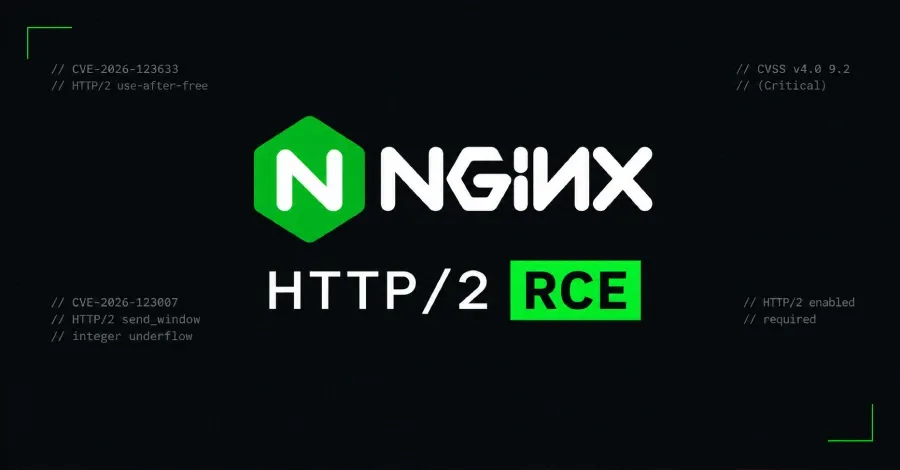 Photo: The Hacker News
Key points
F5 issued emergency patches for ten NGINX vulnerabilities including two critical remote code execution flaws that allow unauthenticated attackers to execute commands on servers.
F5 released emergency patches on 18 November for ten bugs in the open source NGINX web server software. The company addressed critical remote code execution flaws that let attackers hijack NGINX servers with HTTP/2 enabled to steal sensitive data and disrupt services affecting millions of websites running the software globally. Researchers from multiple security firms including Wiz and Xint independently uncovered these issues using artificial intelligence tools to scan the code for weaknesses that had persisted undetected for years. Security teams now face urgent pressure to locate vulnerable versions and configurations before attackers can find and exploit these vulnerabilities across the internet infrastructure. The disclosure adds to a recent wave of critical bugs found in foundational technologies like PHP and Apache that are accelerating vulnerability discovery faster than existing infrastructure was designed to absorb. F5 maintains the open source version of NGINX which powers about a third of all websites globally handling HTTPS requests and routing incoming traffic to the right application or API. Organizations using this software must update to version 1.31.9 as soon as possible to mitigate the risk of unauthenticated remote code execution attacks on their systems.
Emergency patches released 18 November
Two of the vulnerabilities are especially serious as they allow a remote attacker to execute code on the NGINX server without authentication. These two flaws tracked as CVE-2026-123633 and CVE-2026-123007 both received a critical 9.2 CVSS rating based on their severity and potential impact on affected systems. CVE-2026-123007 affects versions dating back to NGINX 1.9.5 in 2015 meaning the flaw has been hiding in the code for at least ten years before discovery. Both vulnerabilities require HTTP/2 to be enabled on the affected NGINX server for the attack to succeed against the targeted infrastructure. All of the security shops listed earlier independently found at least one of these two common vulnerabilities and exposures and reported them to F5 for coordinated disclosure and patching efforts.
Wiz and fellow researchers Nir Ohfeld said in a Wednesday blog about the two bugs that both vulnerabilities are memory safety issues in how NGINX handles HTTP/2 traffic. In CVE-2026-123633 a connection memory memory is freed while a request still needs it creating a use after free condition that attackers can exploit. In CVE-2026-123007 incorrect flow control accounting leads to an invalid memory copy that can be manipulated to execute arbitrary code on the server without authentication or user interaction. Rapid7 team also published a proof of concept to demonstrate leveraging CVE-2026-123007 for unauthenticated remote code execution against a vulnerable linux amd64 Docker image running nginx version 1.31.8 to show how the flaw works in practice.
Researchers from Wiz Ikotas Labs Metnir Rapid7 and Xint worked independently to find these critical NGINX bugs uncovered by artificial intelligence. Tomer Schwartz Wiz chief technology officer of exposure management and AppSec helped find the bug and said the wave of AI discovered flaws point to a new reality for internet security. He said that AI has changed not only which vulnerabilities can be found but how quickly longstanding risks can become real threats for organizations worldwide. Security teams must treat every internet connected system as potentially vulnerable given the speed at which these tools can identify weaknesses in software code that humans might miss during manual review.
How the vulnerabilities work
F5 spokesperson said at this time we have found no evidence of active exploitation of any of these vulnerabilities in the wild. The company continues to monitor closely and will share updates via myF5 as they learn more about how these vulnerabilities might be targeted by malicious actors online. Despite the lack of active exploitation security experts warn that the public disclosure of these flaws means attackers can now study the details and develop their own exploits quickly. The situation highlights the race between defenders applying patches and attackers trying to exploit vulnerabilities before updates reach all affected systems across the internet.
Xint found three other NGINX flaws plus a separate vulnerability in the Linux kernel that can be chained with any of the five NGINX vulnerabilities to gain root privileges on the host system. The research team dubbed the six bugs nginx2root to reflect the ability to escalate from the web server to full control over the underlying operating system. This kernel vulnerability was introduced in the 4.15 kernel in the Stream Control Transmission Protocol subsystem and allows local privilege escalation when combined with the NGINX flaws. A kernel patch for this is not yet available leaving organizations to rely on other mitigations until the fix becomes available.
On many Linux distributions the SCTP module is installed by default and the kernel loads it automatically the first time a program opens an SCTP socket. Whether SCTP is reachable on a given host still depends on the kernel the available modules and the container restrictions that are in place. Where it is reachable the attacker can take over the host kernel. Since all containers on the host share that kernel this gives the attacker control of the host and every container on it running in that environment. This means compromising one container could lead to full host takeover in cloud environments.
Chaining with kernel bug
Xint recommends updating to NGINX 1.31.9 which was just released and to block the SCTP module on hosts that do not need it until a kernel fix is available. The company also published videos demonstrating attacks using CVE-2026-123007 to execute commands as the NGINX worker inside a container and then using the kernel vulnerability to escalate to root on the host system. These attacks work on AWS Microsoft Azure Google Cloud Platform and bare metal servers making them particularly concerning for cloud based deployments and infrastructure.
Schwartz told us that AI is also accelerating vulnerability discovery faster than existing infrastructure was designed to absorb and security teams still face heavy manual work after a vendor ships a fix. He noted that security teams must locate vulnerable versions and configurations test patches deploy interim mitigations such as disabling HTTP/2 and coordinate all of these rollouts across their environments. This process creates a nightmare for security teams vulnerability managers and system administrators who are drowning in the near daily deluge of common vulnerabilities and exposures to patch before attackers find them.
AI-powered offensive security firm Xint said while preparing for ZeroDay Cloud 2026 a Xint researcher found CVE-2026-123007 and a few days later a fully automated Xint scan found the other four without human guidance. This automation shows how artificial intelligence can identify multiple related flaws in rapid succession without requiring constant human oversight during the research process. The company said this approach allows researchers to find weaknesses more quickly and report them to vendors for patching before they can be exploited maliciously in the wild. Schwartz believes continued collaboration between security researchers maintainers and defenders is crucial to absorb the speed and scale of these disclosures as they become more frequent.
Tomer Schwartz said in the long run AI powered vulnerability research will harden foundational software but in the meantime it is a nightmare for security teams managing these threats. He believes that continued collaboration between security researchers maintainers and defenders is crucial to absorb the speed and scale of these disclosures as the industry adapts to this new reality of AI accelerated discovery. The situation highlights the need for better tools to help organizations identify vulnerable versions quickly and apply fixes efficiently without disrupting their services or operations. Schwartz emphasized that treating every internet connected system as potentially vulnerable is essential given how quickly these tools can find weaknesses in code that has been there for years. Schw
Frequently asked questions
What versions of NGINX are affected by the critical HTTP/2 flaws
CVE-2026-123007 affects versions dating back to NGINX 1.9.5 in 2015. Both vulnerabilities require HTTP/2 to be enabled on the affected NGINX server. F5 recommends updating to version 1.31.9 as soon as possible.
Has there been any active exploitation of these vulnerabilities in the wild
A F5 spokesperson told The Register at this time they have found no evidence of active exploitation of any of these vulnerabilities in the wild. The company continues to monitor closely and will share updates via myF5 as they learn more.
What mitigation steps should organizations take beyond patching
F5 recommends updating to NGINX 1.31.9 and blocking the SCTP module on hosts that do not need it until a kernel fix is available. Security teams may also need to disable HTTP/2 as an interim mitigation.