North Korea test-fires two submarine-launched cruise missiles into East Sea
North Korea test-fired two types of submarine-launched strategic cruise missiles into the East Sea on Wednesday, state media KCNA reported on Thursday, calling the launches a Navy training exercise.
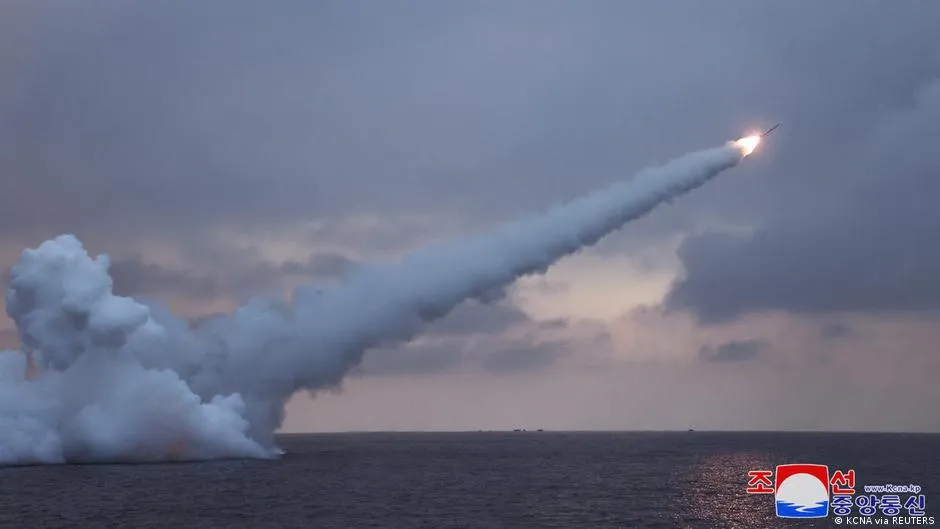 Photo: Deutsche Welle
Key points
North Korea test-fired two types of submarine-launched strategic cruise missiles into the East Sea on Wednesday, state media KCNA reported on Thursday.
North Korea test-fired two types of submarine-launched strategic cruise missiles into the East Sea on Wednesday, the Korean Central News Agency (KCNA) reported on Thursday. The state media report said the launches had no adverse impact on the security of neighbouring countries. The tests extend a run of weapons demonstrations this month by both Koreas, including hypersonic missile tests.
The launches were meant to examine the current mobilized posture of the underwater combat systems and to serve as a Navy training exercise, KCNA said. The agency described the weapons as strategic, which implies an intent to arm them with nuclear warheads. The report said the tests showed the high reliability, trustworthiness and ability of the war deterrents of the Democratic People's Republic of Korea.
What the launches were for
North Korea has carried out several missile launches from submarines in recent years, although its sea-based launch capabilities remain unclear. Pyongyang is not yet believed to have launched a modern missile submarine in full operation, and questions remain over whether a heavily sanctioned country has the resources and technology to build such systems.
Cruise missiles tend to be jet-propelled and fly at a lower altitude than more sophisticated ballistic missiles, which makes them harder to detect and intercept. Photos released by KCNA showed one missile blasting vertically out of the sea trailed by a thick plume of smoke, and another appeared to show a projectile erupting from the water at a 45-degree angle. Other images showed a missile flying horizontally over the sea.
How the missiles flew
Proven submarine-launched ballistic missile capability would take North Korea's arsenal to a new level, allowing deployment far beyond the Korean peninsula and a second-strike capability in the event of an attack. North Korea has claimed progress in recent months in building a nuclear-powered submarine it intends to arm with nuclear-capable weapons, as leader Kim Jong Un turns his focus to strengthening the navy after a decade of expanding the ballistic missile programme.
What remains unconfirmed
The South Korean military did not immediately comment on the tests. North Korea has pushed ahead with modern missile submarines and both ballistic and cruise missile developments, and has carried out multiple ballistic missile tests in October, most recently on Monday. The two Koreas have engaged in a tit-for-tat series of missile tests this month, with both sides test-firing hypersonic weapons.
Where the tensions began
North Korea said the tests were aimed at assessing the readiness of its underwater combat systems, improving the Navy's ability to carry out strategic missions and demonstrating the reliability of its nuclear deterrent. Kim Jong Un has halted all diplomacy and cooperation with South Korea and described it as a permanent enemy. He has rebuffed U.S. President Donald Trump's calls to revive diplomacy, which broke down in 2019.
Trump, alluding to a trip to Asia next month, said earlier in the week that he might meet Kim during the trip. North Korea has put a halt to all coordination with South Korea and removed all references to reunification with the South from its constitution. The two Koreas remain technically at war, as the Korean conflict ended in 1953 with a truce rather than a peace treaty.
Frequently asked questions
What did North Korea test-fire?
North Korea test-fired two types of submarine-launched strategic cruise missiles into the East Sea on Wednesday, state media KCNA reported on Thursday, calling the launches a Navy training exercise.
Why do the launches matter?
Cruise missiles fly at a lower altitude than ballistic missiles, making them harder to detect and intercept. Proven submarine-launched capability would give North Korea a second-strike ability and deployment far beyond the Korean peninsula.