Solomon Islands and Australia sign security treaty with AU$740 million pledge
Matthew Wale and Anthony Albanese signed a treaty in Canberra on 25 November making Australia the Solomon Islands' primary security partner, with AU$740 million over a decade.
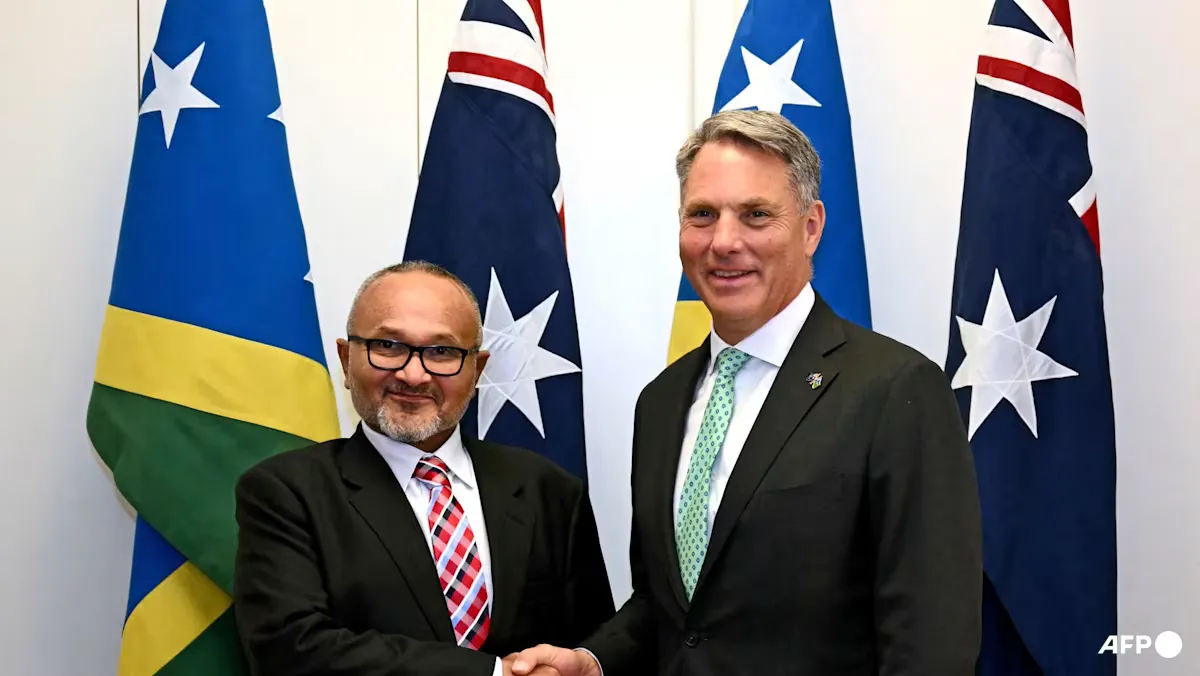 Photo: Channel NewsAsia
Key points
Australia and Solomon Islands signed a treaty on 25 November making Australia the primary security partner, with AU$740 million over a decade and no foreign military base allowed.
Solomon Islands Prime Minister Matthew Wale and Australian Prime Minister Anthony Albanese signed a sweeping security treaty in Canberra on 25 November. It names Australia the island nation's "primary security partner" and commits AU$740 million (US$490 million) over a decade. Wale travelled to the Australian capital with 15 ministers for talks spanning security, infrastructure, education and health.
The treaty affirms the "sovereign decision" by the Solomon Islands that there will be no foreign military or security base on its soil. It also states that the country's "sensitive" infrastructure will "remain free from militarisation, foreign interference and unauthorised access", a clause the treaty text shows spans airports, ports, energy and telecommunications. The clause will not be applied retrospectively.
What the treaty commits
Under the treaty, the Solomon Islands must consult Australia before making deals with other countries on critical infrastructure or security cooperation outside members of the Pacific Islands Forum, the regional bloc. Australia's funding splits into AU$670 million in grants and AU$70 million in concessional loans over a decade, aimed at education, health, policing, resources and climate resilience, and the treaty also covers road and bridge construction.
Wale said the decision to approve the treaty was taken by his entire cabinet, many of whom had travelled to Canberra for the signing. "Solomon Islands has been for a number of years a source of uncertainty and doubt in the region," he told journalists alongside Albanese. "Those days are gone." Albanese said Australia was "proud to be the Solomon Islands' main security partner".
The agreement reverses the direction set by a security pact the Solomon Islands struck with China in April 2022. Mihai Sora, director of research at the Lowy Institute think tank and a former Australian diplomat in the Solomons, said that pact had "caught Canberra unprepared for a new era of intense geopolitical competition with China in Australia's immediate neighbourhood".
Why the 2022 pact mattered
Sora said the 2022 pact "made real the prospect of a persistent Chinese military presence some 1,600 kilometres off the coast of Australia". He called it "the catalyst for the past four years of frenetic Australian diplomacy in the region in an attempt to stem further strategic damage". Australia has since struck security alliances or wide-ranging treaties with other Pacific island countries, including Papua New Guinea, Vanuatu and Fiji, Sora said.
Honiara has informed Beijing that the 2022 agreement will expire when its five-year anniversary arrives in April, and Chinese police are expected to vacate the Solomon Islands next year, with Australia plugging any gaps. Asked about reports he had ended the secretive security pact with Beijing, Wale said discussions with China were "ongoing" and that he could not comment further due to a non-disclosure clause in the deal.
China's foreign ministry said on 24 November that its ties with Pacific nations were not matters of "geopolitical contests". Wale, a long-time critic of the 2022 China deal, had appeared to soften his stance in recent years, leading a delegation to Beijing in 2025 where he praised China's economic development.
Opposition and the China question
Manasseh Sogavare, now the Solomon Islands opposition party leader, criticised the "fast-tracking" of the treaty with Australia on 24 November while the status of the China security arrangement remained "unclear". Reports on 25 November said the Solomon Islands' pact with Beijing had been scrapped, though Wale declined to comment on the status of the deal, citing a non-disclosure agreement.
Solomons officials said on 25 November that parliament will return in January to approve significant reforms including a pledge for free education, with the Australian funds in place by January. A third of Solomon Islands children do not start school, and only 19% finish because of the cost, a baseline the education funding is intended to shift.
The Solomon Islands' internal politics remain unstable. Wale adjourned parliament indefinitely in September after staring down a no-confidence vote, and he was forced to leave a Pacific leaders' summit in Palau to stop an attempt to bring down his new coalition government on the eve of a visit by the US Deputy Secretary of State. Parliament returns in January to consider the reforms tied to the treaty, including the free education pledge, with the Australian funding scheduled to be in place by then.
Frequently asked questions
What did Australia and Solomon Islands sign?
They signed a treaty on 25 November in Canberra naming Australia the Solomon Islands' "primary security partner", affirming no foreign military base will be on its soil and committing AU$740 million (US$490 million) over a decade.
How much is Australia committing to Solomon Islands?
AU$740 million (US$490 million) over a decade: AU$670 million in grants and AU$70 million in concessional loans for education, health, policing, resources and climate resilience.
What happens to the Solomon Islands' security pact with China?
Honiara has informed Beijing the 2022 agreement will expire at its five-year anniversary in April, and Chinese police are expected to vacate next year. Wale said discussions with China were "ongoing".