SpaceX catches Starship in world first after 22-hour orbit
SpaceX's Starship returned from orbit on 14 November and was caught by mechanical arms at its Texas launch pad, a world first for the spacecraft.
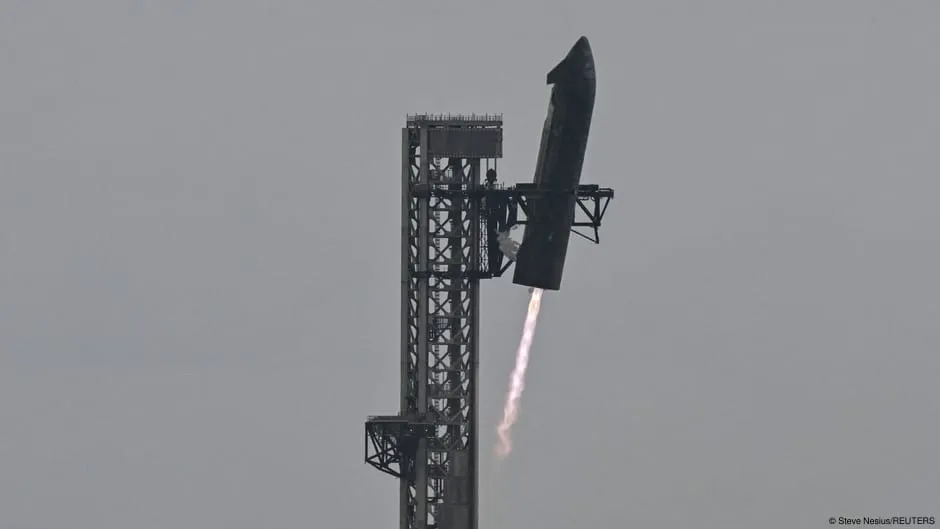 Photo: DW
Key points
SpaceX's Starship returned from orbit on 14 November and was caught by mechanical arms at its Texas launch pad, a world first.
SpaceX's Starship spacecraft returned from its longest-yet flight in orbit on Saturday and was caught by the mechanical 'chopstick arms' above Launch Pad 2 in Texas, a world first for the vessel. The uncrewed Starship 42 launched on Friday and orbited Earth 14 times for over 22 hours, deploying 26 Starlink satellites before its descent.
First capture from orbit
The capture marked the first recovery of the rocket system's centerpiece vessel in SpaceX's decade-long effort to develop a fully reusable rocket. 'Can you believe it?' SpaceX commentator Dan Huot shouted. 'Look at her! Baby, she's back!' It was the 15th test flight of the world's biggest and most powerful rocket system, a 407-foot (124-meter) behemoth that generates some 16 million pounds of thrust at liftoff from 33 first-stage Raptor engines. The spacecraft completed 14 laps around Earth, outshining the previous mission's one to two laps.
NASA welcomed the news. The US space agency is paying billions of dollars for Starship to land Artemis astronauts on the moon later this decade and help build a permanent lunar base. 'It was almost magic,' NASA Administrator Jared Isaacman wrote on X. 'Making more believers by the day ... one step closer to (emojis of the moon and the U.S. flag).'
SpaceX also intended to capture the bottom part of the rocket, known as the Super Heavy booster, but the lower stage recovery was aborted, and it exploded over the Gulf of Mexico shortly after launch on Friday. SpaceX's Kate Tice said its engines stopped firing too soon. The booster's guidance system sensed it was not in the correct position and initiated the self-destruction protocol. Engineers are still investigating the cause.
Booster failure explained
The booster loss did not change SpaceX's timeline. 'This booster loss does not change our timeline to reach high volume, fully reusable Starship flights,' Musk said in a posting on X. He called the problem a 'slight underperformance of engines,' adding that 'these early ships and boosters are already outdated by improved designs in production or on the test stand.'
SpaceX had successfully recovered the first-stage boosters used in three previous launches. The Starship upper stage, however, had previously ended in planned ocean splashdowns. Saturday's catch demonstrated the full reusability of Starship, crucial for rapid and low-cost recycling, SpaceX officials said. The spacecraft faced blistering heat as its orbital speed of some 27,000 kilometres per hour slowed to a supersonic freefall. It then reignited three engines to flip itself vertical and steer toward the launch tower, where the arms clasped onto it as it hovered in place. SpaceX reported that everything on the spacecraft, including its vital heat shield, appeared to work well.
Next steps for Starship
SpaceX expects to begin launching Starships from Florida's Kennedy Space Center within the next few months. That is the starting point for NASA's next Artemis mission, which will skip the moon and remain in orbit around Earth for lunar lander practice. NASA is targeting as soon as 2028 for Artemis IV, humanity's first moon landing since the Apollo era.
SpaceX plans to begin orbital fueling tests in the next several Super Heavy-Starship flights. But the rocket's development has taken longer than initially expected and the space agency is now hedging its bets, saying it's open to using Blue Origin's Blue Moon Mark 2 lander depending on which spacecraft is ready in time.
Frequently asked questions
What happened during SpaceX's Starship test flight?
Starship 42 launched from Texas on Friday, orbited Earth 14 times for over 22 hours, deployed 26 Starlink satellites, and was caught by mechanical arms at the launch pad on Saturday. The Super Heavy booster failed to return and exploded over the Gulf of Mexico.
Why is the Starship capture a world first?
It was the first recovery of a Starship from orbit. Previous test flights ended with planned ocean splashdowns. The capture demonstrates the full reusability of the rocket, a key step toward lowering launch costs.
What went wrong with the Super Heavy booster?
The booster's engines stopped firing too soon on its way back down. Its guidance system sensed it was not in the correct position and initiated self-destruction. Engineers are still investigating the cause.