Trump asks Supreme Court to set aside 20,000 California ballots
On 2 November, the Trump administration asked the Supreme Court to force California to segregate mail ballots from 20,000 alleged noncitizens before Tuesday's midterm election.
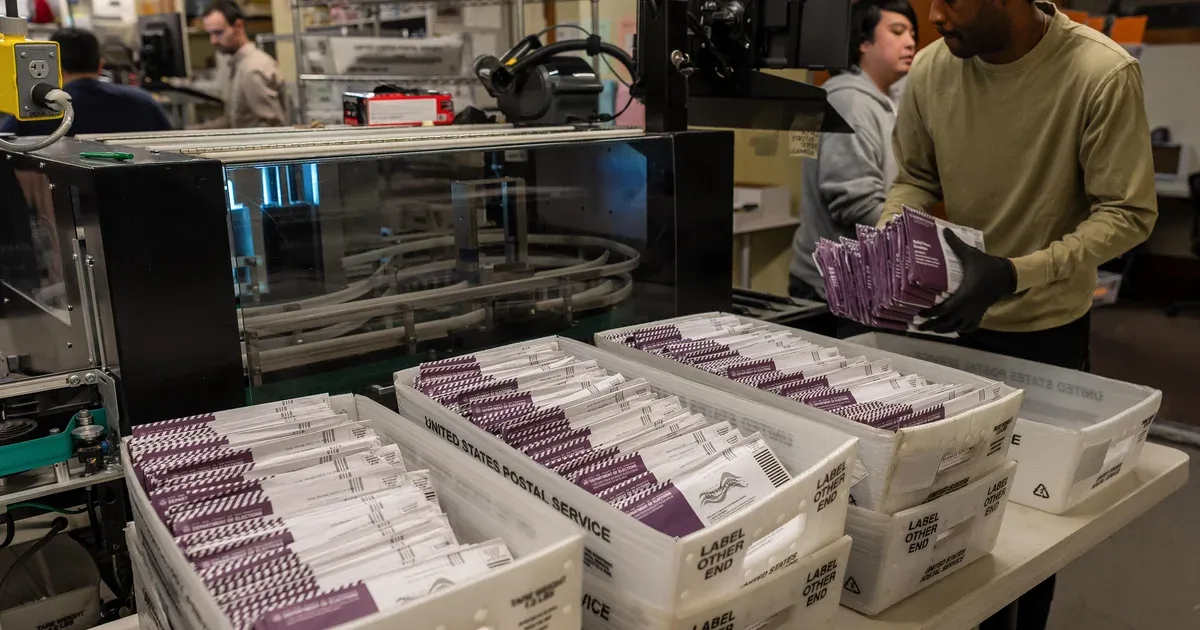 Photo: CBS News
Key points
The Trump administration asked the Supreme Court on 2 November to force California to segregate ballots from 20,000 alleged noncitizens, after losing in lower courts.
The Trump administration on Monday asked the Supreme Court to intervene in its effort to force California election workers to set aside mail ballots from more than 20,000 people it claims are not U.S. citizens. The Justice Department's request for emergency relief came after a federal appeals court on Friday declined to order California officials to segregate the ballots. More than 6 million mail ballots have been returned statewide as of Sunday, according to the California secretary of state's office.
The emergency appeal came in the fast-moving legal battle unfolding in the run-up to Tuesday's elections. The Trump administration so far has not been successful in convincing lower courts to require the ballots at issue to be put aside. In the request to the Supreme Court, Solicitor General D. John Sauer said the government is seeking a 'modest remedy' that will ensure any ballots cast by people who are not American citizens do not 'debase or dilute valid votes.'
Emergency appeal filed
Sauer wrote in a filing: 'Once California commingles the challenged ballots with lawful ones, there is no way to get the challenged ballots back. The only way to preserve the district court's ability to grant relief to the United States after a full merits proceeding, therefore, is to segregate the challenged ballots now.' The appeal goes first to Justice Elena Kagan, who could ask for a response from California, which would take days.
The dispute arose after the Justice Department sent letters to California's secretary of state and the top elections official in Los Angeles County with a list of 20,000 people it claimed were registered to vote but not U.S. citizens, and demanded any ballots returned by them be set aside and not tabulated until their citizenship could be verified. The officials have expressed concerns about the accuracy of the list and the potential for eligible voters to be disenfranchised.
The Justice Department sued California and Dean Logan, the Los Angeles County registrar-recorder and county clerk, and sought a court order requiring the ballots to be segregated. On Wednesday, U.S. District Judge David Carter rejected the Trump administration's request for a temporary restraining order blocking election workers from counting ballots from the alleged noncitizens. Carter, appointed by President Bill Clinton, said: 'Constitutional rights and our democracy are at stake. The public interest favors their protection.'
Lower court rejections
Carter added: 'Individuals who have met the requirements of California's voter registration laws must not be deprived of a core right merely because of unfounded allegations stemming from a procedure rife with uncertainty and errors.' A three-judge panel on the 9th Circuit divided 2-1 on Friday in denying a Justice Department request to require the ballots to be separated and not counted pending citizenship verification.
The 9th Circuit judges in Friday's opinion said that 'this clause expressly dictates which sovereign has the authority to prescribe the manner in which congressional elections are conducted.' Judges Mark J. Bennett, a Trump appointee, and Gabriel P. Sanchez, a Biden appointee, wrote: 'If the United States believes different procedures are necessary for vote-by-mail ballots, we believe it should take that suggestion to Congress, not the courts.' Dissenting Judge Patrick J. Bumatay, a Trump appointee, called the proposal a 'reasonable request' and a 'modest remedy.'
The majority cited a 2013 opinion written by the late Justice Antonin Scalia, who wrote: 'The Elections Clause functions as a default provision. It invests the states with responsibility for the mechanics of congressional elections.' Scalia spoke for a 7-2 majority that rejected an Arizona law requiring voters to show documentary proof of citizenship. In dissent, conservative Justices Clarence Thomas and Samuel A. Alito said they would go farther to protect the states from federal interference.
Dispute over list accuracy
California has said that the state's safeguards against noncitizen voting are robust and that the lawsuit threatens to deprive 20,000 people of their right to vote based on vague accusations. The administration's process for scrutinizing voter lists to identify noncitizens is flawed and likely rife with errors, it said in court papers. Carter raised concerns over the reliability of the administration's data, noting that people recently flagged as noncitizens on voter rolls in other states have repeatedly turned out to be naturalized U.S. citizens.
The Coalition for Humane Immigrant Rights submitted a legal filing on Saturday stating that an analysis of the list found that over 40 percent of the names weren't even in the state's current voter files. In response, the DOJ has suggested that the publication of their analysis violated the terms of the lists released to them, and is urging a federal judge to consider whether contempt charges might be applicable. The DOJ also issued grand jury subpoenas to California's local election officials last week.
The administration has taken an increasingly aggressive approach toward how states run elections. The Justice Department has told election officials in all 50 states that they could face criminal prosecution if they knowingly allow noncitizens to remain on their rolls or cast ballots. Just 129 cases in which noncitizens had been charged with voting illegally since the passage of a 1996 federal law criminalizing such conduct.
The Supreme Court has not yet indicated whether it will act on the emergency appeal. The administration has urged the court to order the ballots to be set aside on an interim basis while the justices formally decide the request. California has 52 seats in the House of Representatives, more than any other state. Democrats need a net gain of four House seats to win a majority in the chamber. The midterm election is scheduled for Tuesday.
Frequently asked questions
What did the Trump administration ask the Supreme Court to do?
The administration asked the Supreme Court on 2 November to force California to segregate mail ballots from more than 20,000 alleged noncitizens, pending verification of their citizenship, before the midterm election.
Why did lower courts reject the request?
A federal judge and the 9th Circuit Court of Appeals rejected the request, citing concerns about the accuracy of the list, potential disenfranchisement, and the state's authority over election procedures. The 9th Circuit said the administration should take its concerns to Congress.
How many ballots are affected?
The request concerns more than 20,000 ballots. More than 6 million mail ballots have been returned statewide as of Sunday. The list was compiled by the Department of Homeland Security.