Uber, Nuro and Lucid start driverless robotaxi testing in Bay Area
Nuro, Lucid and Uber began fully driverless testing on Bay Area public roads on 24 November, with more than 100 Lucid Gravity vehicles and a public launch planned for Q1 2027.
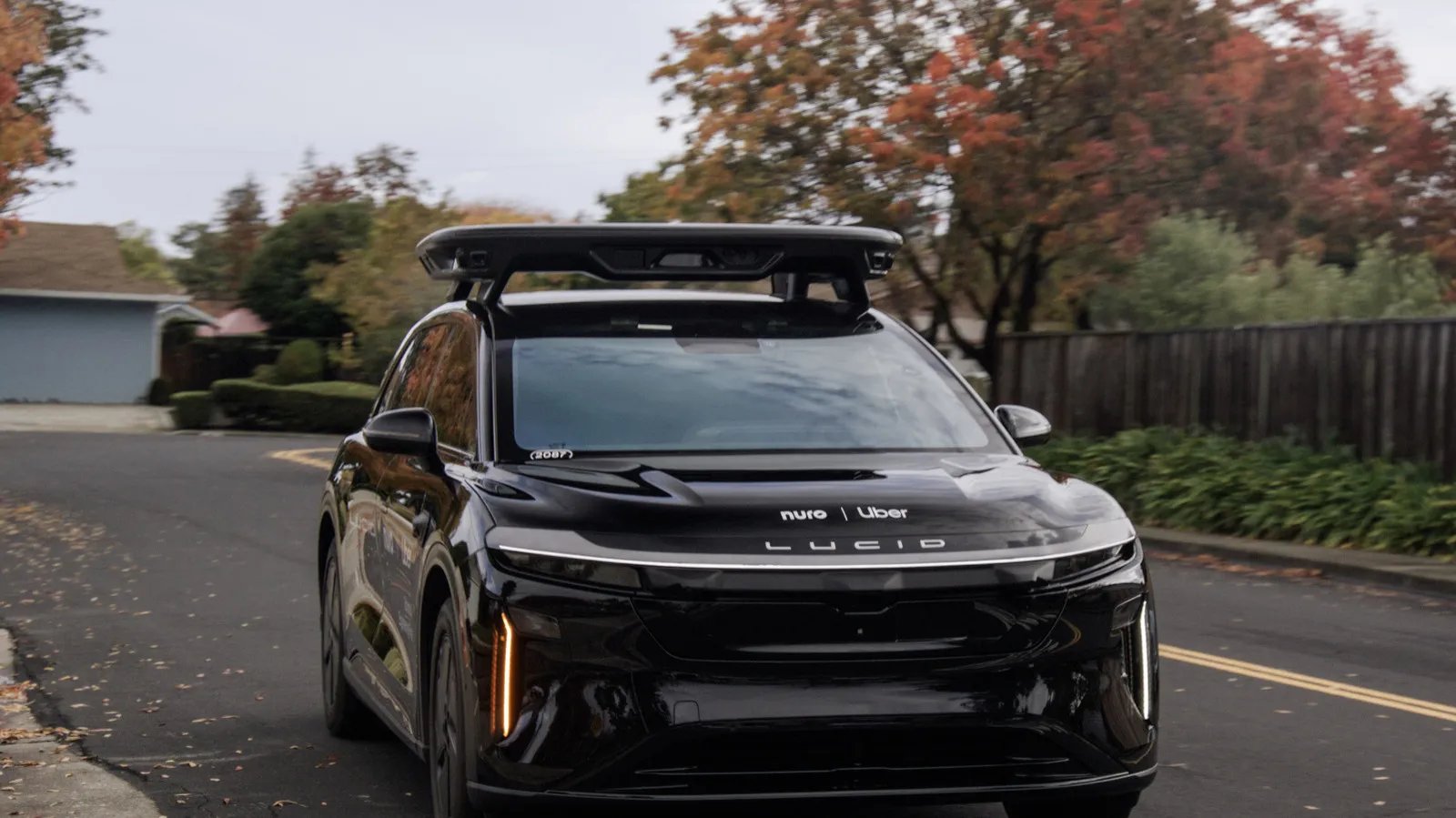 Photo: Engadget
Key points
Uber, Nuro and Lucid have started fully driverless testing on public roads in the San Francisco Bay Area, with no safety driver behind the wheel.
Nuro, Lucid and Uber announced on 24 November that they have started fully driverless testing on public roads across the San Francisco Bay Area, with no safety operator behind the wheel. The three companies said employee rides in the driverless vehicles will begin soon, ahead of an expected public launch in the first quarter of 2027.
The step removes the human backup that has sat in the driver's seat since December 2025, when Nuro began round-the-clock autonomous testing of the Lucid Gravity robotaxi on public roads in the Bay Area and Houston. Nuro said learnings from that supervised testing readied the Nuro Driver, its end-to-end autonomous system, to operate without a safety driver present.
Four cities first
Driverless testing will run first in Palo Alto, Mountain View, Los Altos and Sunnyvale, before expanding to additional Bay Area cities next year. The programme was announced in July 2025 and combines Uber's ride-hailing platform, Nuro's self-driving technology and Lucid's electric vehicles. The vehicle is a modified Lucid Gravity, which the companies presented at CES earlier this year.
To enable this phase, Lucid has delivered a fleet of more than 100 vehicles featuring hardware, software and rider-experience updates. That is up from the 75 engineering vehicles on the road earlier this year. Lucid said it began building pre-production models in October to clear regulatory safety approvals, and it plans to start manufacturing the actual commercial fleet in the coming weeks.
The robotaxi carries a redundant sensor suite of cameras, lidar, radar and a roof-mounted halo that flashes a rider's initials and pickup status. Lidar measures distance by bouncing laser light off objects. Nuro's Level 4 system handles driving without a human fallback within its defined operating area. Uber is designing the in-cabin experience, including personalisation, support and rider controls, with autonomy visualisation provided by Nuro.
How Nuro proved readiness
Nuro attributes its readiness to remove the safety driver to its Safety Case Framework, a structured, evidence-based process that builds and substantiates the case that the Nuro Driver can operate safely on public roads. The framework draws on testing, simulation, system performance, operational procedures and other validation activities, and evaluates readiness against defined safety and reliability requirements.
That validation included closed-course testing at Nuro's Las Vegas facility, where the team ran no-vehicle-operator testing in controlled, repeatable conditions. There it evaluated the vehicle, its systems and operational responses across rare and challenging situations, including pedestrian encounters, right-of-way violations, hazards and unusual traffic conditions. Nuro said the resulting learnings were used to refine the technology and assess readiness for driverless operation.
The start of driverless on-road testing follows two California permits received earlier this year. Nuro obtained a California Public Utilities Commission Drivered Pilot Permit, allowing passenger rides with a safety operator, and a California Department of Motor Vehicles Driverless Testing Permit, making Nuro one of just six companies permitted to test on public roads in California with no driver behind the wheel.
Fleet ownership and the launch plan
The public launch is planned for the San Francisco Bay Area in the first quarter of 2027, with Houston following later that year. Passengers will summon rides through the Uber app. Uber has committed to purchase at least 35,000 Lucid vehicles equipped with the Nuro Driver, including Lucid's upcoming midsize model, with plans to expand across dozens of global markets over the coming years.
The vehicles will be owned and operated by Uber and its fleet partners. Uber's global head of autonomous mobility, Samarth Kejriwal, said removing the safety operator was "an important milestone in our partnership with Nuro and Lucid". Tilo Schwarz, Nuro's vice president of engineering and head of Nuro Driver, said the step was "backed by millions of scenarios of rigorous testing and validation".
The Lucid Gravity robotaxi seats up to six passengers, compared with rides from Waymo and Zoox that seat up to four. Uber's partnership with Nuro and Lucid is one of dozens it holds with autonomous vehicle companies, including Waymo, Zoox, Avride, Wayve and May Mobility. The first driverless passenger rides are planned for the coming months, with the Bay Area public launch set for the first quarter of 2027.
Frequently asked questions
When will Uber, Nuro and Lucid launch their robotaxi service to the public?
The companies plan to launch publicly in the San Francisco Bay Area in the first quarter of 2027, with Houston following later that year. Employee rides in driverless vehicles will begin soon, before the public launch.
Where are the driverless robotaxis being tested?
Testing starts in Palo Alto, Mountain View, Los Altos and Sunnyvale, before expanding to additional Bay Area cities next year. Nuro has also conducted supervised testing in Houston since December 2025.
How many vehicles are in the robotaxi fleet?
Lucid has delivered more than 100 Lucid Gravity vehicles for the programme, up from the 75 engineering vehicles on the road earlier this year. Uber has committed to purchase at least 35,000 Lucid vehicles equipped with the Nuro Driver.