Democrats poised to seize House as midterm polls close
Polls closed in six states on 3 November with Democrats needing three House gains and four Senate seats to take both chambers.
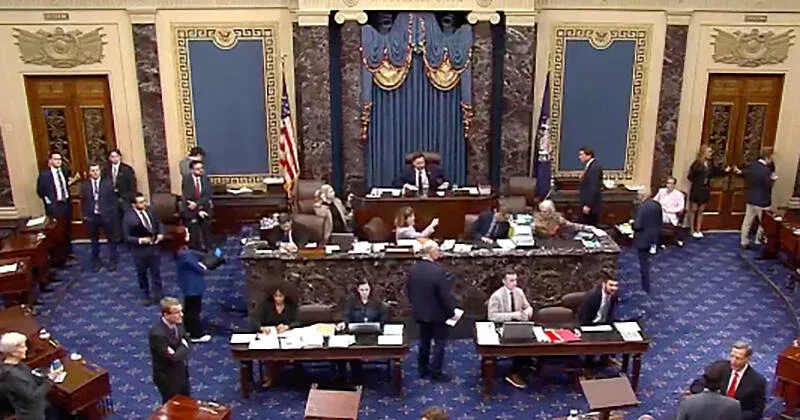 Photo: CBS News
Key points
Democrats are poised to take the House and potentially the Senate as midterm polls close.
Polls closed in six states on 3 November as Democrats positioned themselves to seize the House and potentially the Senate, threatening to shatter President Donald Trump's grip on Washington. Democrats need only three House gains and a net four seats in the Senate to wrest both chambers from Republican hands.
The first results of the night came from Indiana, Georgia, Kentucky, South Carolina, Vermont and Virginia. In Virginia, Democratic Senator Mark Warner secured another term, CBS News projected. The Senate race in Georgia leaned toward incumbent Democrat Jon Ossoff, while the contest in South Carolina between Republican Senator Darline Graham and Democrat Annie Andrews was rated a toss-up.
First results show Democratic gains
House Democratic Minority Leader Hakeem Jeffries told reporters in Washington that Democrats 'are on the verge' of taking back control of the House, but added that they 'take nothing for granted.' 'We're going to continue to run through the finish line,' he said. 'The early vote numbers were strong, and today's vote numbers all across the country are strong in blue states, in swing states and in red states.'
Republicans are defending a 53-47 majority in the Senate, with Democrats aiming to flip enough seats to gain control. There are 11 states considered Senate battlegrounds, with eight held by Republicans and three by Democrats. Democrats have pickup opportunities in North Carolina, Ohio, Maine, Alaska, Kansas, Iowa and Texas, while defending competitive seats including Michigan, where congresswoman Haley Stevens endorsed Republican Mike Rogers over the Democratic nominee, Abdul El-Sayed.
The election amounts to a nationwide judgment on Trump at a time when the mood is turning sharply against Republicans over soaring living costs and the war against Iran. Current exit polls show roughly three-quarters of voters are at least dissatisfied with the direction of the country, with more angry now than in 2024. Trump's approval rating is at 38%, lower than during his first term and lower than George W. Bush's in 2006 when his party lost both houses of Congress.
Voters weigh costs and Trump
Trump returned to office last year promising to bring down prices, but inflation, tariffs and fuel costs inflated by the Middle East conflict that he launched have squeezed Americans. Taylor Cook, a 24-year-old Los Angeles voter, said that affordability and reining in the Trump administration were the two biggest election issues. 'Rent, groceries, utility bills, and property taxes keep climbing, and I want people in Congress who will actually do something about costs,' she said.
In his final public appearance on Monday, Trump barely touched on the election and gave a rambling talk about his problem-plagued renovation of Washington's Reflecting Pool. Senate Democratic leader Chuck Schumer branded Trump's final speech 'pathetic.' Trump defended his record in a final TV phone-in pitch to voters on Tuesday, saying he had rebuilt the country through his immigration crackdown, war on Iran and tariffs.
Trump said in an exclusive phone interview before polls close that he has 'the ultimate power — it's called veto.' He said he is prepared to veto Democratic legislation if necessary, and welcomes the moniker 'Mr. Veto.' He cited Trump v. Slaughter, a Supreme Court decision from earlier this year that allowed him to fire a member of the Federal Trade Commission, saying the 6 to 3 decision enables him to exert sweeping control over many federal agencies regardless of who holds majorities.
What happens next
Concerns were high that Republicans, especially Trump, will refuse to accept results if they lose. Trump, who tried to overturn his 2020 presidential election defeat, has repeatedly alleged widespread voter fraud and accused Democrats, with no evidence, of cheating. Voting machines malfunctioned in a hotly contested House race in New York state on Tuesday, prompting right-wing influencers to fling unfounded allegations of fraud even as local election officials insisted all ballots would be counted.
In Alaska, Democratic Senate candidate Mary Peltola told reporters on Tuesday that accusations of fraud by her GOP opponent, incumbent Senator Dan S. Sullivan, may have been the 'push we needed at the final end to get people reengaged.' The Trump administration filed a lawsuit last month seeking to block results from being certified if Sullivan receives fewer votes, but a federal judge dismissed the lawsuit on Sunday. Peltola said, 'I believe in the rule of law. I believe in justice. I believe in our courts.'
Decision Desk HQ's final forecast projected 241 House seats for Democrats against 194 for Republicans, and a narrower 52-48 Democratic Senate majority. The campaign has attracted more than US$11 billion in political advertising, and mega-rich Trump ally Elon Musk has poured nearly half a billion dollars into Republican efforts. Republicans losing the House would give Democrats the power to stall Trump's legislative agenda and launch sweeping investigations of his administration.
All 435 House seats and 35 of the 100 Senate seats were at stake, along with governorships in 36 states. Democrats last won control of the Senate in 2022, maintaining a narrow majority throughout the Biden administration. Control of the upper chamber has major implications for the White House and its policy priorities and nominations, as Trump eyes the final two years of his presidency. Further results will come as more states close their polls through the night.
Frequently asked questions
What do Democrats need to win control of Congress?
Democrats need only three House gains and a net four seats in the Senate to take both chambers, according to Channel News Asia.
What is Trump's approval rating in the midterms?
Trump's approval rating is at 38%, the lowest for a president in a midterm election, according to early exit polls reported by CBS News.
When did polls close in the first states?
Polls closed in six states — Indiana, Georgia, Kentucky, South Carolina, Vermont and Virginia — by 7 p.m. Eastern on 3 November, CBS News reported.