YouTube adds Made with AI labels to music tracks
YouTube began labelling AI-generated and AI-altered songs in its YouTube Music app on 14 October 2026, with the labels expanding later to the main YouTube app.
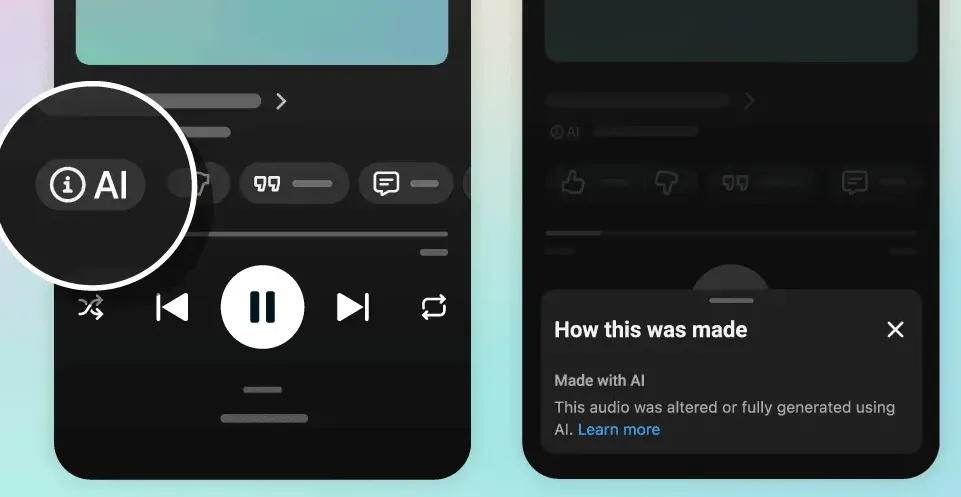 Photo: The Verge
Key points
YouTube began adding Made with AI labels to AI-generated and AI-altered tracks in its YouTube Music app on 14 October 2026.
YouTube is adding a Made with AI label to tracks that were altered or fully generated using AI, starting in the YouTube Music app on 14 October 2026. The label sits directly below the track name on the player page, and a similar approach will expand to the main YouTube app later. The label marks songs where AI played a significant role.
The label matters because streaming platforms are absorbing a fast-growing volume of AI-made music, and listeners currently have little way to tell an AI track from a human-made one on the player page. YouTube's approach is disclosure rather than restriction: AI involvement alone does not make a track ineligible for monetization, which contrasts with platforms that filter or exclude AI music outright.
What the label shows
YouTube said the label covers things like using a generative model to create the composition and vocals, and it will appear on songs fully generated by AI as well as tracks that used a model to create major components such as vocals. Tapping the oblong AI label on the player page opens a menu that shares more information about how AI was used in the track.
YouTube's rules for music partners who upload songs lay out how to disclose generative AI use, and if there is no disclosure, YouTube says it may use other signals to decide if a song is AI-generated. Partners declare their work through one of three designations: Fully Gen AI, Partly Gen AI, or No Gen AI.
The designations divide the work by how much AI is in the track. Fully Gen AI applies to tracks entirely generated by AI, while Partly Gen AI refers to works where artists incorporated AI-generated components but added their own live elements. Tracks edited using pitch-correction tools such as Auto-Tune fall under the No Gen AI category.
How YouTube detects tracks
YouTube said it teamed up with music partners and uses its own detection tools to identify AI-generated tracks, applying the same labeling principles already used across YouTube. The company said its goal is to make it as easy as possible for viewers and listeners to have the right information and clarity about the music they listen to.
Other platforms are moving in different directions. Spotify launched a voluntary AI label earlier this year and said it would not recommend songs from AI personas, and it also has a music spam filter. Apple Music plans to introduce Made With AI labels as part of its AI Transparency Tags later this year.
How other platforms respond
Deezer has taken a stricter stance, reporting in July that it was receiving nearly 90,000 fully AI-generated tracks daily. It labels detected AI-generated music, excludes it from algorithmic recommendations and editorial playlists, and withholds royalties from fraudulent streams, while working on an option to let users filter out AI-generated music. TIDAL labels recordings it identifies as entirely AI-generated, lets listeners disable them, and excludes them from royalty attribution.
YouTube, by contrast, focuses on disclosure rather than blanket restrictions, and it even experiments with AI-powered music creation through its Dream Track tool, which lets select creators generate soundtracks featuring AI-generated versions of participating artists' voices. The labels are rolling out starting 14 October 2026 in the YouTube Music app, expanding to the main YouTube app later, with Apple Music's AI Transparency Tags due later this year.
Frequently asked questions
What labels is YouTube adding to AI-generated music?
YouTube is adding a Made with AI label to tracks that were altered or fully generated using AI, starting in the YouTube Music app on 14 October 2026. Tapping the label opens a menu with more detail on how AI was used.
How does YouTube decide which tracks get an AI label?
YouTube partners declare generative AI use through three designations: Fully Gen AI, Partly Gen AI, or No Gen AI. If there is no disclosure, YouTube says it may use other signals to decide if a song is AI-generated.
How much AI music are streaming platforms receiving?
Deezer reported in July that it was receiving nearly 90,000 fully AI-generated tracks daily, and it labels detected AI music, excludes it from recommendations and editorial playlists, and withholds royalties from fraudulent streams.