Apple tests Harbor app to turn Macs into private AI servers
Apple's Claris subsidiary is testing Harbor, an app that turns Apple silicon Macs into private AI servers, pooling memory over Thunderbolt 5.
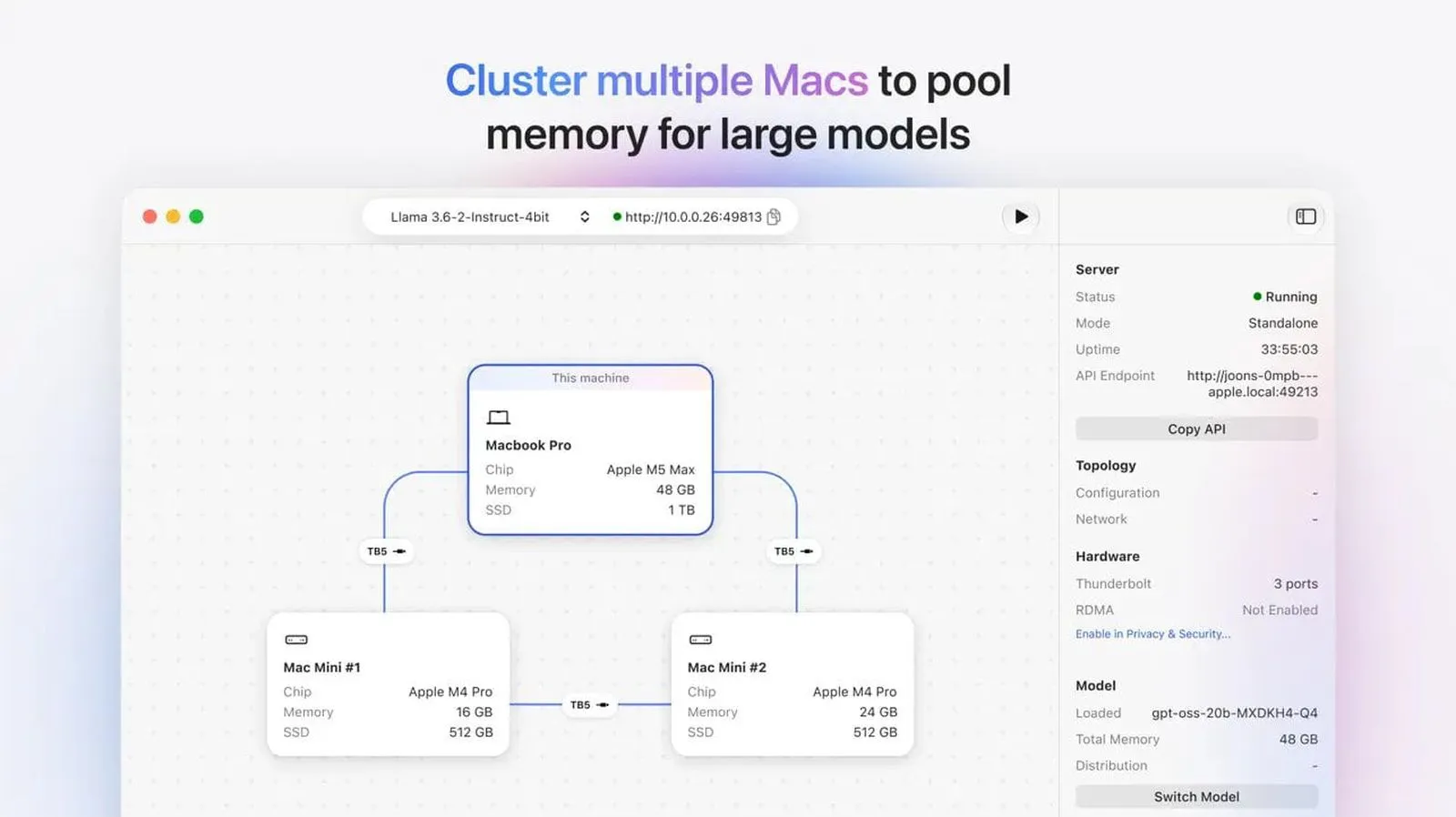 Photo: MacRumors
Key points
Apple's Claris subsidiary is testing Harbor, an app that turns Apple silicon Macs into private AI servers with Thunderbolt 5 clustering.
Apple's Claris subsidiary is testing an app called Harbor that turns Apple silicon Macs into a private AI server, according to a report published on 10 November. The app, discovered by leaker Aaron Perris, is in early access and not publicly available. An App Store listing for it has been removed.
Harbor works with a single Apple silicon Mac, but it also supports connecting multiple Mac computers over Thunderbolt 5 to pool unified memory for larger models. Apple added RDMA over Thunderbolt 5 with macOS Tahoe 26.2, making clustering faster. The app detects devices connected over Thunderbolt 5 and lets users browse for, download, and load open-weight models.
How Harbor works
The app is described as an easy-to-use tool with no manual configuration required. "Harbor turns your Mac into a private AI inference server," the description reads. "Run open-weight models locally on Apple silicon—your data never leaves your hardware, and nothing reaches the cloud." It aims to let users set up in minutes, not hours.
Harbor's clustering feature pools unified memory from two or more Thunderbolt 5-capable Mac computers into a single inference resource. This enables running models that exceed any single computer's capacity or serving more concurrent requests across the cluster. The app handles model management, so users can focus on work rather than setup.
The privacy focus is significant for businesses and professionals handling sensitive documents, as calculations run directly on Apple silicon and data stays on the user's Mac. No information needs to be sent to a remote server to generate a response. This approach is particularly interesting for enterprises, according to the report.
Business focus
Claris is known for its database platform FileMaker, which is aimed at businesses, so it isn't clear how Apple will market Harbor or whether it will be free. The sign-up page for Harbor asks for a company name, which suggests more of a business focus. Apple has not officially confirmed the project.
Harbor builds on Apple's previous work in distributed inference. In a publication last month, the company explained how to run models with several hundred billion parameters on multiple Mac Studio computers using its MLX framework and RDMA over Thunderbolt 5. Apple demonstrated running Muse Spark Open, a model with 816 billion parameters, on four Mac Studio computers.
What is unknown
There are already well-known, free alternatives for Mac users who want to run a local AI server. Exo is an open-source tool for clustering Macs, and LM Studio is available for single-Mac use, but Apple's Harbor app appears to combine LM Studio's simple interface with clustering. This could make distributed AI more accessible to everyday users.
Several details remain unknown. Apple has not communicated any launch date, minimum hardware configurations, compatible Mac lists, pricing, or access conditions for Harbor. The app is currently in a private preview under Apple's Claris brand, but it seems likely that it will launch to the public in the weeks and months ahead.
The discovery comes as the Mac has become more popular this year, both because of budget-friendly options like MacBook Neo and as a tool for running AI models locally on Mac Studio and Mac mini. Apple appears to lean harder into the latter use case with Harbor. No official announcement has been made.
Frequently asked questions
What is Apple's Harbor app?
Harbor is an app being tested by Apple's Claris subsidiary that turns Apple silicon Macs into private AI inference servers. It runs open-weight models locally, keeping data on-device, and supports clustering multiple Macs over Thunderbolt 5.
How does Harbor cluster Macs?
Harbor connects two or more Thunderbolt 5-capable Mac computers and pools their unified memory into a single inference resource. It automatically detects devices and requires no manual configuration, enabling larger models or higher concurrency.
When will Harbor be available?
Harbor is currently in early access and not publicly available. An App Store listing was removed. Apple has not announced a launch date, pricing, or minimum hardware requirements.