France deploys 70,000 police nationwide ahead of Saturday protests
France will deploy about 70,000 police officers nationwide on Saturday 24 October 2026, after riots on 17 October left hundreds jailed and prompted protest bans across major cities.
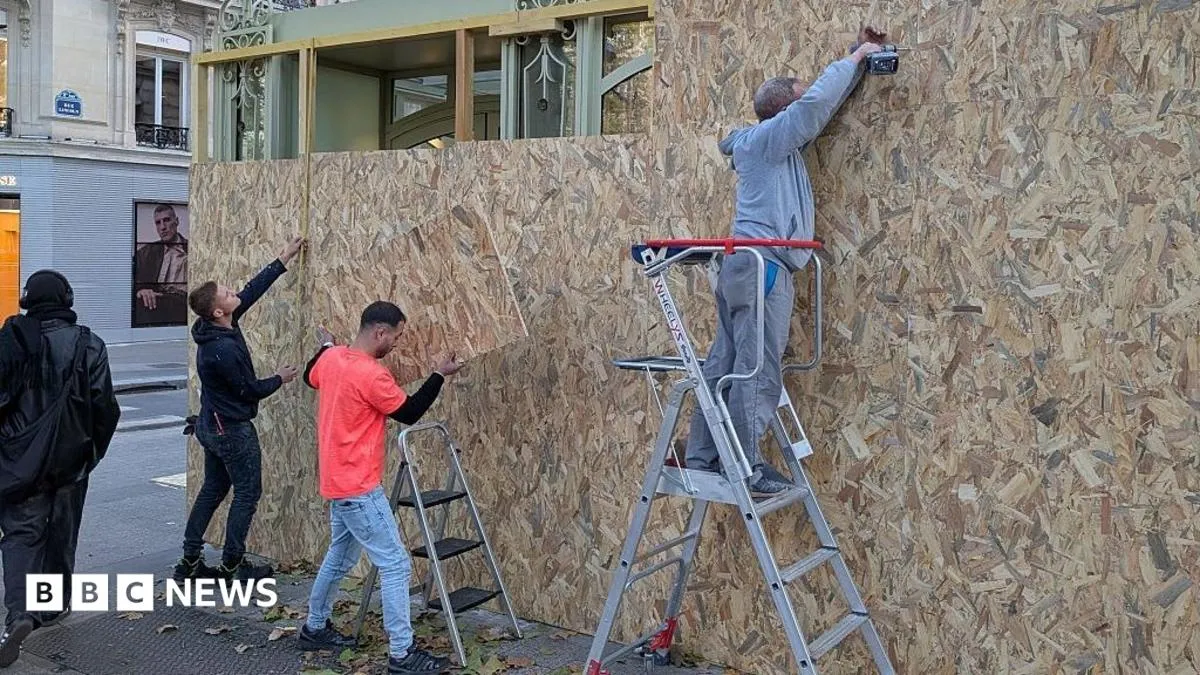 Photo: BBC News
Key points
France will deploy about 70,000 police officers nationwide on Saturday, following riots a week earlier that led to more than 232 imprisonments and protest bans in several cities.
France will deploy about 70,000 police officers nationwide on Saturday, the interior ministry said, as authorities prepare for a second round of nationwide protests a week after riots on 17 October. Hundreds of thousands of protesters are expected to gather in Paris and elsewhere, with demonstrations organised by students, trade unions and wider anti-government groups. Interior Minister Laurent Nuñez announced the deployment after a meeting of senior ministers chaired by President Emmanuel Macron.
The scale of the deployment reflects what the government has called a failure to foresee the unrest on 17 October, which opposition parties criticised. The security forces will include elite units usually used for counter-terrorism operations and hostage rescues, alongside water cannon, armoured vehicles, mounted police, helicopters and drones. Nuñez said calls for violence and looting were circulating on social media, and separately that numerous calls for violence had come from the "far left and radical extreme left".
What the deployment covers
Nuñez told reporters the government would be uncompromising with rioters, looters and all who commit violence. "We are not talking about a peaceful, friendly demonstration," he said, adding that authorities were ready to be extremely firm. The interior ministry said the deployment ramps up the security presence in French cities after the government was accused by opposition parties of failing to foresee the scale of the unrest on 17 October. Hundreds of people have been jailed for vandalism, arson and looting after fast-track court hearings in recent days.
Justice Minister Gérald Darmanin said 232 people had been imprisoned for their role in the 17 October riots and more than 1,100 others had appeared in court. Around 260 of those cases involved charges of organised gang activity, he added. Darmanin has ordered prosecutors to seek punitive measures against people convicted of looting or attacking police officers, including banning them from demonstrations, removing their right to vote and barring them from accessing social media. More than half a million people took to the streets last week.
The protests began with demands from high school students to improve school conditions and fix staff shortages, before violence took hold in places. Disillusionment is high among the French public, who have seen cost-of-living pressures increase and face warnings that any future government will likely come with deep spending cuts. Macron met high-school students' representatives on Friday, and although they said he had made clear commitments, they said students should continue to mobilise. Macron told them his government would make commitments to improve high school education from Monday, his advisers told French TV.
Where the numbers came from
Macron decreed earlier in the week that only demonstrations organised by a recognised trade union would be permitted on Saturday. Several key cities including Lyon, Nice and Montpellier announced blanket bans, while all protests planned for Saturday in Marseille and Lyon, France's second- and third-largest cities, were banned by local authorities. In Marseille, a previous order barring all protests was reversed to allow a trade union-organised march, the only authorised protest in the Bouches-du-Rhône department. In Paris, a union march was ordered onto a route avoiding the city centre.
Union and opposition leaders criticised the government for refusing to allow more rallies, a decision being challenged in court in several cities. Marylise Léon of the CFDT union federation accused Macron of an abuse of authority, saying it was not for the president to decide who can legitimately protest. La France Insoumise said the government had crossed the lines separating a democracy from an authoritarian and police state. A website associated with the gilets jaunes movement listed more than 500 planned demonstrations and 200 other actions on Saturday.
Museums including the Louvre, Orsay, Picasso and Grand Palais will close on Saturday, and a scheduled home match for Paris Saint-Germain has been moved to Monday. Art Basel cancelled its weekend programme after opening to the public on Friday. Luxury boutiques boarded up windows and added guards, while shopkeepers in Paris barricaded stores all week. In Limoges, the 19th-century town hall was set on fire and partly destroyed; Prime Minister Sébastien Lecornu said the national government would pay for it to be reconstructed exactly as it was.
What happens next
French police are equipped with batons, tear gas, sound grenades and foam-round launchers, as well as riot shields with strobe lights, according to a French National Police statement. Electric stun guns are prohibited in crowd-control operations. Critics, including families of injured teenagers, say police have been too heavy-handed and have called for bans on foam-round launchers, tear gas and stun grenades. United Nations guidance says kinetic impact projectiles should be used only against an imminent threat, targeting the abdomen and never the head, face or neck.
The unrest comes six months before presidential elections to choose Macron's successor, with polls showing far-right leader Marine Le Pen as frontrunner. Macron will leave office next spring. On Friday near Paris, one person was killed and five others injured, including a 12-year-old girl, in a shooting Macron called a terrorist act planned to kill based on skin colour or religion. Protests are also expected in Milan, Rome, Turin, Vienna, Madrid, Barcelona, Lisbon, Porto, Dublin and Tirana.
Forecast heavy rain and high winds could dampen turnout on Saturday, while organisers of the refused Paris rallies said they would go ahead regardless. The defence council meeting and Macron's planned address to security forces precede the marches, and his advisers said high school education commitments would be announced from Monday. The liveblog covering the protests continues through Saturday 24 October and Sunday 25 October 2026.
Frequently asked questions
How many police will France deploy on Saturday?
The interior ministry said about 70,000 police officers will be deployed nationwide on Saturday, including elite units usually used for counter-terrorism, plus water cannon, armoured vehicles, mounted police, helicopters and drones.
Why are people protesting in France?
The protests began with high school students demanding improved school conditions and fixes to staff shortages, then expanded into wider demonstrations over cost-of-living pressures, declining public services and inequality.
How many people were jailed after the 17 October riots?
Justice Minister Gérald Darmanin said 232 people had been imprisoned for their role in the 17 October riots, with more than 1,100 others appearing in court and around 260 cases involving organised gang activity charges.