Griffin-1 lander passes NASA JPL tests ahead of Moon launch
Voyager Technologies' Griffin-1 lander finished nearly three months of environmental testing at NASA's Jet Propulsion Laboratory in late September 2026, clearing it to carry 1,100 pounds of cargo to Nobile Crater near the lunar South Pole.
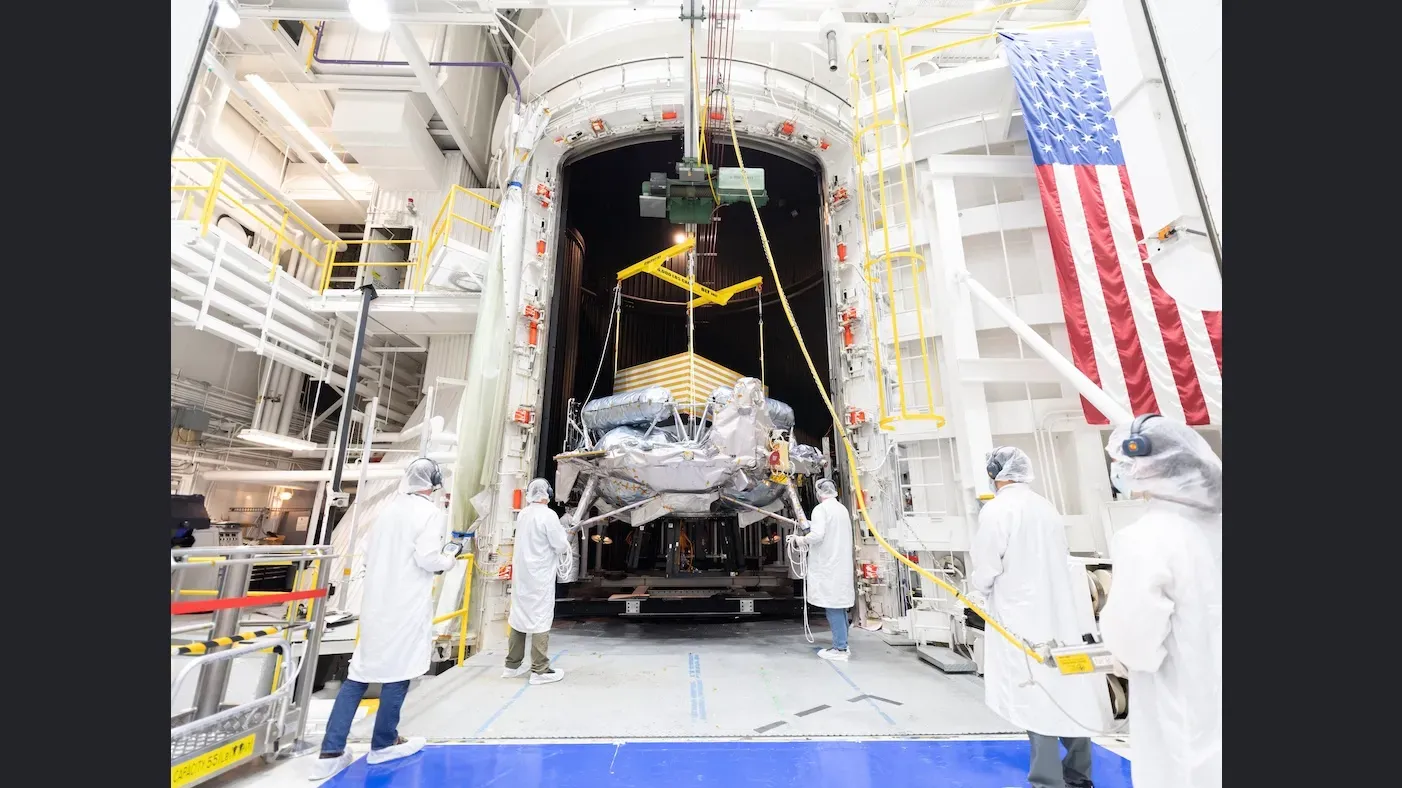 Photo: NASA
Key points
Voyager Technologies' Griffin-1 lander completed nearly three months of environmental testing at NASA's Jet Propulsion Laboratory in late September 2026 and is on track for a late 2026 launch to the Moon.
Voyager Technologies' Griffin Mission One (Griffin-1) lander completed nearly three months of environmental testing at NASA's Jet Propulsion Laboratory (JPL) in Southern California in late September 2026, NASA announced on 13 October 2026. The 2,789-pound (1,265-kilogram) spacecraft passed tests simulating the extreme temperatures, vacuum, vibration, and acoustic conditions of launch and spaceflight, confirming it is ready for its journey to the Moon.
The testing matters because Griffin-1 is part of NASA's Commercial Lunar Payload Services (CLPS) initiative within the Moon Base Program, which aims to establish humanity's first lunar outpost. Unlike earlier CLPS landers focused on small science payloads, Griffin-1 is classified as an infrastructure-class lander, designed to deliver heavy cargo including rovers and power systems needed for sustained operations on the lunar surface.
Why the tests matter
Griffin-1 then underwent electromagnetic interference and compatibility testing inside an anechoic chamber at JPL, where long foam spikes line the walls to absorb sound and electromagnetic waves. This test ensures signals from the spacecraft's electronic components do not interfere with one another. The chamber test took place on 29 July 2026, according to NASA's photojournal record of the campaign.
Anechoic chamber checks signals
The 25-Foot Space Simulator has tested spacecraft since the 1960s, including the Ranger, Surveyor, Mariner, and Voyager missions, as well as the Perseverance Mars rover and Europa Clipper. Charles Whetsel, manager of the Exploration Systems Development Office at JPL, said the Environmental Test Laboratory has been putting robotic explorers to the test since the Ranger program gave NASA its first up-close views of the Moon's surface in the mid-1960s.
John Thornton, executive vice president at Voyager, said completing the environmental testing demonstrates Griffin-1 is ready for launch, deep space travel, and landing at the lunar South Pole. Voyager Technologies (NYSE: VOYG) announced on 13 October 2026 that acceptance testing verified the spacecraft's systems performance and confirmed its readiness for the next phase of launch preparation.
What comes before launch
Griffin-1 will deliver more than 1,100 pounds (455 kilograms) of cargo to Nobile Crater near the lunar South Pole, carrying 10 science and technology demonstrations from six countries. The manifest includes payloads from NASA, the European Space Agency, and other commercial partners, as well as Astrolab's FLIP (FLEX Lunar Innovation Platform) rover, described as the largest commercial payload ever delivered to the Moon.
After completing testing at JPL, Griffin-1 was shipped back to Voyager Lunar Systems' Pittsburgh facility for final assembly. The company said the lander will then be transported to Cape Canaveral, Florida, for launch. Dylan Taylor, chairman and chief executive of Voyager, said when Griffin touches down it will be the largest commercial payload delivery in lunar history.
Griffin-1 is expected to launch in late 2026 aboard a SpaceX Falcon Heavy rocket, delivering cargo as part of NASA's Moon Base Phase I objectives. The lander is designed to support future lunar operations including delivery of rovers, science instruments, and power systems. Caltech in Pasadena manages JPL for NASA.
Frequently asked questions
What testing did Griffin-1 complete at NASA's Jet Propulsion Laboratory?
Griffin-1 completed nearly three months of environmental testing at JPL in late September 2026, including mass properties measurement, electromagnetic compatibility testing, vibration testing, acoustic testing at up to 153 decibels, and thermal vacuum cycling between 75°C and minus 100°C in the 25-Foot Space Simulator.
How much cargo will Griffin-1 deliver to the Moon?
Griffin-1 will deliver more than 1,100 pounds (455 kilograms) of cargo to Nobile Crater near the lunar South Pole, carrying 10 science and technology payloads from six countries, including Astrolab's FLIP rover, the largest commercial payload ever delivered to the Moon.
When is Griffin-1 expected to launch?
Griffin-1 is expected to launch in late 2026 aboard a SpaceX Falcon Heavy rocket from Cape Canaveral, Florida, as part of NASA's Commercial Lunar Payload Services initiative and Moon Base Phase I objectives.