Indian court releases cockroach movement founder Dipke after Delhi detention
India's cockroach movement founder Abhijeet Dipke was released by a court in New Delhi on 17 October 2026, a day after police detained him over a protest demanding the election chief's resignation.
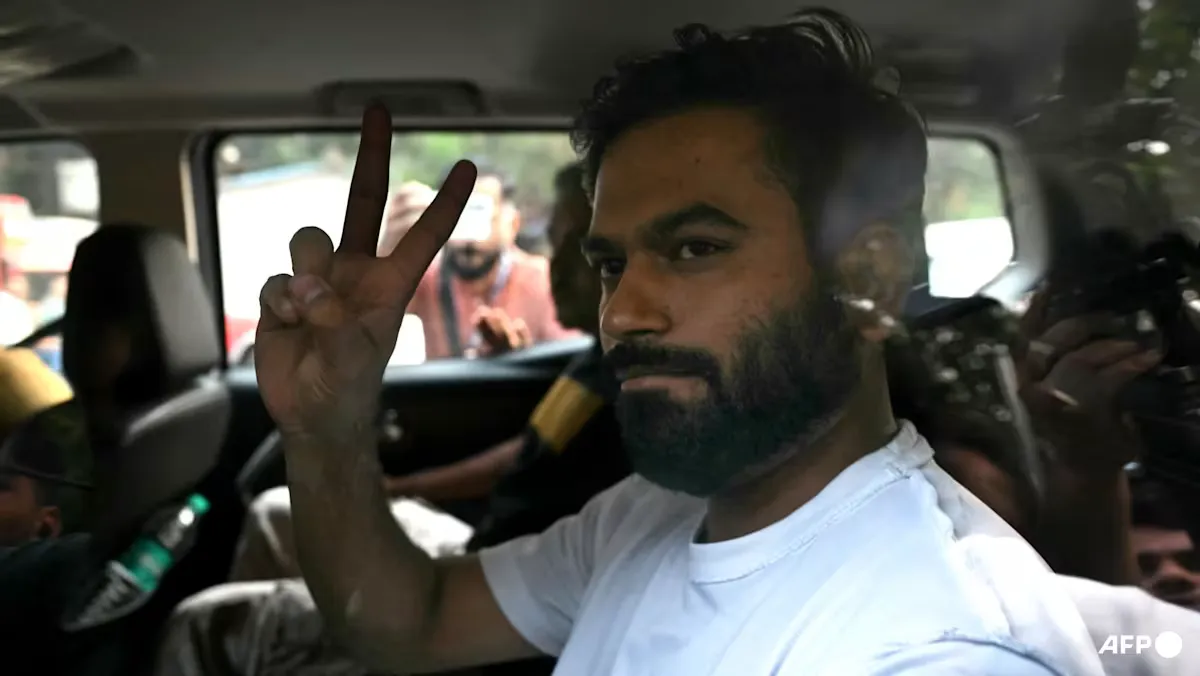 Photo: Channel News Asia
Key points
India's cockroach movement founder Abhijeet Dipke was released by a court in New Delhi on 17 October 2026, a day after police detained him for trying to lead a protest rally.
An Indian court in New Delhi released cockroach movement founder Abhijeet Dipke on 17 October 2026. Police had detained him a day earlier, on 16 October 2026, as he stepped out of a house in central Delhi while trying to lead a protest rally demanding the resignation of the country's election chief. Dipke founded the Cockroach Janta Party.
The release matters because Dipke's youth-led movement has become one of the biggest political challenges faced by Prime Minister Narendra Modi and his Bharatiya Janata Party in the prime minister's 12 years in power. The movement draws its support from the young and has joined with many opposition parties, giving it reach beyond its own membership.
Why the detention drew protests
Dipke was detained on 16 October 2026 as he stepped out of a house in central Delhi, with police hauling him into a police car and driving away after a brief argument. Earlier that day, police had met Dipke and warned him against going ahead with the protest. He was arrested to prevent a breach of the peace and was to be called before a Special Executive Magistrate, broadcasters NDTV and India Today reported.
The Cockroach Janta Party's head of legal affairs, Ratna Singh, said Dipke was released after he agreed to certain conditions, but gave no details of the terms. The movement published a photo of Dipke on X in which it referred to him as "a free man." Student activist Neha Bora, also detained on 16 October 2026 as she tried to reach central Delhi with dozens of supporters, was released on 17 October 2026.
Protesters and opposition parties allege that a revision of voter lists favoured Modi's Bharatiya Janata Party. More than 130 million voters were deleted during the revision. The Election Commission has denied favouring any party and said wrongly deleted voters can re-enrol. The BJP has accused rivals of trying to undermine democracy by wrongly questioning legitimate electoral processes.
What the voter roll revision changed
The demonstrations erupted after the Indian Express newspaper reported that Chief Election Commissioner Gyanesh Kumar's two deputies had raised concerns internally about voter list changes, registration procedures and digital systems. Jantar Mantar, New Delhi's central protest location for decades, was taken off the list of official sites by Delhi police. CJP leaders Saurav Das and Ashutosh Kumar jumped a fence to enter the location and were jailed for five days.
By the night of 16 October 2026, Connaught Place in central Delhi was packed with police and paramilitary forces holding guns, batons and tear gas launchers, who vastly outnumbered the protesters. The protesters were hemmed in by dozens of empty buses and threatened with detention if they refused to follow police orders. For almost two weeks, New Delhi's central business district has operated under heavy security as protests continue.
Where the disputed figures come from
CJP spokesperson Mehr Parsicha said the organisation called the protest after two CJP leaders were jailed for five days for entering Jantar Mantar to wave the Indian flag. She said the leaders went to unfurl the national flag in what is technically a public space. Protester Amit Jaiswal said the chief election commissioner needed to front the press and the public to answer questions about the electoral roll reforms.
Bora, after her release, called on the government to act. "Please, spare the people of India. Impeach Gyanesh Kumar and halt SIR (special intensive revision), so that the ordinary citizens of this country can breathe a sigh of relief, feel at ease, and have their voting rights ensured," she told ANI news agency. Student groups called for more protest action on 17 October 2026.
What happens next for the movement
The controversy has spread beyond India. Indians in Berlin joined calls for accountability over the voter list revisions. Six lawmakers from the United States' Democratic Party — Pramila Jayapal, Ilhan Omar, Jim McGovern, Rashida Tlaib, Eleanor Holmes Norton, and Jesus Garcia — called on US Secretary of State Marco Rubio to raise India's handling of the youth protests during a visit.
Dipke had called the 16 October 2026 protest in support of two CJP leaders detained and sent to jail that week for five days for demonstrating at a protest site in violation of a ban. This was not his first detention: he was also taken into custody ahead of a planned rally one week earlier, before a court ordered his release. Student groups have called for more protest action following the releases.
Frequently asked questions
Who is Abhijeet Dipke?
Abhijeet Dipke is the founder of the Cockroach Janta Party, a youth-led movement in India. He rose to prominence in 2026 when a weeks-long sit-in contributed to the resignation of India's education minister over exam paper leaks.
Why was Dipke detained?
Dipke was detained on 16 October 2026 as he stepped out of a house in central Delhi, after police warned him against leading a protest rally demanding the resignation of Chief Election Commissioner Gyanesh Kumar. He was arrested to prevent a breach of the peace.
What are protesters demanding?
Protesters demand the resignation of Chief Election Commissioner Gyanesh Kumar over a revision of voter lists they say favours the ruling Bharatiya Janata Party. More than 130 million voters were deleted during the revision, which the Election Commission says did not favour any party.