Israeli exit polls show blocs tied at 51 seats each
Israeli television exit polls on 28 October showed Netanyahu's bloc and Eisenkot's bloc tied at 51 seats each, short of the 61 needed for a majority in the 120-seat Knesset.
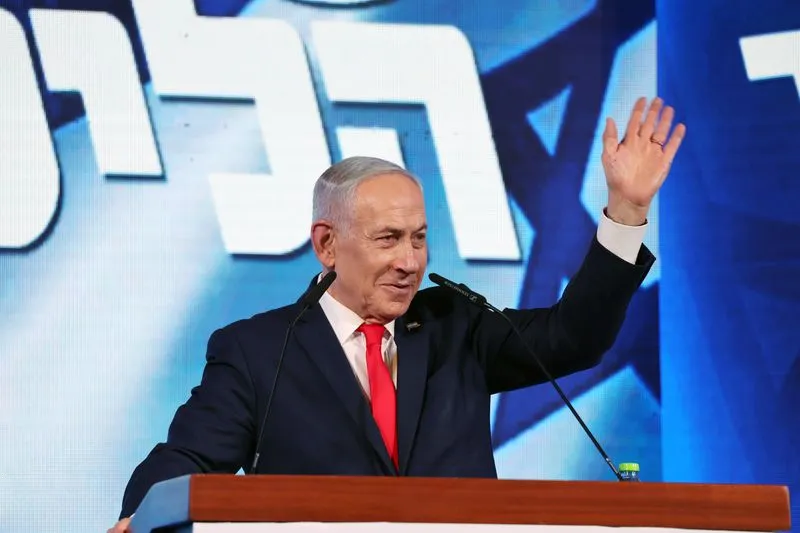 Photo: Daily Maverick
Key points
Israeli exit polls showed Benjamin Netanyahu's bloc and Gadi Eisenkot's bloc tied at 51 seats each, with neither reaching the 61 seats needed for a Knesset majority.
Israeli exit polls showed the election deadlocked, with Prime Minister Benjamin Netanyahu's Likud-led bloc and opposition leader Gadi Eisenkot's bloc tied at 51 seats each, short of the 61 needed for a majority in the 120-seat Knesset. Kan 11 and Channel 13 projected both blocs at 51 seats, while Channel 12 gave Netanyahu's camp a narrow 52-49 lead.
The deadlock means neither side has a clear path to power, and coalition negotiations could run for weeks. Netanyahu, who spoke to Likud supporters in Jerusalem after 3 a.m., did not claim victory outright, calling for a strong right-wing government. Eisenkot, speaking in Tel Aviv, cast the result as a vote against Netanyahu continuing as prime minister. The projections point to a setback for Netanyahu's coalition.
Two blocs level at 51 seats
Likud was projected to remain the largest party but to lose support, keeping at most 27 of its 32 seats, while the main opposition party Yashar, led by Eisenkot, was projected to secure up to 22 seats. When coalition partners are counted, the two blocs levelled out at 51 seats each, according to exit polls from two media outlets. Israeli exit polls are often revised after publication.
Voter turnout reached 77.7%, according to Israel's Central Elections Committee, the highest in more than two decades and about 7 percentage points higher than in 2022. Turnout surged in Arab communities, while ultra-Orthodox Jewish communities, caught up in a military draft exemptions dispute, turned out in lower numbers.
Arab parties were projected to win a combined 18 seats, potentially making them essential to forming a government. The United Arab List and the Joint List have traditionally had low turnout despite one-fifth of Israel's population being Arab. Eisenkot has all but ruled out forming a government with them, complicating his path to power, while Netanyahu said it was forbidden to form a government relying on Arab parties.
Turnout highest in decades
Far-right parties led by Itamar Ben-Gvir and Bezalel Smotrich, which propped up Netanyahu's previous government, were projected to secure six seats each. Votes from soldiers and reservists, counted last, may still shift the totals, and final counting was ongoing with more than 30% counted.
Yohanan Plesner, president of the Israel Democracy Institute, called the exit polls a major defeat for Netanyahu's coalition but cautioned that Eisenkot had not emerged as a clear winner and much could change as votes were counted. Opposition leader Yair Lapid said the Netanyahu bloc had suffered a crushing defeat and a total collapse. Final results could take days.
Arab parties hold balance
Eisenkot, 66, spent 41 years in the Israeli military and served as chief of staff from 2015 to 2019. He entered politics four years ago, joined Netanyahu's war cabinet after the 2023 Hamas attack, and resigned after eight months, accusing the prime minister of lacking a clear strategy. His son and two nephews were killed in combat in Gaza. He opposes Palestinian statehood and says Hamas' military wing must be dismantled.
The election was the first since the Hamas-led attack of October 7, 2023, in which Hamas killed 1,200 people and took 251 hostage, and the ensuing wars in Gaza, Lebanon and Iran. Netanyahu, 77, has served as prime minister for nearly 19 of the past 30 years and entered the election facing corruption charges, which he denies, and criticism over intelligence failures.
Coalition bargaining and 42 days
With no clear winner, President Isaac Herzog will decide which party leader has the best chance to form a government. If no government is formed after 42 days, Netanyahu's current cabinet will stay on as caretaker and a new election will be called. Eisenkot rejected that prospect, saying a worthy leader would announce his retirement and that another election would be a mistake.
Frequently asked questions
What did Israeli exit polls show?
Kan 11 and Channel 13 projected Netanyahu's bloc and Eisenkot's bloc tied at 51 seats each, while Channel 12 gave Netanyahu's Likud-led bloc a narrow 52-49 lead. Neither side reached the 61 seats needed for a majority in the 120-seat Knesset.
What happens if no government is formed?
If no government is formed after 42 days, Netanyahu's current cabinet stays on as caretaker government and a new election is called. President Isaac Herzog decides which party leader has the best chance to form a government first.