Karachi collapse toll reaches eight as rescue enters third day
Rescue officials said the toll from the 25 November collapse of an under-construction six-storey building in Karachi's Administrative Society rose to eight on 27 November, with 14 injured.
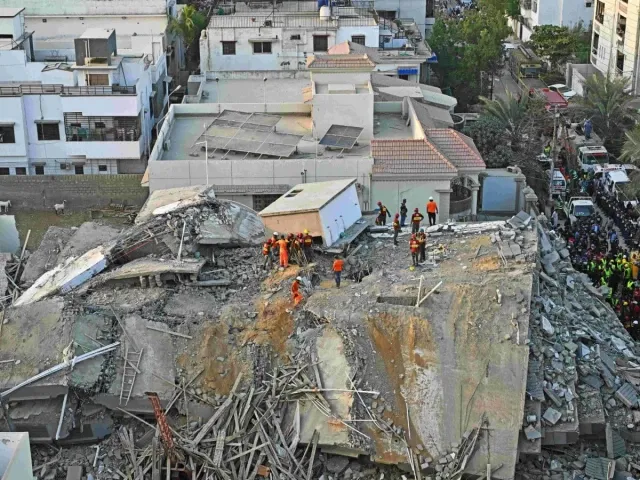 Photo: The Express Tribune
Key points
The death toll from the collapse of an under-construction six-storey building in Karachi's Administrative Society rose to eight on 27 November, rescue officials said.
The death toll from the collapse of an under-construction six-storey building in Karachi's Administrative Society rose to eight on 27 November, rescue officials said, after four more bodies were recovered from the rubble. The building collapsed on 25 November, killing four people and injuring 14 others, with around 30 labourers reportedly inside when the structure gave way. Rescue officials said the operation had run for 45 hours, with heavy machinery used to remove debris and locate those feared trapped. The bodies were taken to Jinnah Postgraduate Medical Centre in ambulances for medico-legal formalities.
Sindh Building Control Authority officials said the approved plan allowed a basement, ground floor and one additional floor, commonly described as G+1, while the structure allegedly had six floors above ground. Initial findings indicated the building had been approved for a basement, ground floor and one additional storey, but six extra floors had allegedly been constructed. The authority's officials put the approved height at G+1 against the six floors above ground that stood on the site before the collapse.
Approved for G+1, built with six
The building plan was reportedly approved in the name of Abdullah Shakeel on 10 March 2026, and the structure was allegedly completed within eight months. Karachi Mayor Murtaza Wahab said the building's approved plan did not permit the structure that was erected, and alleged that the builder, identified as Zeeshan, had obtained a court stay order that prevented action against the building.
Police detained six people, including the contractor and the structural engineer, and the authorities sealed 12 other under-construction buildings in the area. A police case was registered invoking charges related to murder, negligence and carelessness, with 10 people nominated and four arrested. The detentions followed the collapse of the six-storey structure on 25 November, and the sealed buildings are also under construction in the same area.
Officials removed and suspended
Sindh Chief Minister Murad Ali Shah ordered the removal of senior officials, including Waseem Shamshad, who served as both Sindh Building Control Authority director general and local government secretary, and the suspension of 16 officers following the collapse. He also ordered the removal of Deputy Commissioner East Nasrullah Abbasi and, on the advice of the home minister, the immediate removal of SSP East Zubair Sheikh over alleged negligence.
Murad Ali Shah said he would not tolerate any incident that results in the loss of human life or causes suffering to people, and directed the relevant authorities to take immediate action against those responsible. He directed police to arrest the building owner, Salman Tahir, and the builder, Zeeshan, and instructed the chief secretary to include the building's architect and structural engineer in the investigation.
A judicial magistrate remanded four suspects in police custody for five days. Police produced Yar Muhammad, Afzal Khan, Munir Akram and Saad Tahir before the court; the suspects included relatives of the contractor, while the building's owner and contractor were not produced. The investigating officer told the court that permission had been granted for a ground-plus-one-storey building, but six storeys were being constructed in violation of the approved plan. The remand keeps the four in custody while the investigation continues.
Suspects remanded and court dates
One suspect told the court that they had merely been working at the site when they were arrested. The suspect said their role in the building collapse should be clarified, and asked whether being someone's brother was also a crime, adding that their brother fled and they were arrested. The defence counsel questioned the grounds for the arrests over the illegal construction.
A civil court vacated an interim stay order concerning the collapsed building after the plaintiff failed to advance arguments on his application for an interim injunction despite being given several opportunities. The Senior Civil Judge (South) was hearing a suit filed by the building owner against the Sindh Building Control Authority. The court noted that the plaintiff had filed the suit on 1 August, and on 4 August directed the parties to maintain the status quo until the next hearing.
The court noted that on 12 October the plaintiff had been warned that appropriate proceedings could be initiated if arguments were not presented. The judge issued notices on the authority's application seeking dismissal of the suit and directed the parties to submit replies by 4 December. The hearing of the civil suit was adjourned until 4 December.
Frequently asked questions
How many people died in the Karachi building collapse?
The death toll rose to eight on 27 November after four more bodies were recovered, rescue officials said. The six-storey building collapsed on 25 November, killing four people at the time and injuring 14 others.
Why did the Karachi building collapse?
Initial findings indicated the building had been approved for a basement, ground floor and one additional storey, but six extra floors had allegedly been constructed. The investigating officer told a court that six storeys were being built in violation of the approved plan.
What happens next in the Karachi collapse investigation?
A judicial magistrate remanded four suspects in police custody for five days. A civil court adjourned the hearing of the building owner's suit until 4 December and directed the parties to submit replies by that date.