North Korea tests cluster warhead destroying 12 to 13 hectares
North Korea's Missile Administration tested a cluster warhead for tactical ballistic missiles on 31 October, with state media saying Standard Type 2 can raze 12 to 13 hectares.
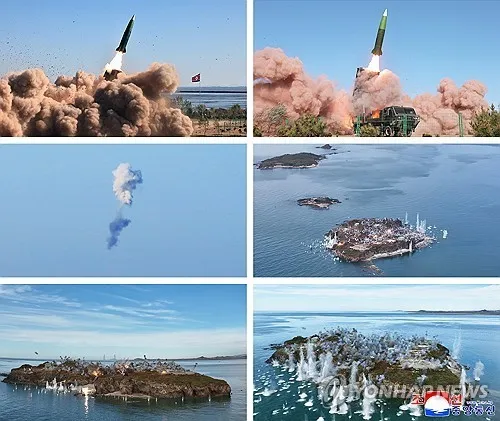 Photo: Yonhap News Agency
Key points
North Korea tested a cluster warhead for tactical ballistic missiles that state media says can destroy 12 to 13 hectares, with four types to be fielded within the year.
North Korea tested a cluster warhead designed for tactical ballistic missiles on 31 October, its state media said, with the Korean Central News Agency reporting that the Missile Administration conducted the test to assess combat adaptation and power. State media said the Standard Type 2 cluster-bomb warhead can turn a target area of 12 to 13 hectares to ashes at its highest-density power.
A cluster bomb releases dozens to hundreds of submunitions, allowing one warhead to strike multiple targets across a wide area rather than a single point. That dispersal is what makes the weapon useful against spread-out personnel and facilities, and also what draws international concern over civilian casualties and unexploded ordnance left behind after use.
Why the warhead matters
Gen. Kim Jong-sik, a member of the Central Military Commission of the ruling Workers' Party of Korea and first vice department director of the party's Central Committee, oversaw the test, according to the Korean Central News Agency. The research institutes under the Missile Administration reported the results on the warhead's destructive power across the stated hectare range.
The test matters because it extends North Korea's warhead development beyond missile flight performance to the strike methods and effectiveness of the payloads themselves. The North said it will enable units to select and use all four categories of cluster warhead within the year, moving toward an operational system where warheads are chosen by target and mission rather than fixed in advance.
The general director of the Missile Administration said cluster bomb warheads are classified into four categories depending on their purposes, including special-purpose and standard types. "Within this year we will enable units to select and use all those types according to operational aims and specific features of targets," the director said, according to state media.
Four categories of warhead
The reported figure of 12 to 13 hectares comes with a conversion: the Korean Central News Agency gave the area as 12 to 13 jeongbo, a Korean unit, and 1 jeongbo is approximately 0.99 hectares, which corresponds to about 11.9 to 12.9 hectares. The Ballistic Missile Systems Institute and the Warhead Research Institute announced the test results.
Released photos show a missile exploding in mid-air and submunitions separating from the warhead to explode across the target area, according to the Korean Central News Agency. However, detailed performance such as the number of submunitions, actual lethal range, accuracy, and failure rate cannot be judged from the test scenes and figures released by North Korea alone.
In April, North Korea said it tested cluster bombs mounted on the Hwasong-11 Ra tactical ballistic missile, a launch overseen by leader Kim Jong-un and his daughter Ju-ae. The North said that launch evaluated the power of the cluster bomb warhead and a fragmentation mine warhead fitted to the weapon system, extending the same warhead line now being tested.
What remains unverified
The UN Convention on Cluster Munitions prohibits the use, development, production, acquisition, stockpiling, and transfer of cluster munitions. As of September 2026, 112 countries are states parties to the convention; North Korea is not a party, and South Korea has also not joined, citing the security situation on the Korean Peninsula.
North Korea described the test as a regular scientific research activity aimed at increasing the power of its combat systems. The report on this test was not published in the Rodong Sinmun, the official newspaper of the Workers' Party intended for North Korean residents, according to the Korean Central News Agency coverage. Neighbouring countries, including the Japanese Ministry of Defense, continue to analyse North Korea's ballistic missile launches and the characteristics of its weapon systems. Actual troop deployment and operational status should be distinguished from North Korea's announced plans to field the four warhead types within the year.
Frequently asked questions
What did North Korea test?
North Korea's Missile Administration tested a cluster warhead designed to be mounted on tactical ballistic missiles, assessing its combat adaptation and power, according to the Korean Central News Agency.
How much area can the warhead destroy?
State media said the Standard Type 2 cluster-bomb warhead can turn a target area of 12 to 13 hectares to ashes at its highest-density power.
How many types of cluster warhead will North Korea field?
The Missile Administration's director said cluster warheads fall into four categories, including special-purpose and standard types, and that units will be able to select and use all types within the year.