Princess Catherine releases Heal, a 30-minute cancer documentary
Catherine, Princess of Wales, releases Heal, a 30-minute documentary about her cancer journey, airing on BBC One on Sunday and NBC on 30 November, with proceeds to the Royal Marsden Cancer Charity.
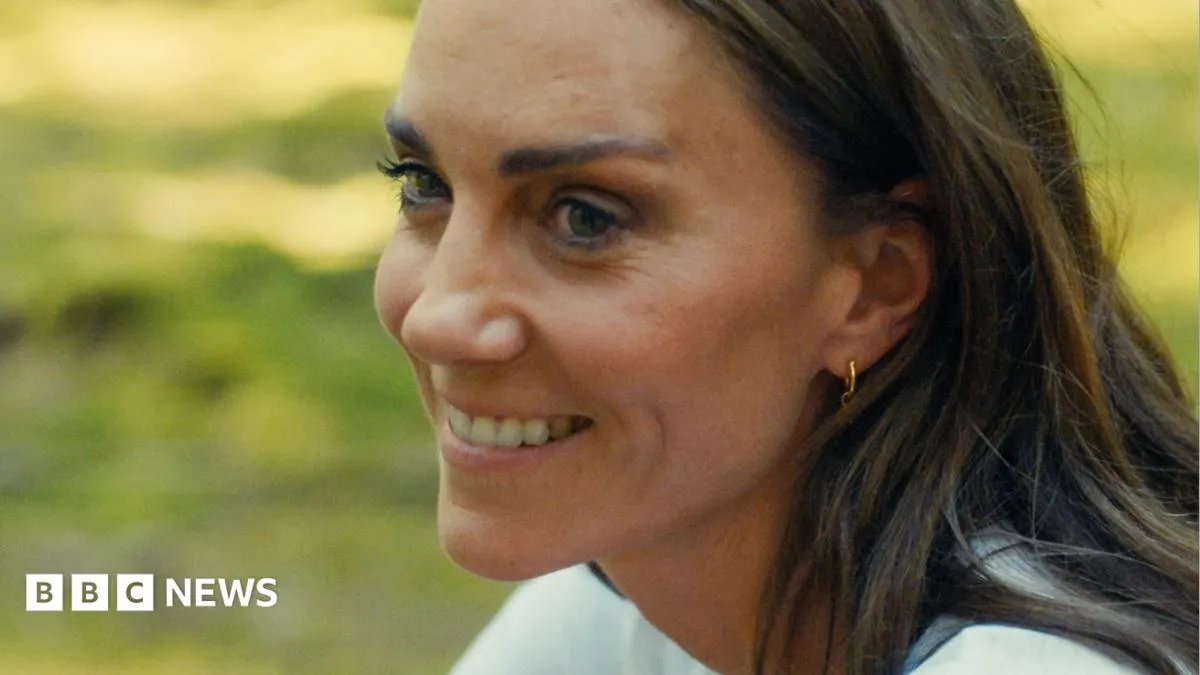 Photo: BBC News
Key points
Catherine, Princess of Wales, released Heal, a 30-minute documentary on her cancer journey, airing on BBC One on Sunday and NBC on 30 November, with proceeds to the Royal Marsden Cancer Charity.
Catherine, Princess of Wales, released Heal, a 30-minute authorized documentary about her cancer journey. It airs on BBC One on Sunday and on NBC on 30 November at 8 p.m. ET/PT, before streaming on Peacock from 1 December. The film was produced to raise money for the Royal Marsden Hospital in London, where she received chemotherapy, and proceeds will go to the Royal Marsden Cancer Charity. Speaking at a special screening in London, Catherine said the documentary was about "giving back" to the cancer community, "whose care and expertise are life changing for so many people." She also hoped it would "encourage compassion, showing the real value in standing alongside one another in the hardest of times."
The documentary marks a change in the way royals have spoken about their personal lives. Emily Nash, NBC News' royal contributor, said "William and Kate are communicating more directly with the public than ever before and being more open emotionally than we've ever seen," adding that this is "as a result of her cancer diagnosis." Valentine Low, author and royal commentator, said "No previous generation of the Royal Family would have considered producing something like this," adding that they would have been "less willing to talk about illness and personal matters." He said the film fits a generation "that's more likely to think in terms of whether there could be a positive message from the experience."
A departure from royal reserve
Catherine said the documentary reflected the "fear, anxiety, uncertainty" shared by hundreds of thousands of people each year "who receive the words no one wants to hear" about having cancer. She described cancer as stripping everything away, saying "Once you experience something like that, it's very hard to go back to the person you were before." She added that "Something like cancer strips everything away," and that "the journey through and beyond treatment requires more than medicine alone." She said cancer "doesn't just affect the body. It changes how you think and feel and profoundly affects every aspect of life."
In the film, Catherine reflects on mortality with an openness that breaks with royal stoicism. She said "I think when you've had to confront your own vulnerabilities, you know, when you're faced with your own mortality, you have to accept that life is not infinite and in those moments, yes, a shift does happen." Prof Pauline MacLaran, of Royal Holloway, University of London, said the film "will be a documentary that most people can relate to and will admire her for doing," adding that there is "an emotional directness that's an unusual departure." She thinks it will connect well with the public, who will admire Catherine's "bravery."
The film follows Catherine's Three Peaks Challenge, in which she climbed the highest mountains in England, Wales and Scotland in a single day — Scafell Pike, Ben Nevis and Snowdon — in just 24 hours. The rugged British landscapes play a central role, and the film was shot with a score by Scottish composer Erland Cooper, who drew inspiration from birdsong and the natural world.
The Three Peaks Challenge
Catherine also met hikers and spoke to other people about the challenges they faced fighting cancer. One hiker said "You don't get any help with that from doctors or the language that they use," adding that "There are no tools in the clinical settings to kind of help with that. Finding language or finding other people, that community or art or something, these are the only tools we have, I think, to explain and to exercise your uncertainty and become OK with it." She joked with her brother James as they walked, playing a game of "Would you rather," and she told him she played the game with her children.
Catherine speaks of her cancer journey being a "pilgrimage" and the need to "spend time on our spiritual health," and she describes a "really dark time" in hospital. She says that on one occasion, "I think I was sort of in and out of consciousness. It was a really dark time. But also then, somewhere through that too, I became aware of someone holding my hand. They weren't talking to me. They weren't trying to fix anything. They were just there. And the presence of someone that stood by me in that time, I'll forever be grateful for." She is seen crying at one point when she hears messages of support from her children.
The film makes no mention of King Charles III, who revealed his own cancer diagnosis in February 2024, a month before Kate. Kate had already broken with royal tradition when revealing her diagnosis and subsequent remission: rather than issuing a traditional text statement, she announced she was receiving treatment in a three-minute video. The royals have invited cameras into their lives before, in 1969's "Royal Family" documentary, but kept their distance through formality.
What is still unconfirmed
Kensington Palace has never confirmed the type of cancer Catherine was diagnosed with in March 2024 after major abdominal surgery, or how far the illness progressed. The film also does not reveal the type of cancer or any details of her treatment. Catherine said ahead of the film's release that she hoped it would help support the life-changing work of the Royal Marsden and all those navigating life with cancer to ensure no one faces this disease feeling unseen, unsupported or alone. Michelle Mitchell said "Watching someone speak so openly about the fear, the hope and the long road to recovery can make a real difference to those going through it."
Valentine Low said the film-making approach, sharing her own chosen thoughts with the camera without an interviewer, still allows Catherine to "control the narrative." He noted that the film's open, empathetic tone has been warmly welcomed by those working with cancer patients, and that it could raise wider questions about the treatment, waiting times and recovery support available to NHS patients who do not have royal titles. The documentary is a self-scripted, video diary rather than a conventional journalistic documentary, and it is deliberately raw and unadorned in how it is presented.
Frequently asked questions
When does Heal air?
Heal airs on BBC One on Sunday and on NBC on 30 November at 8 p.m. ET/PT, before streaming on Peacock from 1 December.
What does the film cover?
It covers Catherine's cancer journey, her Three Peaks Challenge, and her encounters with other cancer patients and climbers.
What is still unconfirmed?
Kensington Palace has never confirmed the type of cancer Catherine was diagnosed with in March 2024, or how far the illness progressed.